


Classic
One amp and cabinet handle the full-range signal. Start with a familiar guitar or bass chain, then shape its channel, gain and EQ.

Ein persönliches Portfolio und eine Vision für die Zukunft des Bassgitarrenbaus
RAVENFORGE / LUTHIER INTELLIGENCE
Nordische Geschichten, Materialforschung und der Weg zum eigenen Bass.
Prototypen entdecken
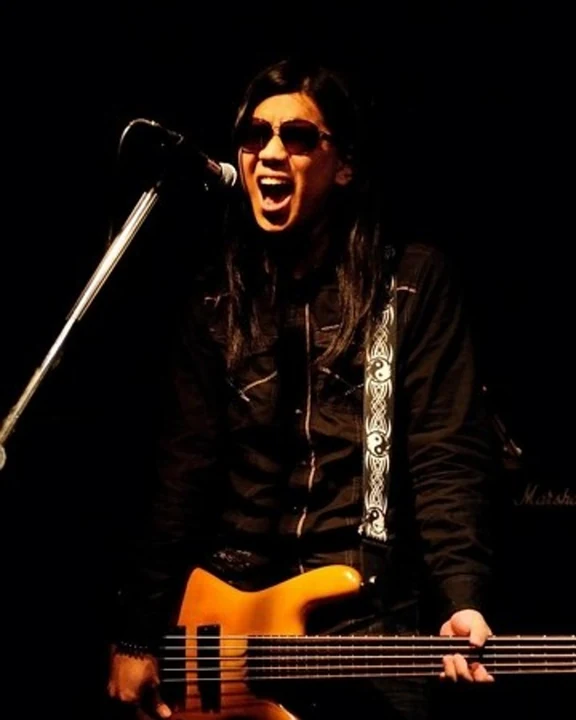
Hallo, ich bin Raven Cho (@raven_deadwire). Meine Reise ist eine zwischen zwei Welten: der intellektuellen Strenge der Philosophie und der rohen Leidenschaft der Metal-Musik, die beide im Handwerk des Gitarrenbaus zusammenfließen.
Als Hauptfachstudent der Philosophie an der Yonsei-Universität habe ich eine Weltanschauung entwickelt, die auf Ästhetik und kritischem Denken basiert. Dieser akademische Hintergrund wurde zur Seele meines künstlerischen Ausdrucks als Leiter von DEADWIRE, einer Melodic-Death-Metal-Band im skandinavischen Stil. Mein tiefes Eintauchen in das Genre führte mich zur Erforschung der nordischen Mythologie und Folklore, was letztendlich die Vision für RavenForge entfachte.
Mein Weg zum Gitarrenbauer war praxisnah und engagiert. Ich habe meine ersten Fähigkeiten von 2010-2013 in renommierten koreanischen Werkstätten wie dem Freebud Mod Shop und Craftshouse verfeinert. Heute, während ich beruflich im Bildungsverlagswesen und in der EdTech-Branche tätig bin, setze ich meine Ausbildung zum Gitarrenbauer unter zwei großen Meistern fort und strebe unermüdlich nach der Meisterschaft in diesem Handwerk.
Dieses Dokument enthält die tiefgehende Recherche und Vision, die ich bei der Konzeption von 'RavenForge', meinem lang gehegten Traum einer Bassmarke, gesammelt habe. Mit dem Ziel, eines Tages Instrumente zu schaffen, die meine eigene Philosophie verkörpern, habe ich weltweit High-End-Gitarrenbauer analysiert, um die wesentlichen Anforderungen an einen überlegenen Bass zu ergründen.
Dieser Prozess war eine Reise des tiefen Respekts vor den Meistern des Handwerks. Ich habe von ihren vielfältigen Philosophien gelernt, von ihrer Ehrfurcht vor dem Holz bis hin zu ihrem Streben nach technischer Innovation. Dieses Portfolio ist ein Zeugnis dieser Forschung und eine Präsentation meines eigenen zukünftigen Weges als Gitarrenbauer.
Die erste Frau: Sensibilität & Balance

Der erste Mann: Aggression & Instinkt

Der ältere Dichter: Saga & Überlieferung
Grundspezifikationen und Custom-Beispiele der drei RavenForge-Bassmodelle. Materialien, Halsausführung, Oberflächen sowie passende Hardware und Elektronik sind innerhalb der bestehenden Formen wählbar. Weitere Saitenzahlen, Mensuren und neue Fräsformen sind geplant; aktuell wählbare Kombinationen zeigt der Konfigurator.
RAVENFORGE / CONCEPT LAB
Ein Ort für Skizzen, Konzeptkunst und Formstudien. Ideen bleiben offen und entwickeln sich weiter.
Skizzen / Konzeptkunst / Formstudien
OFFENES SKIZZENBUCH
Hier wurden noch keine Skizzen veröffentlicht.
Guitar & bass amps, cabinets and effects
Chimera is a guitar and bass amp simulator. Pick a ready-made sound, turn a few knobs and play. When you want more, combine two amps, split your signal into frequency bands, or build a pedalboard and effects rack.
Release notes & all downloadsOPEN BETA 1.3.2 · v1.3.2-beta.1
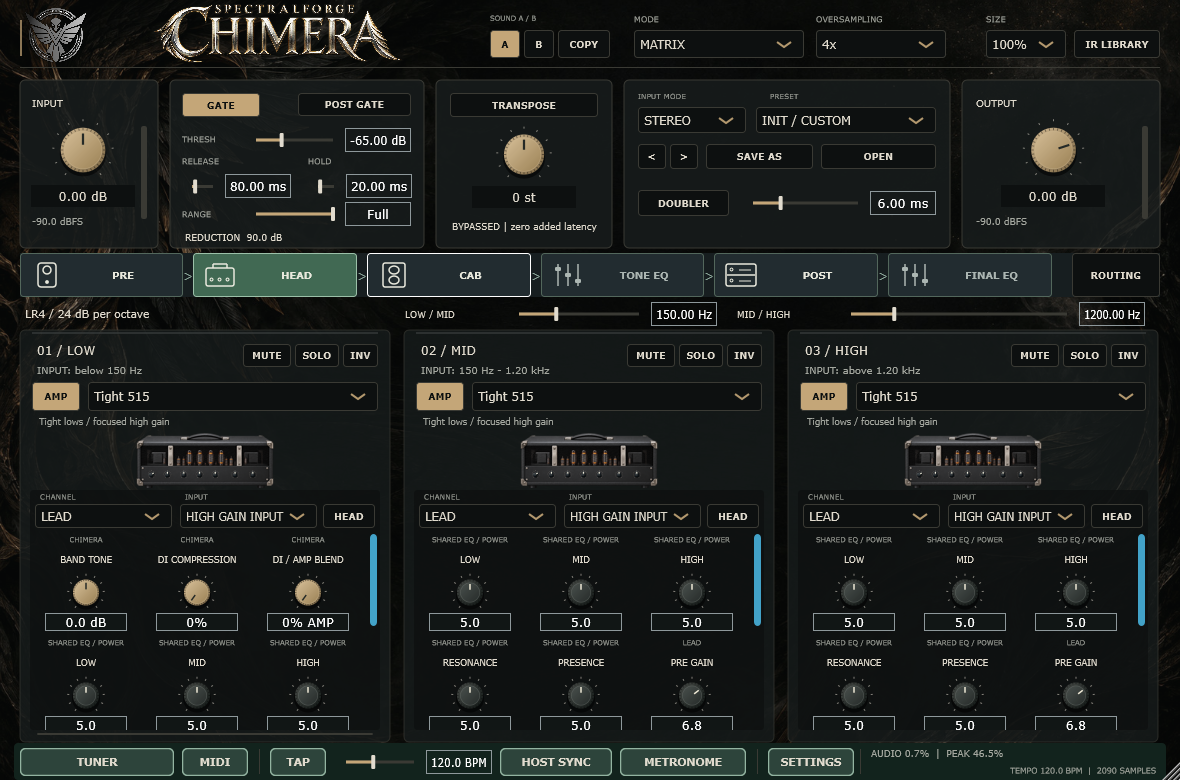
Coming in the next build: Easy view with six large knobs, and Auto Set, which sets your level and tone while you play.
Choose amps and channels in HEAD. Build one full-range tone, blend two rigs, or give the LOW, MID and HIGH bands their own character. Each rig connects its amp to a cabinet or IR before the signals come together.
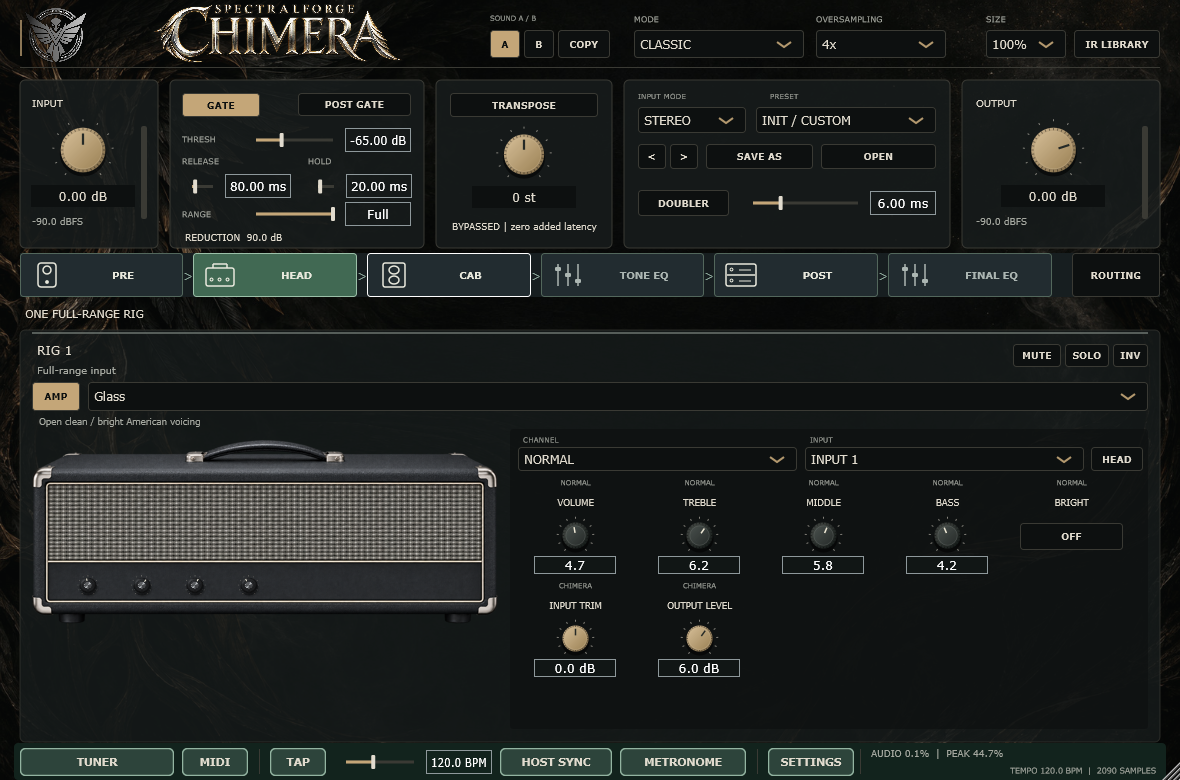
One amp and cabinet handle the full-range signal. Start with a familiar guitar or bass chain, then shape its channel, gain and EQ.
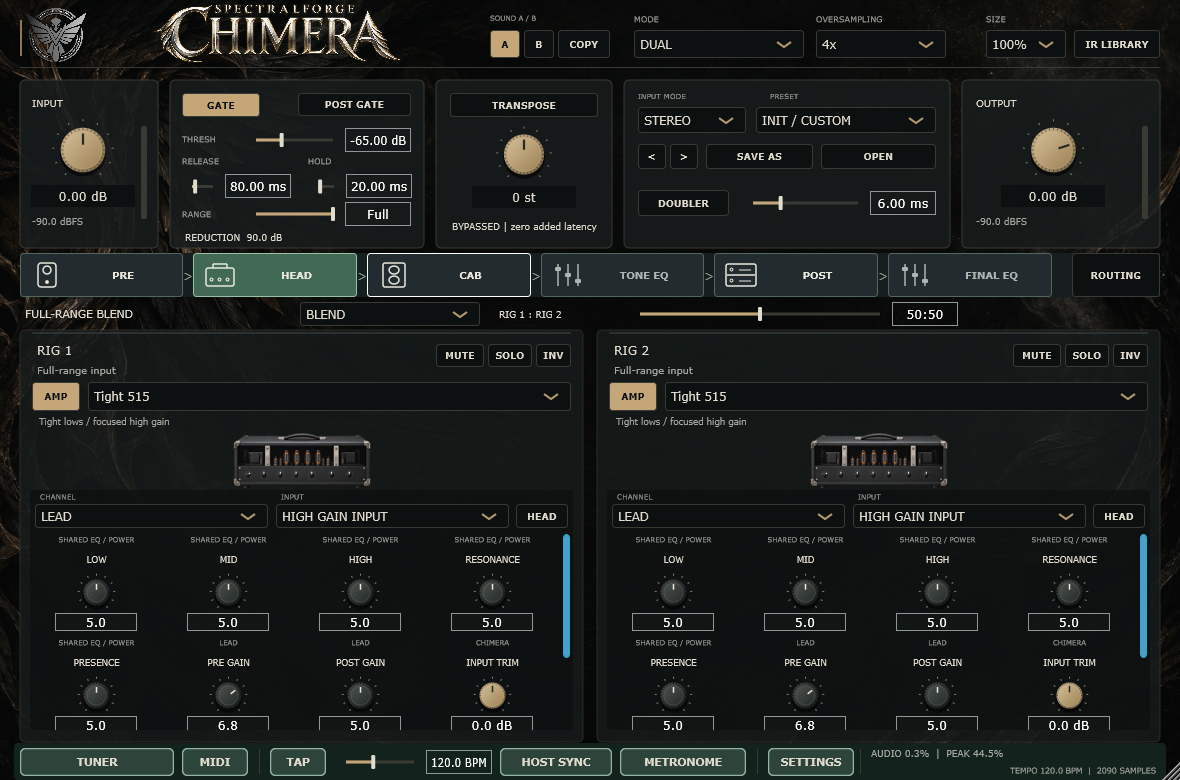
Combine two independent amp-and-cabinet rigs. BLEND mixes both across the full range; CROSSOVER assigns the lows and highs to separate rigs.
Shape LOW, MID and HIGH independently with two crossover points. LOW blends DI with the AMP+CAB path and has its own compression, while MID and HIGH add their own amp character.
Choose from 25 amp heads, from models based on classic and modern amplifiers to the SpectralForge Originals Niflheimr and Náströnd. Select a head to enlarge it and adjust its channel and knobs directly. MUTE, SOLO and polarity controls help check how the rigs combine.
The 48 factory and signature presets combine PRE, amps, cabinets and POST. Start near the sound you need, adjust the routing and controls, compare two versions with A/B, and save your own rig.
25 amps · 39 PRE · 21 POST · 9 cabinet layouts · 14 speakers · 20 microphones
Work directly on the amp head, follow the signal through your rig and finish the tone with two independent graphical EQs.
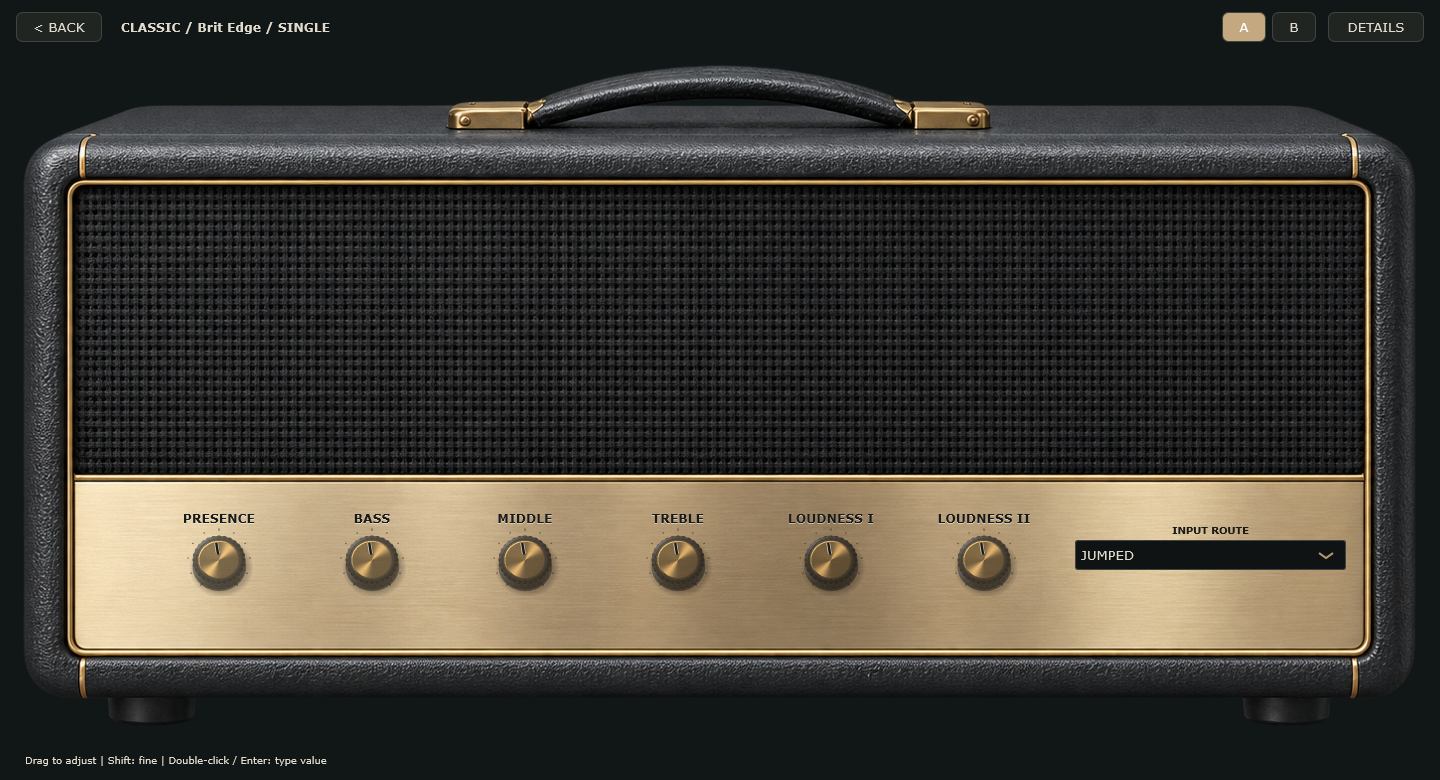
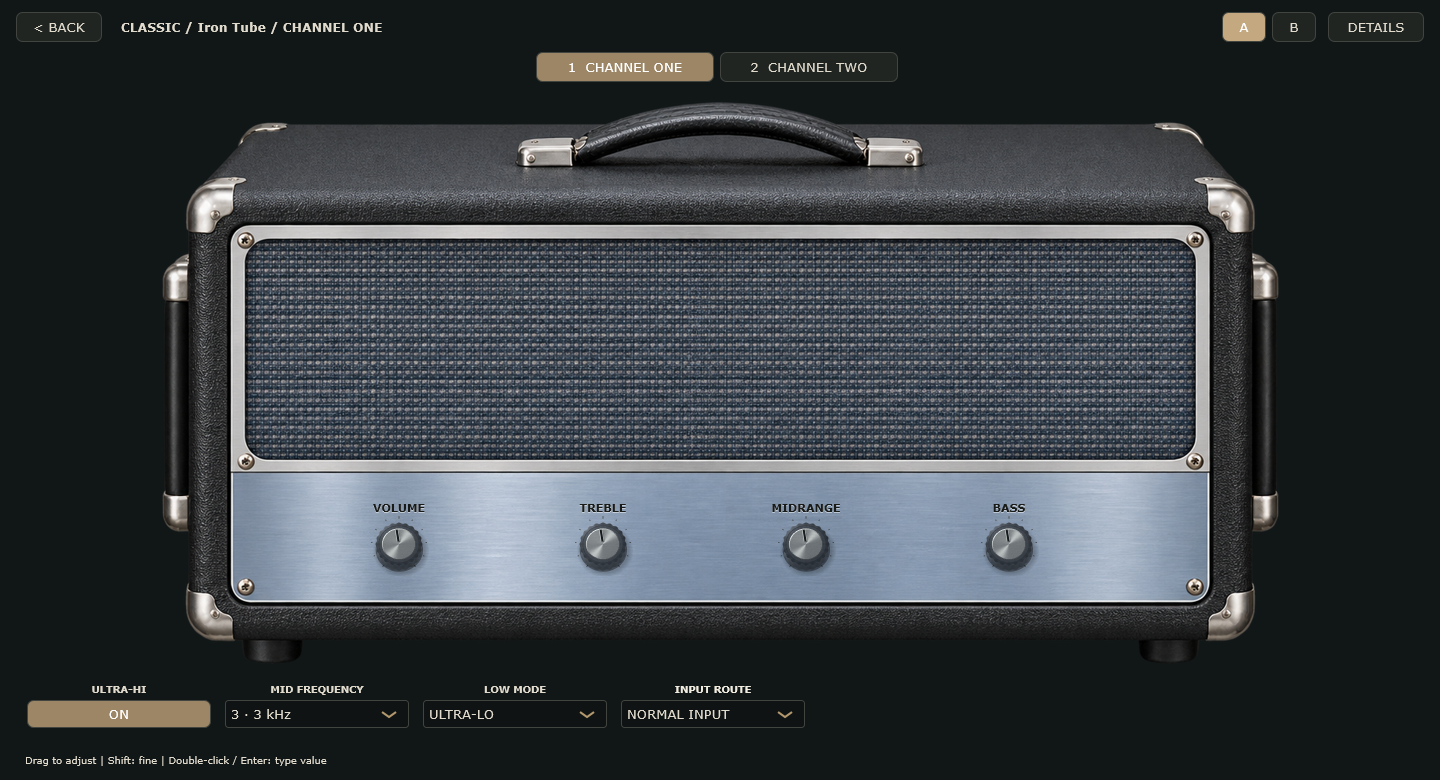
Select a head in Classic, Dual or Matrix to open its enlarged front panel. Change channels and turn the controls where you expect to find them. Shift gives finer adjustment; double-click a knob or press Enter to type a value.
Knob shapes, caps, pointers and materials follow each model’s hardware design. Control names are visible while idle; adjusting a knob or entering a value temporarily replaces that name with the value. Niflheimr’s 14 controls and Náströnd’s 13 controls keep their own head designs.
Use PRE → HEAD → CAB → TONE EQ → POST → FINAL EQ to move directly between stages. ROUTING opens the complete route, including the LOW DI and amp blend.
Each EQ offers up to 12 bands, graph editing, band addition and deletion, undo/redo, and IN/OUT spectrum views with resolution and freeze controls. Tone EQ shapes the combined rigs before POST; Final EQ makes the final tonal adjustments.
Guitar 1×12, 2×12 and 4×12; bass 1×15, 2×10, 4×10, 6×10, 1×12 and 2×12. Choose compatible speakers for nine cabinet layouts, then shape the response with rear opening and tweeter controls.
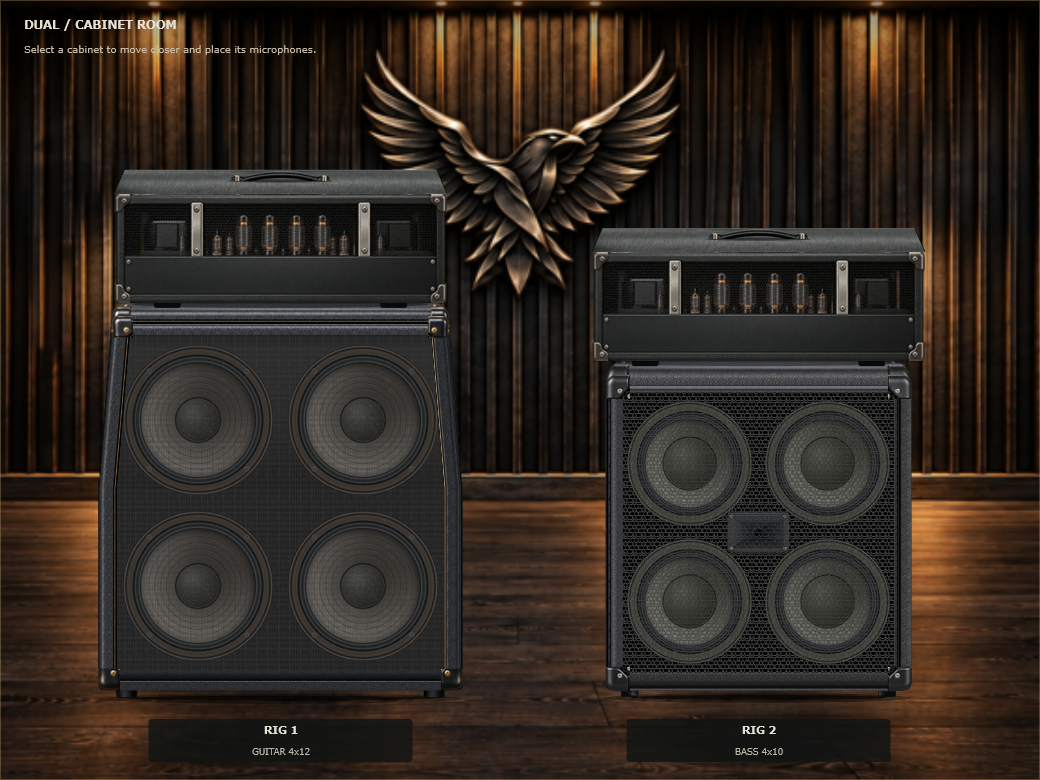
Classic, Dual and Matrix show the active rigs in the cabinet room. Select a head to adjust its controls, or a cabinet to open its microphone view and adjust the mic placement.
Shape the cabinet tone with your choice of speaker and tweeter. Choose Chimera HF, Silk HF, Metal HF or Air HF to tune the high-frequency character.
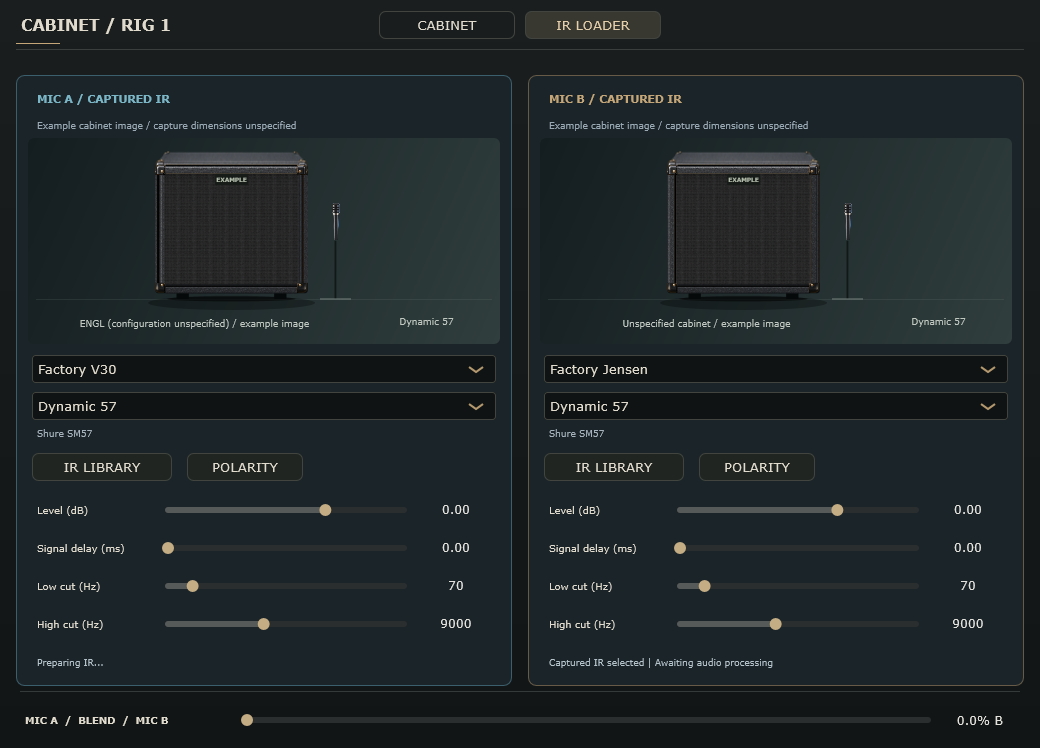
Choose from nine dynamics, three ribbons and eight condensers. Place Mic A/B on the same or different drivers and adjust position and distance. Blend, level, polarity, delay and low/high cuts help combine the two paths.
Use modeled cabinets or captured IRs independently in Mic A/B. While a microphone uses a modeled cabinet, its retained IR slot and shared controls are inactive in the IR loader; adjust that mic in CABINET. Selecting an IR switches only that microphone to the IR source.
Niflheimr is a SpectralForge Original bass amp for technical metal, death/grind, industrial, slam and sludge/doom. Five channels combine a clean low-frequency foundation with distinct drive textures, from precise rhythmic attack to dense, sustained fuzz.
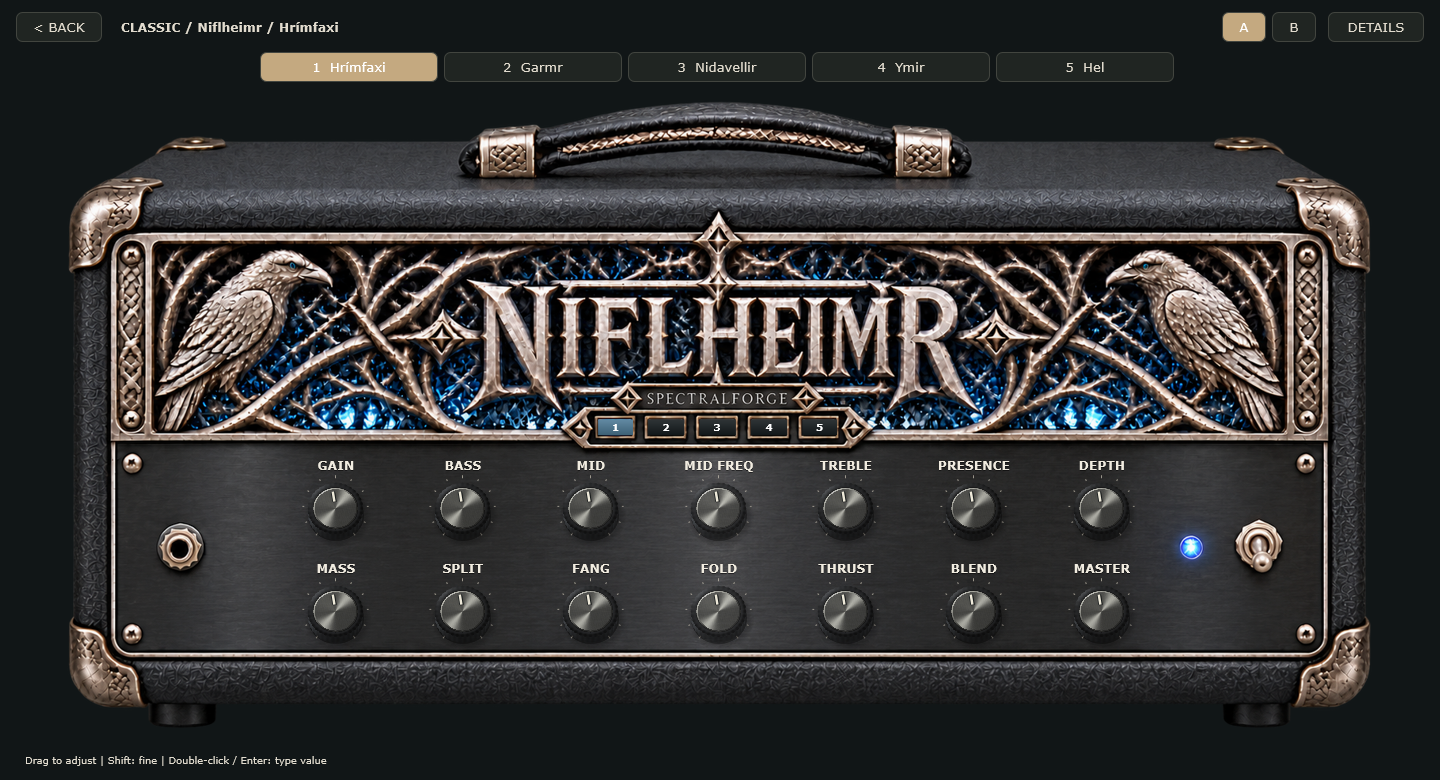
Controlled lows and a fast, defined attack. A voice for technical and progressive metal with tightly articulated rhythms.
Coarse grind and a clear midrange attack. A voice for fast death-metal and grindcore bass lines.
Hard-edged drive and a focused upper-mid bite. A voice for industrial riffs and insistent, repeating pulses.
Dense distortion and a percussive low-end hit. A voice for slam and brutal death riffs built around weight and impact.
Dark, mid-rich fuzz and slow, lingering sustain. A voice for sludge and doom riffs that let each note spread.
GAIN and EQ set the foundation. MASS · SPLIT · FANG · FOLD · THRUST shape body, band split, edge, saturation and attack response. BLEND sets the dry/driven balance around a clean low end. Each channel remembers all 14 controls.
Start with Metal Clank or Doom Fuzz in Classic, Death Grind in Dual, or Heavy Pulse and Slam Punch in Matrix. Each preset combines PRE, amp, bass cabinet and POST, with global OUTPUT starting at 0 dB.
Náströnd is a SpectralForge Original high-gain guitar amp for Thall, Slam and Sludge. From tightly stopped low riffs to abrasive grind and spreading sustain, five channels let you shape the attack, density and weight around your playing.
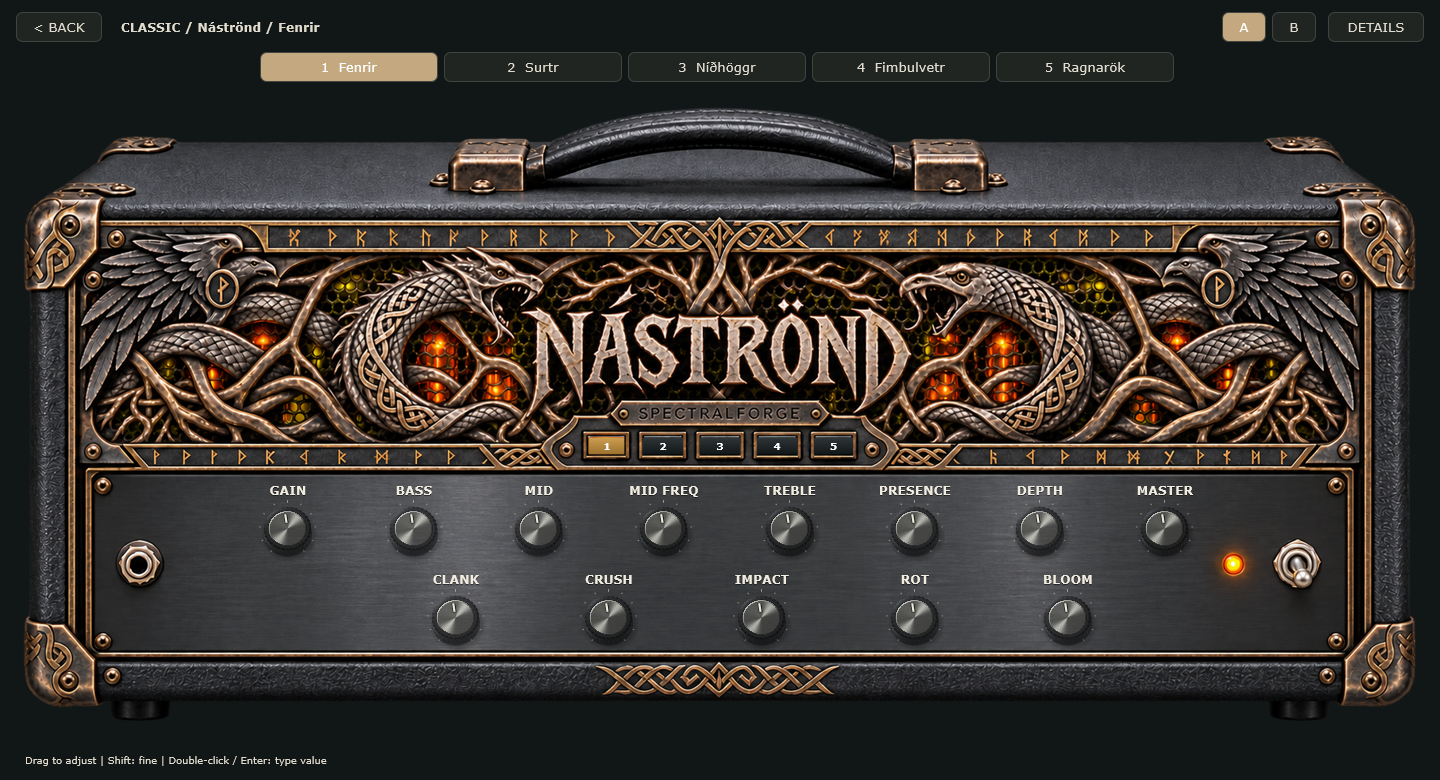
Fast attack and tightly controlled lows. Built for low-tuned palm mutes and closely articulated rhythm.
Forward mids and dense sustain. A voice for leads that carry a melody through long, singing notes.
Coarse grind from asymmetric saturation. A voice for angular riffs and abrasive, decaying textures.
Broad lows and a yielding response. A voice for slow sludge and doom riffs that let each note linger.
A deep low-end hit with a firm attack. Focused on the impact of slam riffs and breakdowns.
GAIN and EQ set the foundation. CLANK · CRUSH · IMPACT · ROT · BLOOM shape attack, saturation density, low-end impact, grain and sustain. Each channel remembers all 13 controls as you move between sounds.
Start with Thall Rhythm, Molten Lead, Rotten Grind, Sludge Mass or Slam Impact. These five presets combine PRE, amp, cabinet and POST in Classic, Dual and Matrix, ready to shape around your playing.
Shape dynamics and drive before the amps, then add texture and space after the rigs are combined.
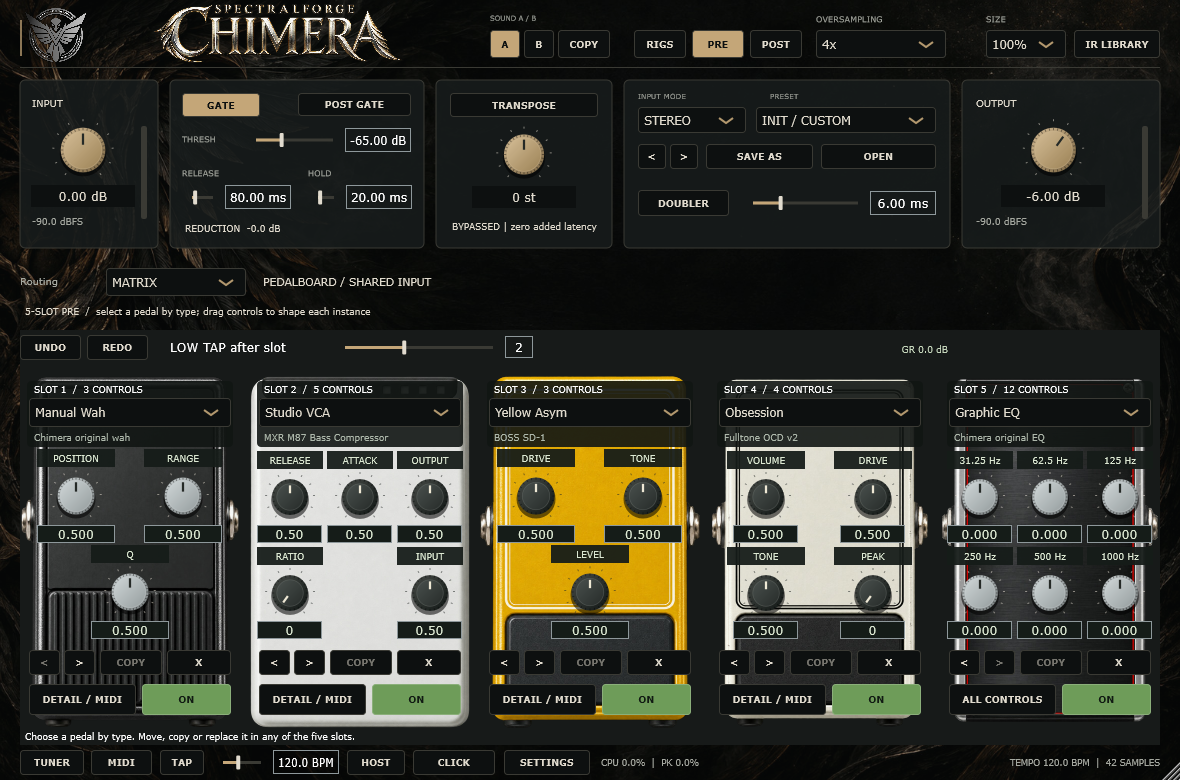
5 slots · 39 models
Choose from dynamics, filter, gain, modulation, octave and EQ pedals to build a five-slot board.
Compressor · Filter / Wah · Fuzz · Boost · Overdrive · Modulation · Octave · EQ
Select, duplicate and reorder pedals freely within five slots. Model settings, MIDI and A/B states are retained.
Matrix LOW provides a clean low-frequency foundation alongside the mid/high rigs.
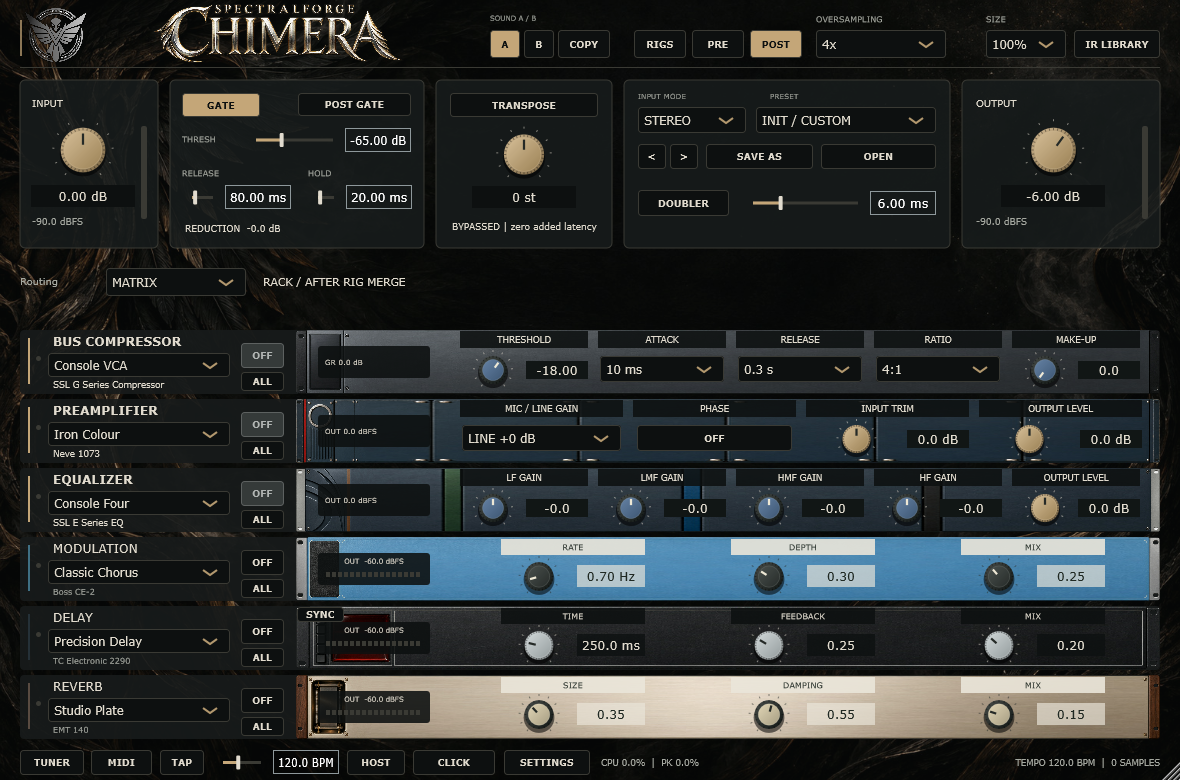
6 categories · 21 models
Add weight and texture to the combined rigs with bus compression, preamp colour and EQ, then finish with modulation, delay and reverb for movement and space.
Bus compressor · Preamp · EQ · Modulation · Delay · Reverb
After the rigs are combined, processing follows BUS COMP → PREAMP → EQ → MODULATION → DELAY → REVERB.
Version 1.3.2-beta.1. Choose the installer for your operating system.
Updating from an earlier beta or preview? Download 1.3.2-beta.1 below, close Chimera and all DAWs, then run the installer. The update preserves personal presets and IRs.
Windows 10/11 · x64
Standalone · VST3
Download installerEXE · x64Portable ZIPmacOS 12+ · Apple Silicon & Intel
Standalone · VST3 · AU
Download installerUniversal PKGDebian / Ubuntu · x86_64 · glibc 2.35+
Standalone · VST3
Download installerDEB · x86_64TAR.GZ archiveReload Factory / Signature presets to apply the new settings. Saved knob, channel and user IR settings are retained, while revised amp DSP can change the tone and level of existing projects.
Windows packages are unsigned. The macOS beta is not Developer ID signed or notarized. Your operating system may display a warning during installation.
The manual covers precision tuning, signal-stage navigation, graphical EQ editing, common dynamics, direct head controls, cabinets and independent Mic A/B paths.
Copyright © 2026 RavenForge Luthier Intelligence. All rights reserved.
Third-party software and assets are subject to their respective copyright notices and license terms.
Third-party noticesDie Kernphilosophien und Technologien von High-End-Gitarrenbauern lassen sich in mehrere Schlüsselthemen einteilen. Klicken Sie auf jeden Balken im Diagramm unten, um die Gitarrenbauer zu filtern, die diesem Thema entsprechen. Dies fasst die technologischen Trends auf dem Markt und die Bereiche zusammen, auf die ich mich in meiner Forschung konzentriert habe.
Verwenden Sie die Filter unten, um Gitarrenbauer nach Region oder Innovationsthema zu erkunden. Klicken Sie auf jede Karte, um eine detaillierte Analyse anzuzeigen.
RAVENFORGE / DEVELOPMENT ROADMAP
Quest & Aspiration
What instruments should we build, and what supports those choices? Six quests connect the current design direction with research, unresolved questions and the next validation steps.
Status describes the public records linked here, not an instrument’s build progress or performance grade. No performance figures or completion percentages are presented without supporting evidence.
Publication does not establish that a design has passed measurement or playing tests. Each source states its own evidence and limitations.
Schematic illustrations of structures and relationships—not measured dimensions, response curves or production drawings.
How should each model balance stiffness, mass and adjustability—not simply laminate count?
1Section & geometry2Reinforce & adjust3Neck joint Evidence scopeMaterial literature & model rationale / no linked long-term validationLaminate count or reinforcement alone must not be presented as a guarantee against twisting or dead spots.
Distinguish EDDA’s simpler neck from EMBLA/ASKR laminates. Evaluate section geometry, fingerboard, reinforcement, truss rod and joint as an assembly.
Use repeatable differences with documented conditions to inform decisions. Simplify or defer complexity whose benefit has not been established.
Literature framework for material properties and coupled structure.
EMBLA laminate selection rationale; measurement remains separate.
EDDA’s simpler neck structure and heritage-oriented rationale.
References for comparison, not proof of performance or a claim of partnership.
How can blank condition and sourcing evidence take precedence over a species’ reputation?
1Blank condition2Grain direction3Sourcing record Evidence scopeMaterial & model research / individual stock records to followTreating a species label as proof of mass, stiffness or drying condition obscures the actual design assumptions.
Retain the elm direction for EMBLA, ash for ASKR and alder for EDDA, while assessing each blank separately. Rarity and visual impact are not substitutes for performance evidence.
Use stock when its record supports the fabrication requirements. Defer uncertain material and do not imply sustainability certification without documentation.
Criteria based on properties and structure rather than species labels.
Design and sourcing rationale for elm and fingerboard candidates.
Ash/fingerboard rationale distinguishing observations from experiments.
References for comparison, not proof of performance or a claim of partnership.
Which shapes help with which posture and playing task?
1Posture2Reach3BalanceBased on published EMBLA art · posture, reach & support Evidence scopeL02/L03/L13 literature frameworks / no linked user evaluationA compact body, low mass or asymmetrical neck cannot be assumed comfortable for every player.
Consider strap support, balance, low/high-fret reach, neck profile and control access together. Separate seated/standing use and playing techniques.
Prefer geometry that supports the defined task without hindering others. Stop a test that causes discomfort or pain; do not interpret findings as medical benefits.
L02: literature framework for player-relative geometry.
A framework relating skill, task and available musical actions.
Proposed evaluation of how controls and geometry mediate perception/action.
References for comparison, not proof of performance or a claim of partnership.
How can sound be understandable and repeatable rather than merely feature-rich?
1Pickup loading2Signal path3Reference state Evidence scopeCircuit/supply reviews & test protocols / no linked finished-instrument validationMore controls, higher supply voltage and complex routing do not inherently produce useful voicing or a better playing experience.
Describe each model’s pickup/EQ/filter choices through paths and control states. Distinguish active reference, bypass, power failure and recovery; treat ensemble use as an evaluation task.
Adopt configurations supported by measurable differences, understandable operation and the model’s role. Do not guarantee 18V superiority or circuit transparency before validation.
Design criteria for passive loading, filtering, routing and reference states.
Specification combining signal path, impedance boundaries and control states.
Supply choices are product-specific; documented compatibility is separate from measured effects.
Proposed evaluation of reference-state recognition and recovery.
Measurement protocol for pickup-position comparison, not proxy evidence of results.
References for comparison, not proof of performance or a claim of partnership.
How can a story shape form, material and use rather than remain decoration?
1EMBLA2ASKR3EDDABodies from published art · equal display height, not measured relative size Evidence scopeModel studies & Concept Lab / separate from finished performanceRunes, rare woods and finishes alone can disconnect differentiation from function and model identity.
Translate model narratives into reasons for proportion, curves, colour and material choices. Develop a consistent language without sacrificing playing or service access.
Retain designs that explain their appearance and meet playing, fabrication and service requirements. Judge visual ageing separately from acoustic effects, and rarity separately from performance.
Design rationale linking EMBLA’s narrative and material choices.
ASKR’s character interpreted as system requirements, not a species label.
Heritage for EDDA beyond a single vintage archetype.
References for comparison, not proof of performance or a claim of partnership.
How does a selected specification become a buildable, inspectable and serviceable instrument?
1Drawings & parts2Build & assemble3Inspect & service Evidence scopeConfigurator & development records / fabrication checks remain separateAn option available online is not the same as a configuration checked through measurement, machining and assembly.
Start from the existing configurator and connect options to measured hardware, cavities and wiring. Define how component changes update drawing revisions and inspection criteria together.
Approve builds based on fabrication and inspection evidence, not merely an available UI option. Keep unverified combinations explicitly under review.
Development record including geometry/clearance issues and discarded layouts.
Connects wiring and failure/recovery states to inspectable specifications.
A separate SpectralForge development example: distinguish implementation from verification.
Review compatible options · Configurator ↗
References for comparison, not proof of performance or a claim of partnership.
RESEARCH / QUEST / INSTRUMENT
Select a quest to reveal its connected research and model applications.
Lines show relationships in public records, not verified performance or completed builds.
RAVENFORGE / WORKING METHOD
Empirical making and iterative prototyping run through every quest. Literature, drawings, observations and measurements stay distinguishable so each revision has a traceable reason.
Feed observations and decisions into the next revision
Record: specimen/revision, comparison conditions, observations/measurements, uncertainty, decision and conditions for review. A planned test is never recorded as a result.
The long-term aim is to grow as a maker who translates a player’s musical narrative into form, material and sound. Respect for established builders should lead to learning, practical work and trusted collaboration, while developing an independent design language. The twenty-year vision remains; the next step starts with one build and one accountable decision.
This revision · · v1.0
The six strategic initiatives are now a research, design and validation roadmap. Guarantees tied to laminate count or ageing effects were removed; the configurator task now concerns compatibility, fabrication and inspection rather than initial introduction. This is an editorial and planning revision, not a report of new tests.
2026-09-27 · Visual layer v1.1 — Added native SVG quest illustrations, an interactive research/model connection map and an iterative design flow inside this page. Visual labels support Korean, English and German.
Eine Sammlung meiner persönlichen Forschungsarbeiten und Essays zu Akustik, Holzanalyse und Designphilosophien von RavenForge.
Konfigurieren Sie einen RavenForge-Bass oder eine GRAMR-Gitarre mit Materialien, Halsgefühl, Oberflächen, Hardware und Elektronik innerhalb der bestehenden Maße und Anordnungen. Weitere Saitenzahlen, Mensuren und neue Fräsformen sind geplant. Wählen Sie die Oberflächenbehandlung und geben Sie die gewünschte Farbe separat an.