RAVENFORGE / MODEL MATERIAL SELECTION LOG — ASKR
RAVENFORGE
Model Material Selection Log
ASKR — Why Ash, and Why the Fingerboard Remains an Open Variable?
From long-scale structural control to Mpingo / Kingwood candidates
Document purpose |
Projects | RavenForge ASKR — 35" standard / 37–34" multiscale option |
Current body | 3-piece solid: Ash center core + Ash side wings |
Current neck | 5-piece laminated: Ash / Maple / Wenge family |
Current fretboard | Wenge standard · Ebony recommended reference |
Preferred natural candidates | Mpingo (Dalbergia melanoxylon) / Kingwood (Dalbergia cearensis) |
Synthetic trials | Ebonol / Richlite-type paper-resin composites — not adopted as standard |
Status | Design rationale established · matched prototype A/B pending |
1. Starting Point — In ASKR, “Aggression” Is a System Requirement, Not a Species Name
In the current RavenForge configurator, ASKR is defined as “Premium & Aggressive,” with a 35-inch extra-long scale as standard and a 37–34-inch multiscale as an extended option [R1]. The current pickup/preamp baseline is the Fishman Fluence system, and the RavenForge modern asymmetrical neck profile is standard [R1]. The design problem is therefore not simply choosing “a wood that suits metal,” but integrating a long scale, down-tuning, a slim and fast neck feel, and a high-output electronic system into one mechanical platform.
With the same string gauge and pitch, increasing scale length raises the required string tension; in a real instrument, however, gauge, tuning, action, and break angle can change at the same time. The design therefore does not assume that “37 inches automatically produces a particular tone.” Instead, the neck assembly is brought into a predictable range of stiffness, mass, and modal response, and the effects of the body and fingerboard on that structure are treated as measurement targets.
Core perspective |
Figure 1. Decision structure for ASKR material selection. RavenForge internal design framework · linked to Material & Acoustics Research Log 01 |
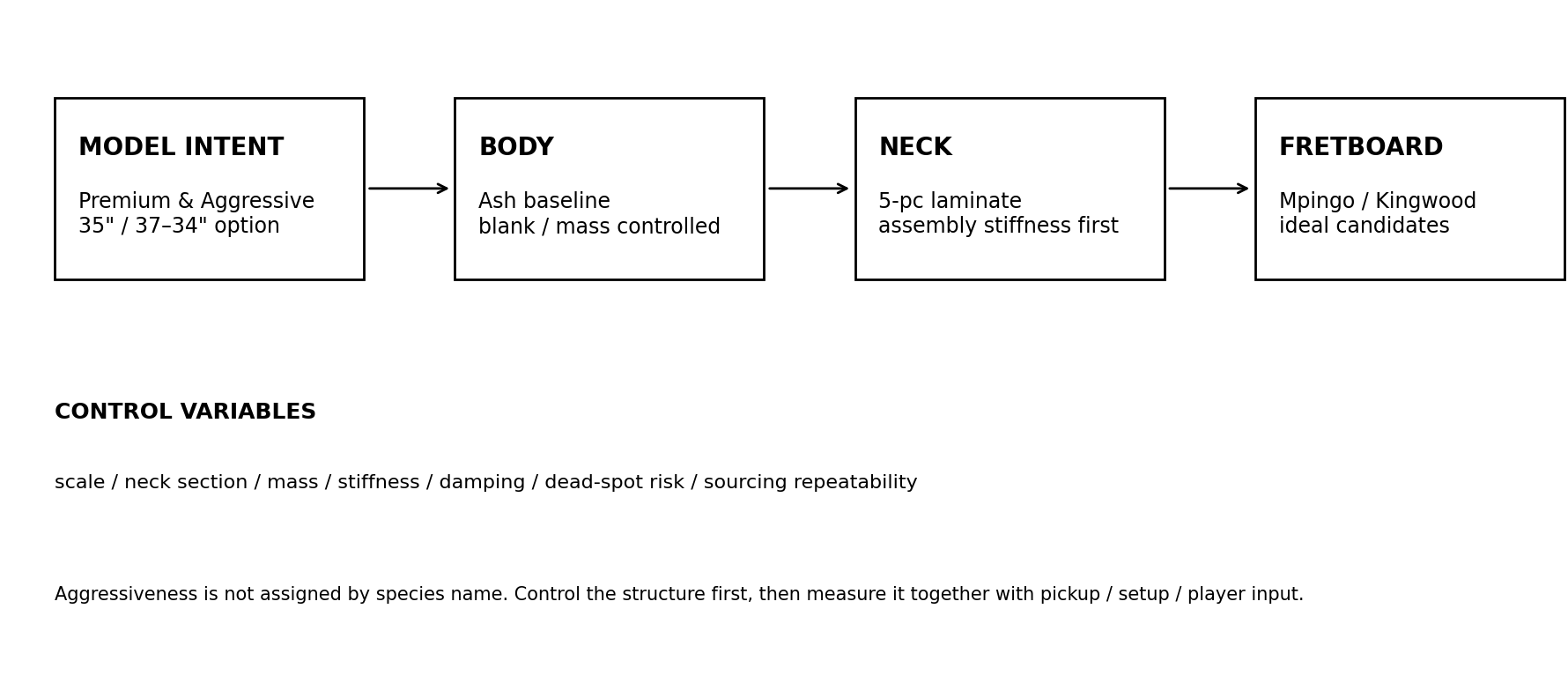
1.1 Closer to “Boundary-Condition Design” Than “Tonewood Selection”
As summarized in Research Log 01, string energy couples to the instrument structure at the fret/nut side and at the bridge side. In ASKR, making those boundary conditions as consistent as possible makes it easier to evaluate pickups, preamps, string gauges, and setup as separate variables [R2]. The body therefore uses Ash as a reference baseline, neck variability is reduced through lamination, and the fingerboard is screened independently as a high-density, high-stiffness, wear-resistant outer layer.
2. Body — Why Ash Is the ASKR Baseline
The current ASKR standard body in the configurator is a 3-piece solid construction with Ash specified for both the center core and the side wings [R1]. This is not an adoption of the traditional shorthand “Ash is bright and tight” as a scientific fact. Instead, Ash is used as an obtainable structural material that can be standardized by measuring density and stiffness blank by blank.
2.1 Controlled Tests Show That Structural Response Can Change — Not That “Ash Is Always Better”
Ray, Kaljun, and Straže (2021) compared instruments using the same neck, bridge, pickups, and strings while changing only the body between European Ash (Fraxinus excelsior) and Walnut. In that test, the stiffer Ash body shifted modal frequencies upward, showed lower damping than Walnut, and produced longer decay in some open-string harmonics [1]. This is direct evidence that body-material properties can influence bridge-side structural response.
However, the instrument comparison used only one body per species and specific support/open-string conditions [1]. RavenForge therefore does not take away the conclusion “Ash = longer sustain.” The useful conclusion is methodological: record the density, stiffness, and damping of each body blank, then evaluate the finished instrument’s FRF and decay together.
ASKR body question | Design response |
Why Ash? | Measurable structural baseline; sufficient stiffness and established machining route |
Why 3-piece? | Allows defect/grain/weight screening and repeatable body width without claiming tonal superiority |
Main risk | Ash density varies widely; heavy blanks can defeat ergonomic targets |
Control method | Record MC, mass, density; chamber or reject by weight target; compare bridge-side FRF |
The early ASKR #001 custom quote specifies a 1-piece chambered Ash body with a Flame Maple veneer [R3]. Because this architecture differs from the current 3-piece solid Ash/Ash standard, #001 should be interpreted not as a sample that verifies “Ash as a species,” but as an integrated prototype that includes chambering and body architecture as part of the experiment.
3. Neck — At Long Scale, Lamination Is for Variability Management, Not “Tone Layers”
The current ASKR baseline neck is a 5-piece laminated construction using the Ash / Maple / Wenge material family [R1]. On a 35-inch or 37–34-inch platform with a modern asymmetrical carve, the requirement is not simply to make the neck thicker, but to manage stiffness and torsional behavior of the finished neck assembly while preserving the intended playing feel.
Lamination does not automatically increase EI merely because more glue lines are present. With the same material, section, and grain direction, the number of pieces alone does not guarantee higher stiffness [R2]. ASKR uses five pieces as the baseline because each lamella can be screened for grain runout, density, moisture state, and a resonance proxy, while left/right mass and stiffness distribution can be balanced.
Design rule |
3.1 Because the Neck Matters, Species Character Is Controlled First
Research on dead spots and decay in solid-body instruments repeatedly shows that coupling between neck resonances and string partials can have a large effect [R2]. Treating the neck as a lower-priority “tonewood selection” area in ASKR therefore does not mean its acoustic influence is small. The strategy is the opposite: first bring a highly influential structure into a predictable range, then observe the differences introduced by the fingerboard and body.
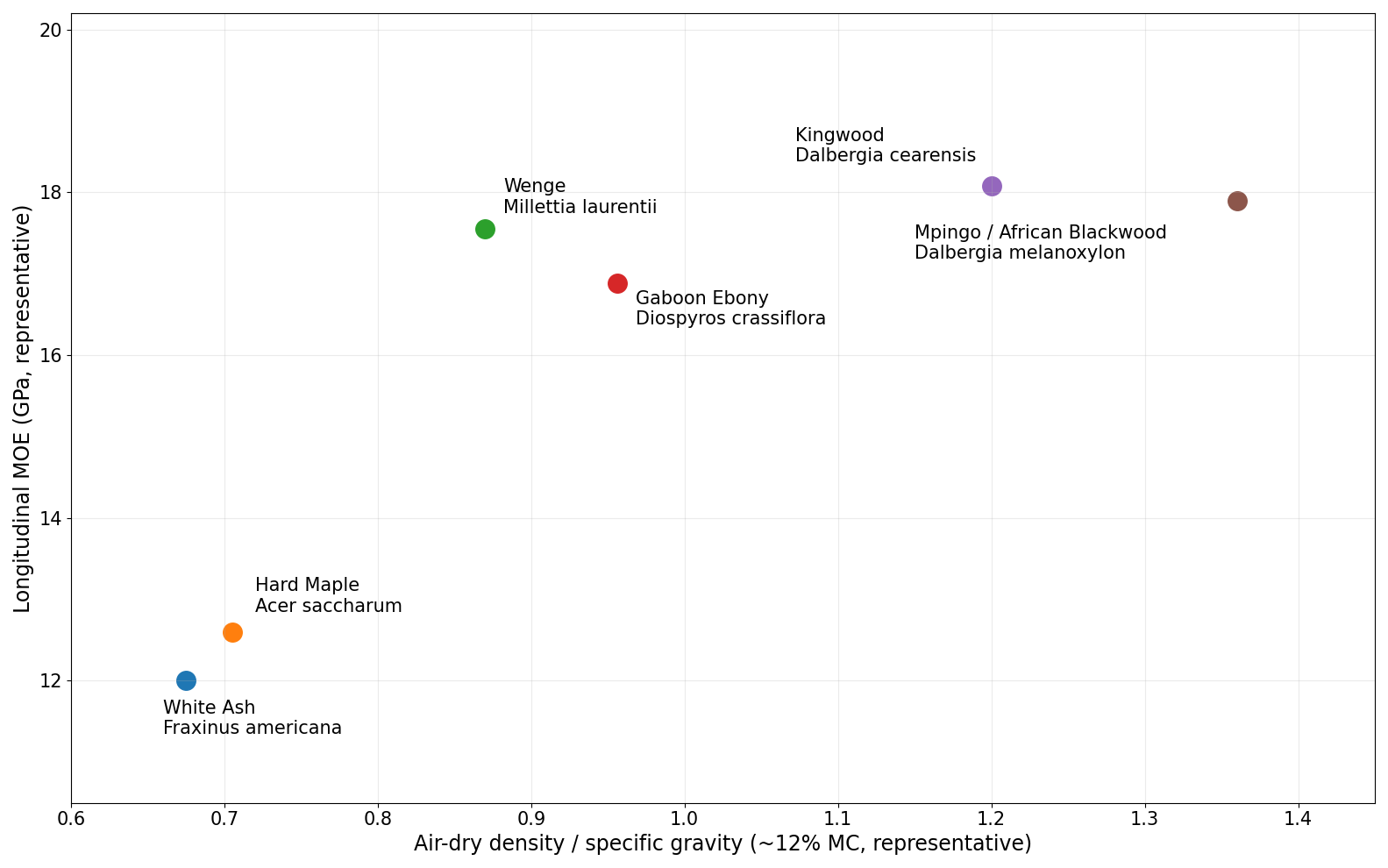
Figure 2. Representative density–MOE range of major natural materials relevant to ASKR. Representative values: Liu et al. 2020; Wood Database cross-check; Decorative Hardwoods Association guide. Different test methods are mixed, so use only as scale reference. |
4. Fingerboard — Mpingo and Kingwood Are the Highest-Priority Natural Candidates
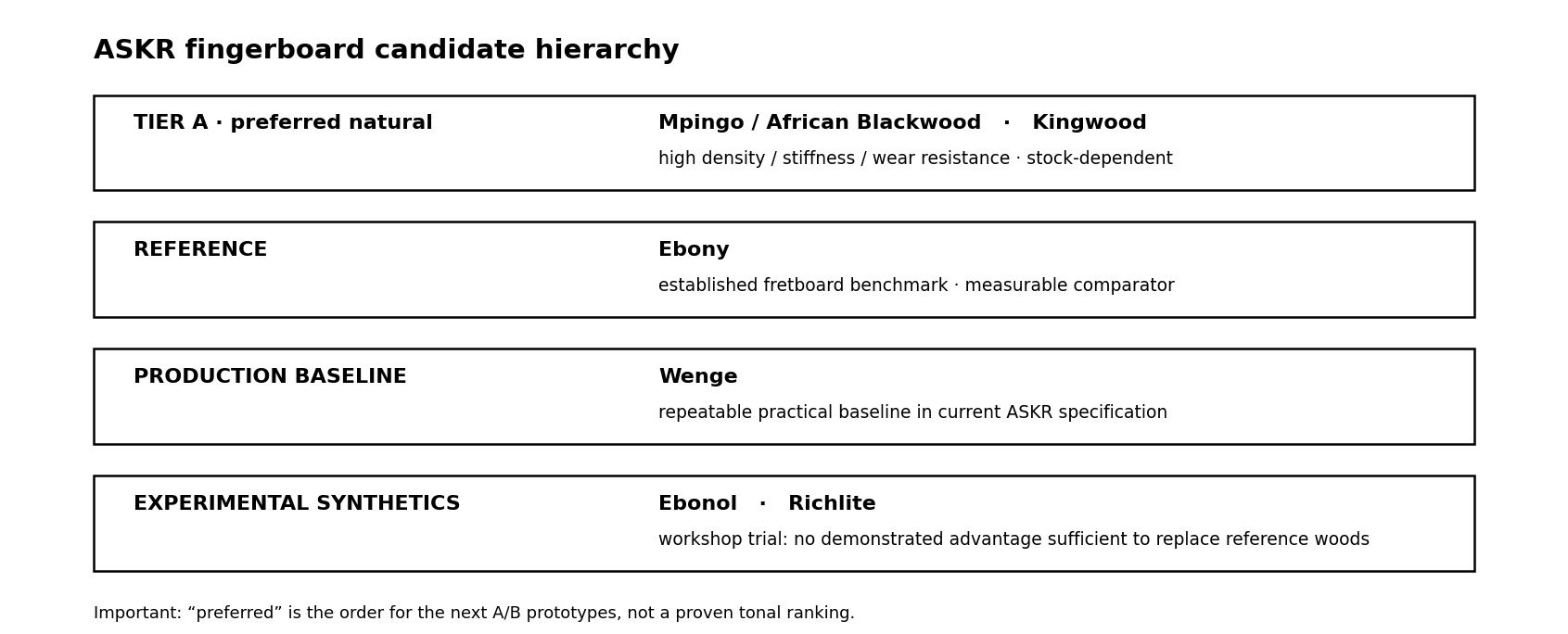
In the current configurator, Wenge is the ASKR standard fingerboard and Ebony is the recommended alternative [R1]. From RavenForge’s material-research perspective, however, the next highest-priority natural candidates are Mpingo / African Blackwood (Dalbergia melanoxylon) and Kingwood (Dalbergia cearensis). This priority does not mean that either species has already been shown to “sound better.” It means their high density, stiffness, hardness, and potential contribution as an outer structural layer are the properties to test first in matched A/B prototypes.
4.1 Mpingo — The High-Density Candidate with the Strongest Current Evidence
Liu et al. compared Ebony, Indian Rosewood, African Blackwood (Mpingo), and Hard Maple under the same experimental protocol. In their samples, African Blackwood had the highest air-dry density at 1.36 g/cm³, an MOE of 17.9 GPa, and an MOR of 190.8 MPa, while showing the lowest moisture-induced swelling among the four species [2]. Macro-hardness in the three measured directions was also high at 15.5 / 18.7 / 16.5 kN, and wear resistance met the criteria considered suitable for fretboard material [2].
These results make Mpingo mechanically compelling as an ASKR fingerboard candidate. A high-density board, however, increases neck-assembly mass and can shift modal frequencies, so high property values do not automatically guarantee better electrical output or longer sustain. The “high-E / high-ρ outer layer” hypothesis must be tested through actual neck conductance and string decay.
4.2 Kingwood — Mechanically Attractive, but Direct Fretboard Evidence Is More Limited
Kingwood is an attractive Dalbergia for small fretboard stock because of its very high density, high hardness, and fine, even texture. The Decorative Hardwoods Association Veneer Species Guide gives a representative specific gravity of about 1.20 and an MOE of about 2.62 million psi (approximately 18.1 GPa) [4]. Unlike Mpingo, however, this review did not identify a study that directly compares Kingwood with Ebony/Maple under a fretboard-specific protocol.
Kingwood therefore remains a high-priority candidate, but it is not treated as a “proven upgrade over Ebony.” Available blank width, length, defects, oiliness, bonding behavior, and machinability must be checked on actual stock before it is used in a prototype.
Figure 3. Current research priority of ASKR fingerboard candidates. “Preferred” means next material to validate, not a proven tonal ranking. |
5. Supply Reality — Why Mpingo and Kingwood Are Difficult to Fix as Standard Materials
Mpingo and Kingwood both belong to the genus Dalbergia, and Dalbergia spp. other than D. nigra fall under CITES Appendix II Annotation #15. The current annotation exempts finished musical instruments, finished musical-instrument parts/accessories, and certain finished products below specified weight thresholds, but international trade in raw logs, sawn wood, or unfinished fingerboard blanks is not automatically exempt [5]. Shipping a completed bass and repeatedly importing raw blanks for production are therefore not the same regulatory problem.
For Kingwood, Brazilian native-wood export procedures and CITES licensing must both be considered; IBAMA separately administers export authorization for native wood products and the CITES licensing process [6]. Mpingo likewise requires attention to a limited East African supply chain and conservation/legal-origin documentation. Both species are therefore better managed as stock-dependent research/custom materials with verified provenance and paperwork than as casual “exotic options whenever available.”
5.1 This Does Not Reduce the Roles of Ebony and Wenge
Ebony remains a fingerboard reference material because of its high hardness, density, and accumulated lutherie experience. In the Liu et al. experiment, Ebony also showed high hardness and MOE, supporting its role as a traditional benchmark [2]. Mpingo showed greater dimensional stability and stronger values in some mechanical metrics in that study, but there is no direct evidence that this translates into acoustic “superiority” on an electric bass.
Wenge remains the current ASKR standard [R1]. This is not because it is considered acoustically “below Mpingo,” but because it provides a production baseline around which repeatable data can be accumulated, including sourcing availability, machining experience, cost, and compatibility with the neck-lamination system. Separating the standard material from the highest-priority research candidate is not a design contradiction; it separates production from research.
Material | RavenForge role | Main advantage to test | Main constraint |
Mpingo | Tier A research candidate | high E / ρ, hardness, dimensional stability | CITES / provenance / mass / stock |
Kingwood | Tier A research candidate | dense fine-textured outer layer | scarce dimensions / CITES / Brazilian export chain |
Ebony | reference comparator | established hardness / wear benchmark | species-specific sourcing and blank variability |
Wenge | production baseline | repeatable practical standard; high stiffness | not a proxy for “best tone” |
6. Synthetic Fingerboards — Why Ebonol and Richlite Were Not Adopted as Standard
The reasons for evaluating synthetic fingerboards were reasonable: reduce species- and specimen-level variability, lessen dependence on scarce tropical woods and international-trade paperwork, and obtain a repeatable black surface and stable dimensions. Ebonol is described as a laminate of black paper and phenolic resin [7], while Richlite is a paper composite made by impregnating paper with thermosetting resin and consolidating it under heat and pressure [8]. Both are therefore fiber/resin laminates rather than simply “plastic imitations of wood.”
6.1 RavenForge Workshop Observation — The Advantage Was Not Large Enough to Displace Ebony
Workshop observation · not a controlled study |
Manufacturer descriptions of Ebonol as “tight / bright” may be useful as product descriptions, but they are not controlled evidence that it outperforms Ebony in ASKR pickup output, decay, or FRF [7]. Richlite is likewise documented by its manufacturer as uniform and machinable [8], but this review did not identify a peer-reviewed A/B study directly comparing its electric-bass fingerboard modal response with Ebony under the same protocol.
The current conclusion is therefore not that “synthetic materials are bad.” They can be reconsidered for separate purposes such as sourcing ethics, color consistency, specific customer requirements, or a fretless wear surface. For ASKR, however, there is not yet a reason to replace high-density natural fingerboards without a clear acoustic, structural, or maintenance gain.
Question | Ebonol / Richlite current assessment |
Material consistency | Likely advantage; manufactured layered composite |
Acoustic superiority over Ebony | Not demonstrated in RavenForge experience or controlled literature found |
Maintenance-free claim | Not adopted; workshop experience did not show decisive practical advantage |
Regulatory / scarce-wood burden | Potential advantage, but not sufficient by itself to define standard |
Current status | Experimental / customer-specific only; not ASKR standard |
7. ASKR #001 — How Should an Early Prototype That Differs from the Current Standard Be Used?
The ASKR #001 custom quote records a 37–34-inch multiscale, a 1-piece chambered Ash body, Flame Maple veneer, Wenge fingerboard, 5-piece Maple/Wenge neck, EMG TW45 pickups, and a Darkglass Tone Capsule [R3]. The current configurator standard is a 35-inch scale, 3-piece Ash/Ash body, 5-piece Ash/Maple/Wenge family, Wenge standard / Ebony recommended reference, and Fishman Fluence system [R1].
The completed #001 therefore must not be interpreted as single-variable evidence that “Ash was correct” or “Wenge was correct.” It remains highly valuable as an integrated prototype baseline showing how body architecture, neck family, scale, and electronics operate together relative to the current standard.
Item | Current ASKR standard | #001 prototype | Research use |
Scale | 35" | 37–34" multiscale | long-scale architecture comparison |
Body | 3-pc Ash / Ash | 1-pc chambered Ash | mass / chambering / body-mode comparison |
Top | matching / none | Flame Maple veneer | primarily aesthetic thin-top control |
Fingerboard | Wenge std. / Ebony ref. | Wenge | baseline before Mpingo / Kingwood tests |
Neck | 5-pc Ash/Maple/Wenge family | 5-pc Maple/Wenge | assembly-family comparison |
Electronics | Fishman Fluence system | EMG TW45 + Tone Capsule | not a tonewood A/B; separate signal-chain variable |
7.1 The Next Prototype Should Get Closer to “Changing Only the Fingerboard”
To validate fingerboard candidates, matched necks that retain the same profile, truss rod, reinforcement, and fret geometry are more useful than an ASKR #001-type prototype in which several variables change at once. Wenge / Ebony / Mpingo should be compared first, with Kingwood added as a fourth candidate when legal stock of sufficient dimensions can be secured. Ebonol/Richlite should be revisited as separate matched synthetic samples only if there is a reason to quantify the earlier workshop experience.
8. Evidence Matrix — What Can We Currently Claim?
Claim | Assessment | Evidence | RavenForge wording |
Ash body can alter modal response vs another body wood | Supported | Controlled electric-guitar A/B | Use as structural baseline; do not claim generic “bright tone” |
Mpingo is mechanically strong for fretboard use | Strongly supported | Peer-reviewed direct fretboard material study | Tier A natural candidate |
Mpingo will sound better than Ebony on ASKR | Not established | No matched ASKR A/B | Prototype hypothesis only |
Kingwood is a promising dense/stiff fretboard candidate | Conditionally supported | Technical properties; direct fretboard A/B limited | Tier A stock-dependent candidate |
Mpingo / Kingwood are easy repeatable standard materials | Not supported | CITES + supply chain | Custom/research stock only |
Ebonol / Richlite outperform Ebony acoustically | Not established | Workshop observation + no controlled study found | Do not claim |
Synthetic = maintenance free | Not supported by RavenForge experience | Workshop observation | No production advantage assumed |
5-pc laminate automatically has better tone | Not generalizable | Beam mechanics / R2 | Use for variability management |
9. ASKR Prototype Measurement Protocol
The literature can only narrow the candidates. In actual ASKR prototypes, the chain from blank → assembly → string output should be recorded in the following order. |
Stage | Record | Decision |
Raw body / lamella | MC, mass, dimensions, density, grain/runout | accept / reject / chamber target |
Finished neck without board | mass, relief, tap/FRF, torsional tendency | neck-family baseline |
Matched fingerboard build | board mass, thickness, density; finished-neck FRF | Wenge / Ebony / Mpingo / Kingwood comparison |
Assembled bass | neck & bridge driving-point FRF / conductance | dead-spot candidates |
String test | partial decay, T60, DI spectrum, repeatable pluck | actual response |
RH cycle | MC, relief, bow, twist, modal shift | stability / maintenance cost |
10. Current Conclusion — ASKR Materials Build a Controlled Structure, Not an “Aggressive Tonewood”
In ASKR, Ash is not a species that promises a particular tone; it is a baseline material for repeatable measurement of the body-side structure. The 5-piece laminated neck is likewise not a story about being more premium or stronger because it has more stripes, but a manufacturing method for controlling neck mass, stiffness, and torsional variability first on the 35-inch and 37–34-inch platforms.
For the fingerboard, Mpingo and Kingwood are the highest-priority natural research candidates. Mpingo has the strongest current evidence because direct fretboard-material research shows high density, MOE, hardness, and strong dimensional stability [2]. Kingwood is likewise a dense, stiff candidate, but comparable direct data are more limited [4]. Neither species is fixed as a current standard specification because of Dalbergia trade requirements and the difficulty of maintaining stable stock [5,6].
Ebony remains the reference comparator, while Wenge is the current production baseline. Ebonol- and Richlite-type materials have the potential advantage of material consistency, but RavenForge’s practical experience has not shown a meaningful response or maintenance advantage large enough to replace Ebony. Synthetic materials are therefore not adopted by default simply because they are “advanced materials”; they will be tested again when a use case emerges in which a measurable advantage can be demonstrated.
Current design position |
References
[1] Ray, T.; Kaljun, J.; Straže, A. “Comparison of the Vibration Damping of the Wood Species Used for the Body of an Electric Guitar on the Vibration Response of Open-Strings.” Materials 14(18), 5281 (2021). DOI: 10.3390/ma14185281.
[2] Liu, M.; Peng, L.; Lyu, S.; Lyu, J. “Properties of common tropical hardwoods for fretboard of string instruments.” Journal of Wood Science 66, 14 (2020). DOI: 10.1186/s10086-020-01862-7.
[3] Alkadri, A. et al. “Hygromechanical properties of grenadilla wood (Dalbergia melanoxylon).” Wood Science and Technology 54 (2020), 1269–1297. DOI: 10.1007/s00226-020-01215-z.
[4] Decorative Hardwoods Association. Veneer Species Guide — Kingwood (Dalbergia cearensis): representative SG / MOE / MOR data. Technical reference; not a direct fretboard A/B study.
[5] CITES. Appendix-II Annotation #15 for Dalbergia spp. (except Appendix-I species): current exemptions include finished musical instruments, finished musical-instrument parts/accessories, and specified finished products; unfinished stock remains subject to the listing scope.
[6] IBAMA. Native wood-product export procedures and CITES licensing guidance, Brazil. Instrução Normativa No. 8/2022 (as amended) and Licença Cites portal (updated 2026).
[7] Ibanez. Product documentation for Ebonol fingerboards: layered black paper / phenolic-resin synthetic material. Manufacturer description; tonal marketing claim not treated as scientific evidence.
[8] Richlite Company. “What Is Richlite?” Official material documentation: FSC-certified paper infused with thermosetting resin and heat/pressure consolidated into a dense panel.
[R1] RavenForge Bass Configurator — current internal revision. ASKR: Premium & Aggressive; 35" standard / 37–34" multiscale option; 3-pc Ash/Ash body; 5-pc Ash/Maple/Wenge neck; Wenge standard / Ebony recommended fretboard; Fishman Fluence system.
[R2] RavenForge / Material & Acoustics Research Log 01. “Tonewood as a Structural Variable.”
[R3] RavenForge ASKR #001 custom quote — internal prototype specification. 37–34" multiscale; chambered Ash body; Flame Maple veneer; Wenge fingerboard; 5-pc Maple/Wenge neck; EMG TW45; Darkglass Tone Capsule.
Source-status note |
Working research document · 2026.09.03