RAVENFORGE / LIBERAL ARTS RESEARCH LOG — L02
RAVENFORGE
Liberal Arts Research Log
L02 — The Instrument as an Extension of the Body
From body schema and technological transparency to player-relative instrument geometry
Document Purpose |
Code | L02 |
Focus | Body schema · embodiment relation · musician–instrument coupling · affordance · ergonomics · player-relative geometry |
Evidence | Phenomenology / postphenomenology · embodied music cognition · Applied Ergonomics · posture / biomechanics studies · anthropometric standards |
RavenForge link | neck profile · scale / multiscale · string spacing · body geometry · bridge / strap / COM · player-relative fret position |
Downstream logs | A02 next in sequence · future human-factors C-series validation |
Status | Literature framework established · RavenForge prototype validation pending |
1. Research Question — When Does the Instrument Shift from an External Object to Part of the “Body Capable of Playing”?
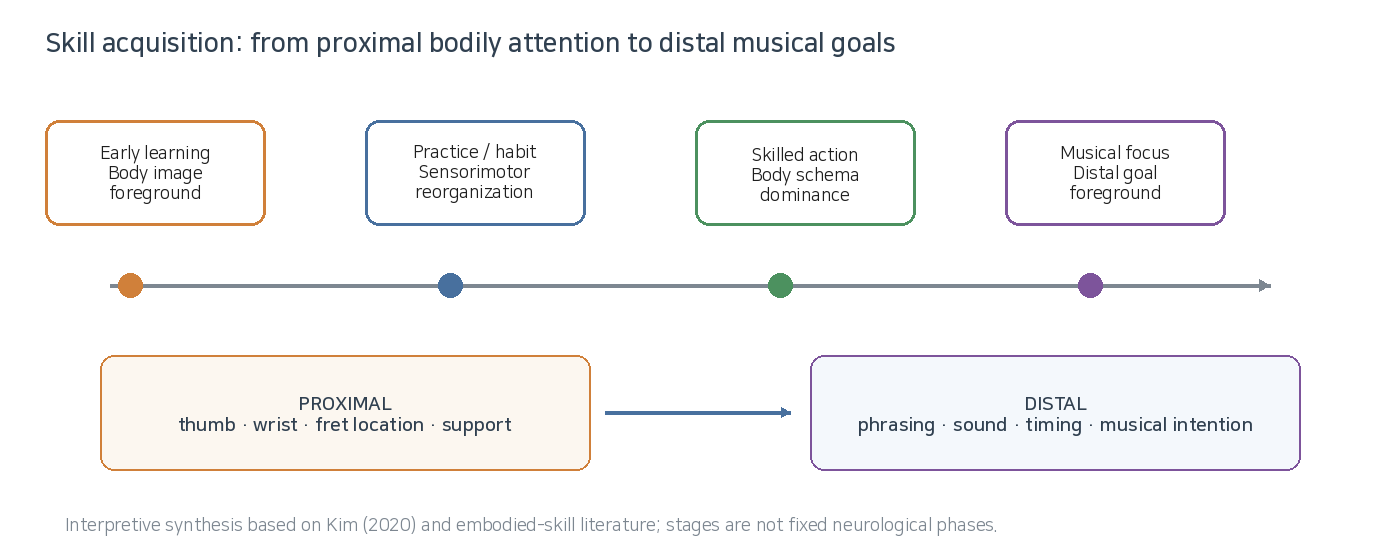
When learning an instrument, the player’s attention initially concentrates on proximal bodily states such as finger position, wrist angle, string location, and instrument support. As skill develops, much of this operation can become habitual action, while attention shifts toward distal musical goals such as sound, phrasing, and timing. Kim analyzes instrumental skill acquisition through the dynamic relation between body image and body schema, and through an attentional shift from proximal to distal [3].
The question RavenForge asks in L02 is therefore not simply “Is this instrument comfortable?” A more direct question is: “Does this geometry force the player to keep spending attention on manipulating, supporting, and correcting the instrument itself, or does it allow that attention to move toward musical action?”
Key Perspective |
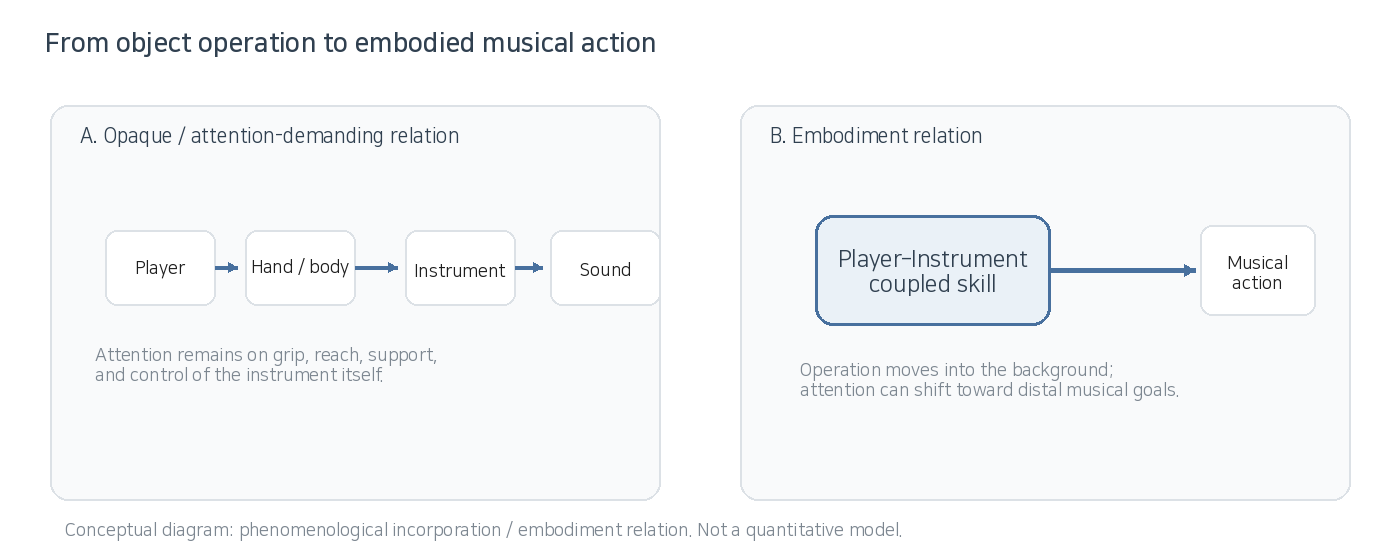
Figure 1. Conceptual transition from operating an external object to an embodiment relation. RavenForge schematic · phenomenological framework based on Merleau-Ponty, Ihde, Kim and Nijs [1–4]. |
2. Body Schema — Merleau-Ponty, Habit, and “I Can”
2.1 Body Image and Body Schema
In contemporary interpretation, body image concerns the level at which one perceives, judges, and consciously represents one’s own body, whereas body schema is closer to the pre-reflective sensorimotor organization that operates beneath skilled action [3]. A player finding a particular fret and string without consciously calculating every finger position is a useful example of this habitual motor organization.
Merleau-Ponty’s central point is that the body is not merely an object located in space but the center of “what I can do” (“I can”) [1]. Applied to instrument design, dimensions are not static comfort dimensions; they are conditions that make particular fretting, muting, reaching, and shifting actions immediately available to the player.
2.2 Tool Incorporation — The Cane Does Not Literally Become the Body
In Merleau-Ponty’s example of the blind man’s cane, the skilled user does not calculate the cane tip as a separate object but explores the location and surface of the world through it [1]. Incorporation here does not mean that the tool biologically becomes part of the body; it is the phenomenological claim that a new action space including the tool operates within the habitual body schema.
Modern experiments have also reported that repeated tool use can influence later free-hand movement kinematics and body representation [6]. This does not justify directly generalizing that “a guitar becomes part of the body through the same neurological mechanism.” RavenForge therefore records phenomenological incorporation and empirical body-representation plasticity as different levels of evidence.
Design rule |
Figure 2. Conceptual model of proximal bodily attention shifting toward distal musical goals through skill acquisition. Interpretive synthesis based on Kim (2020) [3]. Stages are conceptual, not fixed neurological phases. |
3. Embodiment Relation — Ihde and Technological Transparency
In Don Ihde’s postphenomenology, an embodiment relation is one in which the world is experienced through technology while the technology itself recedes from the foreground of experience. It can be schematized as (Human–Technology) → World [2]. Research on musical technology likewise connects sufficiently skilled musician–instrument relations with this form of transparency [3,4].
Transparency here is not the same as being physically unobtrusive. A small, light, or thin instrument is not automatically transparent; conversely, a thick neck may cease to be a persistent attentional bottleneck if it couples stably with a particular player’s habitual grip.
Design rule |
4. Musician–Instrument Coupling — Affordance Is Not Fixed Inside the Instrument
Krueger treats musical affordances as possibilities for action offered by music and environment, describing musical activity as an integrated brain–body–music system [5]. Nijs, Lesaffre & Leman likewise study performer–instrument interaction by treating the musical instrument as a “natural extension” of the musician [4].
The same 37-inch scale therefore does not afford the same actions to every player. Differences in hand span, forearm length, habitual thumb strategy, instrument pose, and task change the reach and movement demanded by the same geometry. Rather than saying “37 inch = ergonomic” or “37 inch = unergonomic,” the more direct question is what movement strategy and compensation a geometry requires in a specific player context.
Revised assumption |
5. Ergonomics as Body–Instrument Coupling — Interaction Geometry Rather Than Comfort Alone
Marmaras & Zarboutis identified features of existing electric-guitar models that increased player fatigue or difficulty, derived ergonomic requirements, and then designed a new electric guitar in 1997. In comparison with three existing models, the new design was reported to provide better user fit [7]. This does not support the assumption that conventional electric-guitar geometry is already an ergonomic optimum.
The electric-guitar study by Genani, Dekker & Molenbroek likewise used surveys, user observation, biomechanical analysis, and laboratory measurement to treat poor posture and high wrist flexion as key problems and to propose a new ergonomic guitar [8]. The important point is not that a particular historical outline was retained, but that neck position, support, and instrument orientation were treated as variables in the human–instrument interface.
In a classical-guitar support study, posture, comfort, and self-efficacy ratings changed with support dimensions and positioning even when the instrument itself was unchanged [9]. In particular, subjective comfort and postural-risk scores did not move in exactly the same direction, providing a reason to avoid the direct equation “feels comfortable = biomechanically optimal.”
A systematic review by Rousseau et al. found that musician-posture studies use methods including visual assessment and 3D analysis, but definitions of “physiological posture” are inconsistent and evidence is insufficient to assume a strong association between impaired playing posture and pain [10]. RavenForge therefore limits its human-factors log to engineering validation that compares prototype interaction rather than making direct injury-prevention claims.
Evidence boundary |
6. Myth of the “Full-Size Ergonomic Baseline”
6.1 The Causal Problem in the Claim “A Smaller Body Pushes the Low Frets Farther Away”
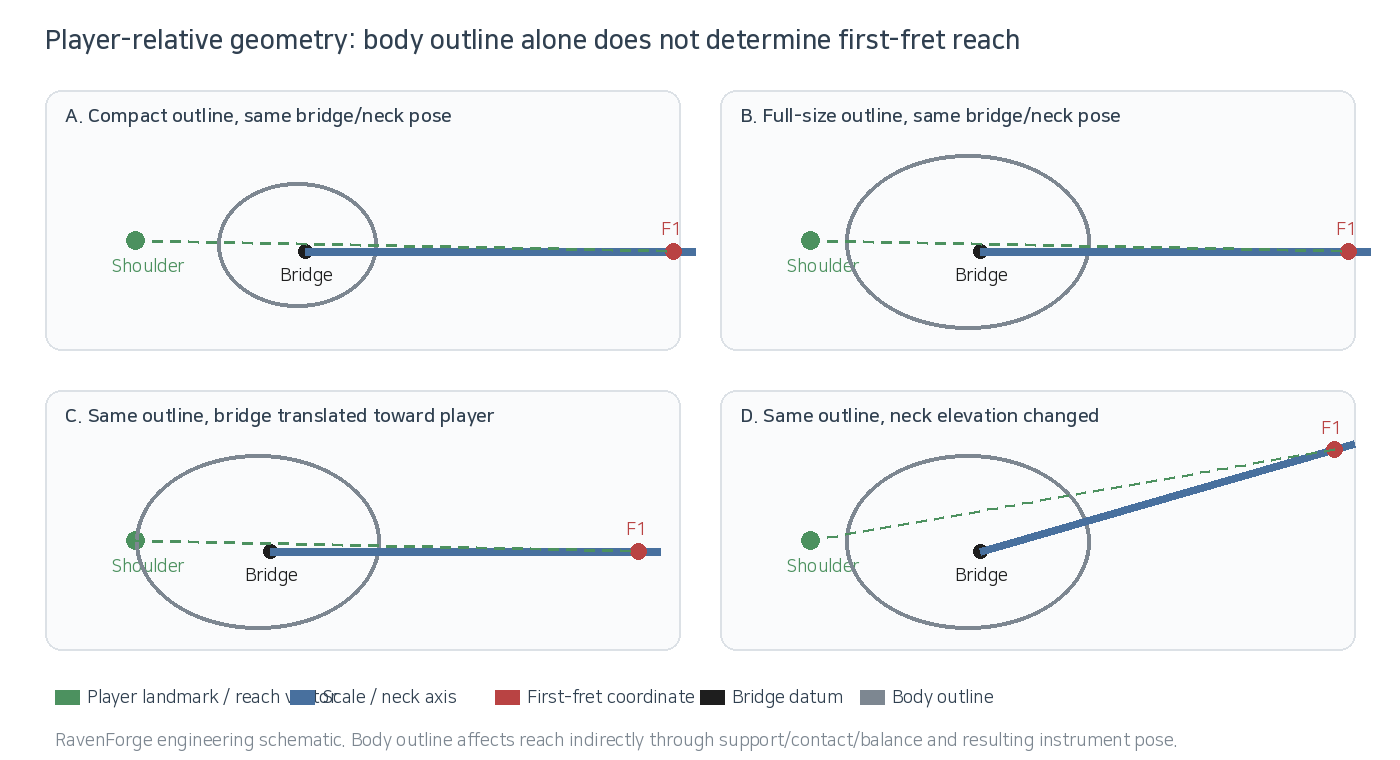
Online discussions often present a causal chain such as `small body → neck shifts outward → first fret moves farther away → full-size body is ergonomic`. However, the overall length or area of a body outline does not directly determine the player-relative first-fret coordinate. Body geometry can affect reach indirectly by changing the instrument pose through support points, seated contact datums, bridge position, strap coordinates, center of mass, and equilibrium orientation.
A more defensible causal chain is therefore `body geometry → support / contact / balance → player-relative instrument pose → fret reach`. A particular compact design can place the first position farther away if its bridge or contact datum is poorly arranged, but that is not an inevitable consequence of a compact outline. For the same reason, a conventional full-size outline does not automatically improve first-position reach.
6.2 Is “Full-Size” an Ergonomic Category?
The electric-guitar ergonomics research and anthropometric standards reviewed here describe users in terms of anatomical landmarks, body dimensions, posture, instrument position, support, and load distribution [7–11]. ISO 7250-1 provides definitions and landmarks for human-body measurements used in technological design, but it does not define a “full-size guitar/bass body” as an ergonomic category [11].
RavenForge may therefore use “full-size” as a historical or market size description, but not as a standardized ergonomic variable or neutral ergonomic baseline. The long history of a traditional outline can support familiarity and manufacturing lineage, but it does not demonstrate anthropometric optimization.
Design rule |
7. Player-Relative Instrument Geometry — The Question Is Where the Scale Sits Relative to the Body, Not How Large the Body Is
RavenForge defines low-fret reach in a player coordinate system rather than by body length. Let S be the fretting-side shoulder landmark of a right-handed player, t the player-relative translation of an instrument reference datum, R(θ) the neck orientation, and pₙ the coordinate of fret n within the instrument. The player-relative fret coordinate can then be written as:
p_Fn,player = t + R(θ) · p_Fn,instrument
The reach vector from the shoulder to fret n can then be written as r_S→Fn = p_Fn,player − p_S, with the actual distance proxy recorded as D_S,Fn = ||r_S→Fn||. This is not an equation taken directly from an existing paper; it is an engineering coordinate model derived to apply the geometry, posture, and anthropometry variables identified in the L02 literature to RavenForge CAD and prototype measurements.
In this model, body area and overall body length do not appear as independent terms. The body influences t and R(θ) indirectly by changing bridge/contact/strap datums and orientation. Thus, different body outlines can produce the same first-fret coordinate if bridge and neck pose are identical in the player frame, while the same outline can produce a different reach when bridge translation or neck elevation changes.
Figure 3. RavenForge geometry schematic separating body outline from player-relative first-fret reach. Legend is embedded in the figure. Blue = scale axis; red = F1; green = player landmark/reach; black = bridge; grey = body outline. RavenForge engineering model, not experimental data. |
7.1 Separate Scale Length from Instrument Placement
In equal temperament, the nut→F1 distance is about 48.47 mm on a 34-inch (863.6 mm) scale and about 52.75 mm on a 37-inch (939.8 mm) scale, a difference of approximately 4.28 mm in the first-fret spacing near the nut. By contrast, if the bridge is assumed to remain fixed at the same position in the player frame, the longitudinal bridge→F1 position differs by about 71.92 mm. These values answer different questions.
It is therefore incorrect to confuse “the first fret is about 4 mm farther from the nut on a 37-inch scale” with “the scale extends about 72 mm farther from the same bridge datum.” Actual reach must be evaluated by measuring scale length together with the bridge player-coordinate, body contact, strap suspension, and neck elevation.
8. RavenForge Application — Redefining Specifications as Body–Instrument Coupling Variables
Design variable | Meaning in L02 | Prototype measurement |
Neck profile | thumb–palm–finger interaction | thumb position / wrist angle / subjective effort |
Neck width / string spacing | fretting · muting · crossing affordance | finger spread / accuracy / hand strategy |
Scale length | player-relative fret distribution | shoulder→F1/F5/F12 |
Multiscale / fret fan | wrist · forearm trajectory | wrist deviation / shift path |
Body contour / size | torso · thigh contact interface | pose repeatability / contact datum |
Bridge body-coordinate | translation of the entire scale | bridge→torso / shoulder→F1 |
Upper horn / strap point | standing suspension geometry | neck elevation / horizontal position |
Center of mass | equilibrium orientation / neck dive | support correction / unloaded rotation |
Instrument mass | prolonged support load | posture drift / perceived effort |
Control placement | right-hand task interruption | reach excursion / task time |
8.1 ASKR — Evaluate the 37–34 Inch Multiscale as Player-Relative Geometry, Not Simply as “Long/Short”
ASKR’s 37–34 inch multiscale has a longer low-string speaking length than a conventional 34-inch bass, but that alone does not justify the conclusions “the first fret is too far away” or “multiscale is more ergonomic.” At minimum, bridge player-coordinate + strap support + seated contact datum + neck elevation + fret fan must be recorded together, then compared against shoulder→F1/F5/F12 and wrist/elbow/shoulder response.
Initial unfamiliarity is also a separate variable. Embodied-skill literature supports the idea that a new instrument relation can change through repeated practice and adaptation [3,4], but this must not become an excuse that “an uncomfortable design is fine once you get used to it.” Initial unfamiliarity must be distinguished from unnecessary compensation that persists after repeated sessions.
ASKR validation rule |
8.2 EMBLA and Future RavenForge Designs
EMBLA’s neck feel is likewise not reduced to profile thickness alone. Neck width, string spacing, body balance, and neck orientation jointly shape habitual hand strategy. Future compact-body designs will not be labeled “compact ergonomic body” in advance, and traditional full-size bodies will not be treated as a neutral baseline. Both will be compared using the same player-relative coordinates and task protocol.
9. Evidence Matrix — What Can L02 Actually Claim?
Claim | Assessment | Evidence | RavenForge wording |
Habitual skill is connected with body schema | Supported framework | Merleau-Ponty / Kim [1,3] | habitual sensorimotor organization |
Tool use can change body representation | Supported | Cardinali et al. [6] | plasticity evidence; no guitar-specific generalization |
A skilled instrument can be experienced transparently | Supported conceptually | Ihde / Kim / Nijs [2–4] | reduced attention to operation |
Musician–instrument can be treated as a coupled system | Supported framework | Krueger / Nijs [4,5] | player × instrument interaction |
Affordance is identical for every player | Incorrect | affordance framework [5] | record morphology / skill / task context |
Conventional full-size body is an ergonomic optimum | Not supported | ergonomic redesign studies [7,8] | conventional ≠ ergonomic reference |
Compact body inherently moves F1 farther away | Not generalizable | RavenForge geometry inference | measure player-relative F1 |
A larger body always helps by shifting the instrument to the right | Depends on geometry | support/contact logic [7–9] | measure standing/seated datums separately |
Subjective comfort alone identifies the optimum | Not supported | support study [9] | subjective + objective channels |
A particular posture directly causes pain | Not established | systematic review [10] | no clinical causality claim |
Multiscale is universally ergonomic | Not established | direct comparative evidence insufficient | RavenForge validation required |
If it feels unfamiliar at first, it is non-ergonomic | Not sufficient | skill-acquisition framework [3,4] | familiarity ≠ long-term embodiment |
10. L02-Derived Human-Factors Prototype Measurement Protocol
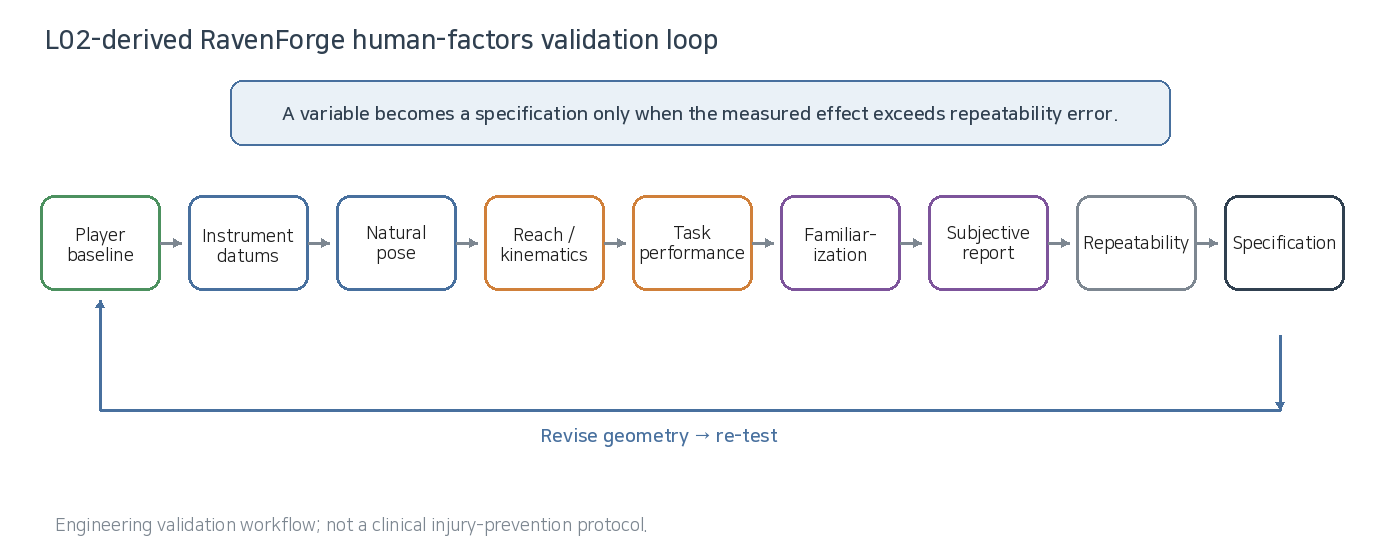
The literature establishes that instrument–player interaction matters, but it does not provide RavenForge with a single set of optimal dimensions. Prototype work therefore prioritizes within-subject engineering comparisons in which the same player experiences multiple geometries, while clearly separating population-level ergonomic proof from internal design screening.
Figure 4. L02-derived RavenForge human-factors validation loop. A variable becomes a specification only when the observed effect exceeds measurement and repetition error. Engineering workflow; not a medical protocol. |
Stage | Record | Decision |
Anthropometry | stature, shoulder breadth, upper-arm / forearm length, hand span, key landmarks | player context |
Instrument datums | bridge, nut, F1/F5/F12, strap points, contact points, COM | instrument reference |
Standing pose | bridge / neck player-coordinate, elevation / yaw | standing geometry |
Seated pose | thigh / torso contact datum, bridge position | seated geometry |
Low-fret task | shoulder→F1/F5, elbow / shoulder / wrist angles | first-position demand |
Position shift | F1↔F12 trajectory, time, error | scale navigation |
Right-hand task | playing zone→control reach | control ergonomics |
Balance test | unloaded neck tendency, corrective support | neck-dive / support demand |
Extended block | pose drift, subjective effort | sustained interaction |
Familiarization | repeated sessions | immediate vs adapted response |
Transparency report | instrument awareness / task focus | exploratory phenomenological metric |
Gauge R&R | repeated landmark / angle measurement | measurement noise floor |
Measurement rule |
A 2026 bass-guitar support study applied motion capture, postural assessment, and musculoskeletal modelling to 15 experienced bassists, and simulated three support configurations across anthropometric percentiles [12]. The study does not provide a direct answer for RavenForge body design, but it is a recent example showing that bass ergonomics can be analyzed through the relationship among support geometry, pose, muscular demand, and anthropometry rather than “body size” alone.
11. Current Conclusion — Ergonomics Is Not a Property of the Body Outline
Calling the instrument an “extension of the body” in L02 is not merely a romantic metaphor. In skilled musical interaction, habitual body schema, instrument affordance, and support geometry can combine so that the player’s attention shifts from instrument operation toward distal musical goals [1–5].
For RavenForge, ergonomics is therefore not an adjective attached to a product but a performance characteristic of the player–instrument relation. Material, scale, body outline, neck profile, and strap point are not treated as independent “comfort parts”; instead, RavenForge measures how they jointly construct player-relative pose and action space.
Current design position |
RavenForge defines its human-factors design sequence as `player → task → instrument geometry → player-relative pose → kinematics / effort → adaptation → specification`.
12. Next Research — Division of Roles After L02
Code | Research question | Variables passed forward from L02 |
A02 | Pickup Position and Harmonic Sampling | normalized pickup coordinate, node/null, finite sensing width |
B02 | Voicing Before Specification | derive specification backward from target response |
Future C03 | Player-Relative Reach Mapping | shoulder / torso datum → F1/F5/F12 |
Future C04 | Balance & Support Kinematics | COM, strap/support line, instrument pose |
Future C05 | Neck Profile & Hand Interaction | thumb / wrist / hand strategy |
Future C06 | Scale / Multiscale Adaptation | initial familiarity vs repeated-session compensation |
References
[1] Merleau-Ponty, M. Phenomenology of Perception. Gallimard, 1945; English translations by Routledge. Body schema, habit and the blind-man’s cane are used here as phenomenological framework rather than quantitative ergonomic evidence.
[2] Ihde, D. Technology and the Lifeworld: From Garden to Earth. Indiana University Press, 1990. Embodiment relation / human–technology–world framework.
[3] Kim, J. H. “From the Body Image to the Body Schema, From the Proximal to the Distal: Embodied Musical Activity Toward Learning Instrumental Musical Skills.” Frontiers in Psychology 11, 101 (2020). DOI: 10.3389/fpsyg.2020.00101.
[4] Nijs, L.; Lesaffre, M.; Leman, M. “The Musical Instrument as a Natural Extension of the Musician.” In Music and Its Instruments, Éditions Delatour France, 2013, pp. 467–484.
[5] Krueger, J. “Affordances and the Musically Extended Mind.” Frontiers in Psychology 4, 1003 (2014). DOI: 10.3389/fpsyg.2013.01003.
[6] Cardinali, L. et al. “Tool-use induces morphological updating of the body schema.” Current Biology 19(12), R478–R479 (2009). DOI: 10.1016/j.cub.2009.05.009.
[7] Marmaras, N.; Zarboutis, N. “Ergonomic redesign of the electric guitar.” Applied Ergonomics 28(1), 59–67 (1997). DOI: 10.1016/S0003-6870(96)00032-4.
[8] Genani, G.; Dekker, M. C.; Molenbroek, J. F. M. “Design of an ergonomic electric guitar.” Tijdschrift voor Ergonomie 38(2), 43–49 (2013). TU Delft repository UUID: 913d9ce8-4a22-471d-8adf-311937698992.
[9] Valenzuela-Gómez, S.-A.; Rey-Galindo, J.-A.; Aceves-González, C. “Analyzing working conditions for classical guitarists: Design guidelines for new supports and guitar positioning.” Work 65(4), 891–901 (2020). DOI: 10.3233/WOR-203140.
[10] Rousseau, C.; Taha, L.; Barton, G.; Garden, P.; Baltzopoulos, V. “Assessing posture while playing in musicians – A systematic review.” Applied Ergonomics 106, 103883 (2023). DOI: 10.1016/j.apergo.2022.103883.
[11] ISO 7250-1:2017. Basic human body measurements for technological design — Part 1: Body measurement definitions and landmarks.
[12] Meglio, G.; Guacci, M.; Laiola, N.; Naddeo, A. “Human Digital Biomechanical Twin-Driven Ergonomic Optimization of Bass-Guitar Support Systems: Predictive Design and Experimental Validation.” Applied Sciences 16(11), 5224 (2026). DOI: 10.3390/app16115224.
[R1] RavenForge / Signal & Transduction Research Log A01. “From Mechanical Vibration to Electrical Signal.” 2026.09.05.
[R2] RavenForge internal Liberal Arts research sequence. L01 → A01 → L02 framework.
Source-status note |
Working research document · 2026.09.06