RAVENFORGE / MODEL MATERIAL SELECTION LOG — EDDA
RAVENFORGE
Model Material Selection Log
EDDA — Why Alder, and What Does “Heritage” Mean?
From Fender-derived vintage grammar to Alembic / Wal and parallel bass lineages
Document purpose |
Projects | RavenForge EDDA — 4-string / 34" heritage & improved-vintage platform |
Current body | 3-piece solid: Alder center core + Alder side wings |
Recommended body | 3-piece solid: Alder center core + Limba side wings |
Current neck | 1-piece Maple standard · 3-piece Maple option |
Current fretboard | Rosewood standard · Ebony recommended reference |
Premium materials | Jindai Keyaki body · Ironwood / Bog Oak fretboard · Ancient Kauri cap — Custom / Request |
Status | Design rationale established · matched prototype validation pending |
1. Starting Point — How EDDA Evolved from an Unplanned Model into a Heritage Research Platform
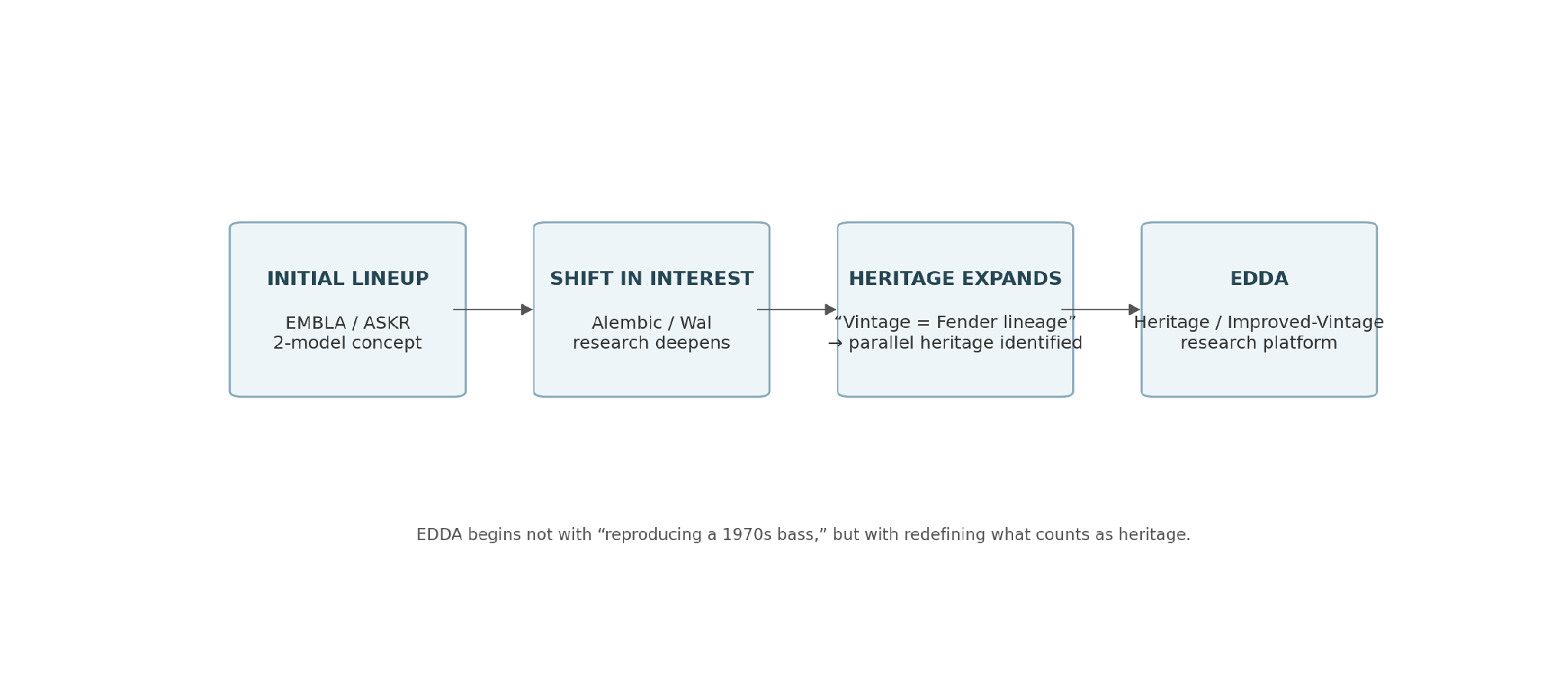
The early RavenForge lineup was centered on modern playability, extended string counts and scale lengths, laminated necks, and active electronics, as represented by EMBLA and ASKR. At that stage, a separate vintage-oriented model such as EDDA did not seem necessary. The market already contained many “vintage” instruments that repeated Precision/Jazz Bass-derived shapes and component layouts, and adding another instrument in the same grammar seemed to offer little research value [R3].
The turning point came when Alembic and Wal began to appear not merely as expensive vintage brands, but as engineering lineages that tried to redefine bass design in their own time. Following that history shows that the heritage of the 1970s does not reside only in old body shapes or nitro finishes. The heritage also lies in the attempt to redesign the entire instrument as one system: pickup impedance, onboard gain, filter topology, dedicated hardware, multi-laminate construction, and feedback from studio and road use [1–4].
Core perspective |
Figure 1. Conceptual path by which EDDA was added outside the original lineup. RavenForge internal development narrative [R3]. |
1.1 Not Rejecting Fender Heritage, but Expanding the Meaning of “Vintage”
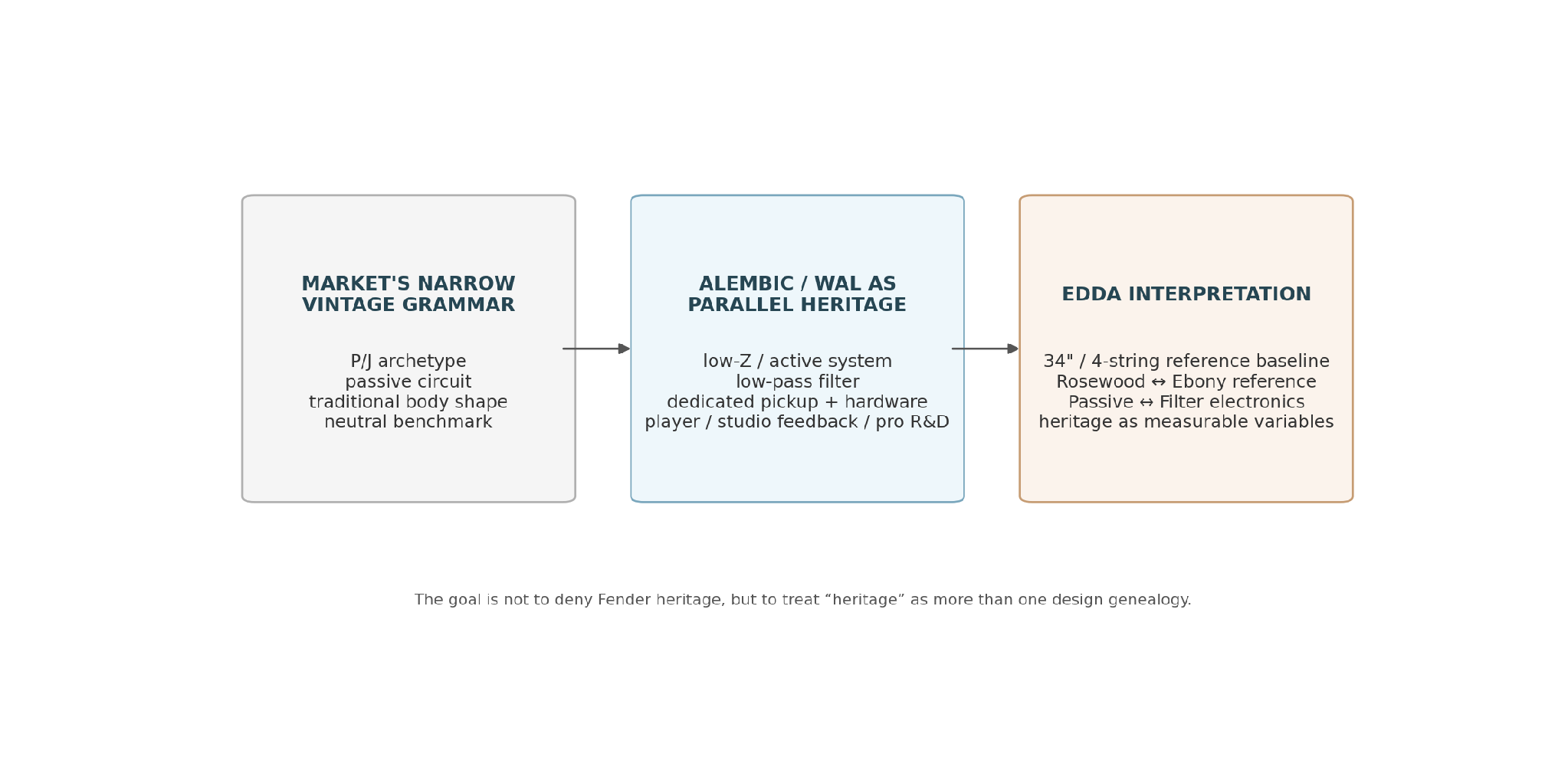
Fender Precision and Jazz Basses are among the most important reference points in electric-bass history, and the accumulated manufacturing data and playing experience around Alder/Maple/Rosewood construction and passive circuits cannot be ignored. However, when the modern market allows the word “vintage” to converge too narrowly on those silhouettes, pickup layouts, and passive controls, lineages such as Alembic and Wal—whose designers re-asked what an electric bass could be in very different ways—become obscured. EDDA does not erase the Fender lineage; it expands the coordinate system of heritage.
2. Heritage Reference — What Does EDDA Actually Inherit from Alembic and Wal?
2.1 Alembic — A Lineage That Treated “Instrument + Electronics = One System” Before Tonewood Narratives
Alembic began in 1969 as a consulting operation founded by Ron and Susan Wickersham to improve live sound and recording quality, and later expanded its research toward the instrument’s own noise and bandwidth limitations. According to Alembic’s official history, Ron Wickersham developed low-impedance pickups for wider bandwidth together with onboard preamplification to compensate their output, and the company built its first in-house bass for Jack Casady in 1972 [1]. The Series I documentation likewise treats pickup and electronics not as separate parts but as one system, with low-pass-filter tone control at its core [2].
Absolute claims such as “Alembic invented the first active electric instrument” are avoided. Historical coverage in Vintage Guitar notes earlier onboard-preamp examples such as the 1962 Burns TR2 [5]. The historical conclusion relevant to EDDA is therefore not a contest over who was “first,” but that Alembic played a pioneering role in establishing low-impedance pickups, active preamps, filters, and custom construction as an integrated boutique-bass design language.
2.2 Wal — professional feedback, proprietary pickup, per-pickup low-pass filter
Wal’s official history identifies a 1976 custom bass for session player John G. Perry as the starting point and describes how Ian Waller and Pete Stevens continuously incorporated feedback from top-flight players and recording producers into the design process [3]. Current Wal pickups use matched coil pairs for each string, while the preamp combines an electronic low-pass filter for each pickup with roll-off-frequency control and a pull boost [4].
This point is directly important to EDDA. If “vintage” is understood only as the restoration of passive volume/tone controls, filter-based instrument design that already existed in the 1970s is pushed outside the history it belongs to. EDDA therefore keeps passive electronics as the standard while preserving Double NFP and custom dual-filter architectures as major development paths—not to copy those lineages, but to study their design questions [R1].
Figure 2. The scope of heritage used by EDDA. Historical references: Alembic [1,2], Wal [3,4]. Diagram is a RavenForge interpretation, not a market-share claim. |
Design rule |
3. Body — Why Alder Is EDDA’s Baseline Material
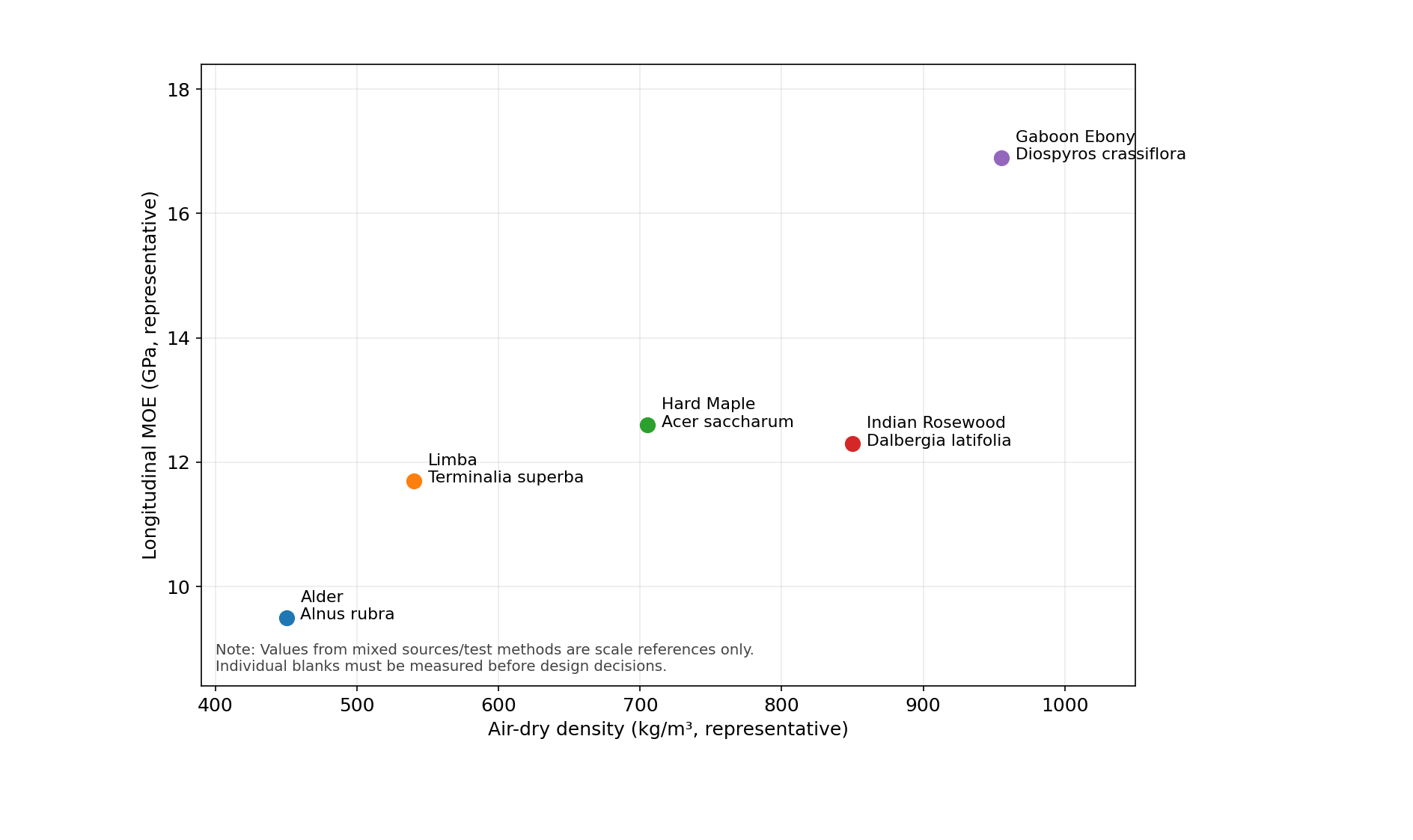
The current EDDA standard body is a 3-piece solid construction with an Alder center core and Alder side wings [R1]. This was not chosen by treating the conventional claim that “Alder produces vintage tone” as scientific fact. Representative values for Red Alder (Alnus rubra) are approximately 450 kg/m³ air-dry density and about 9.5 GPa longitudinal MOE, placing it in a lighter and lower-stiffness region than dense materials such as Hard Maple or Ebony [6,7]. Its favorable machining and finishing behavior, together with relatively repeatable availability as body stock, also make it useful as a production baseline [6].
In EDDA, Alder is not intended to produce “a Fender-like sound”; it is a familiar reference coordinate. In a 34-inch 4-string platform with a comparatively simple Maple neck and passive baseline, it provides a starting point that keeps body mass under control while allowing later pickup, filter, and hardware changes to be compared. The tonal result of the completed instrument is not predicted from the species name Alder, but evaluated through bridge-side FRF and string decay [R2].
EDDA body question | Design response |
Why Alder? | Repeatable low-to-medium-density baseline; favorable total-mass control and machinability |
Why 3-piece? | Core and wing blanks can be screened separately; easier defect and mass-variation management |
Main risk | Alder still varies in density and MC by blank; the species name cannot guarantee “light weight” |
Control method | Record MC, mass, density → finished body/bridge FRF → actual string-decay comparison |
3.1 Limba Wings — A Controlled Peripheral Mass/Stiffness Variant, Not a “Warm Wood” Claim
The Recommended EDDA retains an Alder center core while allowing Limba (Terminalia superba) side wings [R1]. ITTO data give representative Limba values of roughly 0.54 g/cm³ air-dry density, about 11.7 GPa MOE, and a tangential/radial shrinkage ratio around 1.4, together with generally favorable workability [8]. It therefore occupies a somewhat higher density/stiffness region than Alder without becoming an extreme heavy hardwood.
The research value of this combination is not the traditional claim that “Limba sounds warmer,” but the ability to keep the Alder center core beneath the bridge and neck joint while changing the mass/stiffness window of the peripheral wings. A glued body remains a continuous structure, so the wings cannot be treated as acoustically independent. Meaningful interpretation requires comparing Alder/Alder and Alder/Limba body modes, bridge mobility, and total mass under the same protocol.
Figure 3. Representative density–MOE positions of major materials directly relevant to EDDA. Representative values: USDA / Wood Database [6,7,9–11], ITTO [8]. Mixed-source scale reference only. |
4. Neck — Why EDDA Uses 1-Piece / 3-Piece Maple Instead of a 5-Piece Laminate
Unlike EMBLA and ASKR, which use a 5-piece laminated neck as the production baseline, EDDA uses 1-piece Maple as standard and 3-piece Maple as an option [R1]. This does not adopt the hypothesis that “a one-piece neck sounds more vintage.” EDDA intentionally reduces neck-architecture complexity to establish a structural reference for the 34-inch 4-string heritage platform, making changes in body, fingerboard, and electronics easier to observe separately.
Representative Hard Maple (Acer saccharum) values are approximately 705 kg/m³ air-dry density and about 12.6 GPa longitudinal MOE, placing it in a higher stiffness/mass region than Alder [9]. Actual neck stiffness, however, is determined not by species alone but by profile, grain orientation, truss rod, reinforcement, and the final bonded section geometry including the fingerboard [R2]. Statements such as “Maple neck = bright” are therefore not used.
4.1 What 3-Piece Maple Means — A Stock-Selection Option, Not Reinforcement Marketing
Three-piece Maple is not assumed to be automatically stronger or more stable than one-piece Maple simply because it contains more pieces. The practical advantage is the ability to screen each strip for grain runout, defects, density, and moisture content, and to manage left/right placement. In EDDA, this simple 1pc↔3pc contrast is itself a useful research variable. With matched necks using the same fingerboard and profile, modal frequency, torsional tendency, and relief change after RH cycling can be compared directly.
Design rule |
5. Fingerboard — Why Rosewood and Ebony Remain the Reference Pair
EDDA uses Rosewood as standard and Ebony as the recommended reference [R1]. Here too, comparability takes priority over traditional tonal adjectives. Liu et al. compared Indian Rosewood, Ebony, African Blackwood, and Hard Maple in the same fretboard-material protocol, measuring density, MOE, hardness, swelling, and wear [12]. In that study, Indian Rosewood had an air-dry density of 0.81 g/cm³ and Ebony 1.21 g/cm³; both met hardness and wear requirements for fingerboard use, but their mechanical properties and dimensional responses differed [12].
Rosewood↔Ebony is therefore not a psychological “warm↔bright” axis, but a comparison between two established fingerboard materials with different density, hardness, stiffness, and mass contribution within the same neck family. This is also why EDDA does not prioritize the highest material-property candidates such as Mpingo/Kingwood in the way ASKR does. EDDA first asks what two historically familiar references actually change in the completed neck assembly rather than pursuing a high-density fingerboard competition.
6. Premium Fingerboard — Why Ironwood and Bog Oak Are Stock-Specific Materials
6.1 “Ironwood” Is Not a Species — The Technical BOM Must Resolve It to a Botanical Name
The current portfolio lists “Ironwood / Bog Oak” as Custom / Request premium fingerboards for EDDA [R1]. However, Ironwood is not a single botanical species; it is a commercial/common name applied to different dense woods in different regions. A production BOM or research record must therefore never infer density, MOE, oil content, CITES status, bonding behavior, or machinability from the word “Ironwood” alone. A stock becomes a distinct material candidate only after exact species identification and provenance are verified.
6.2 Bog Oak — Age Is Not a Guarantee of Greater Stability or Hardness
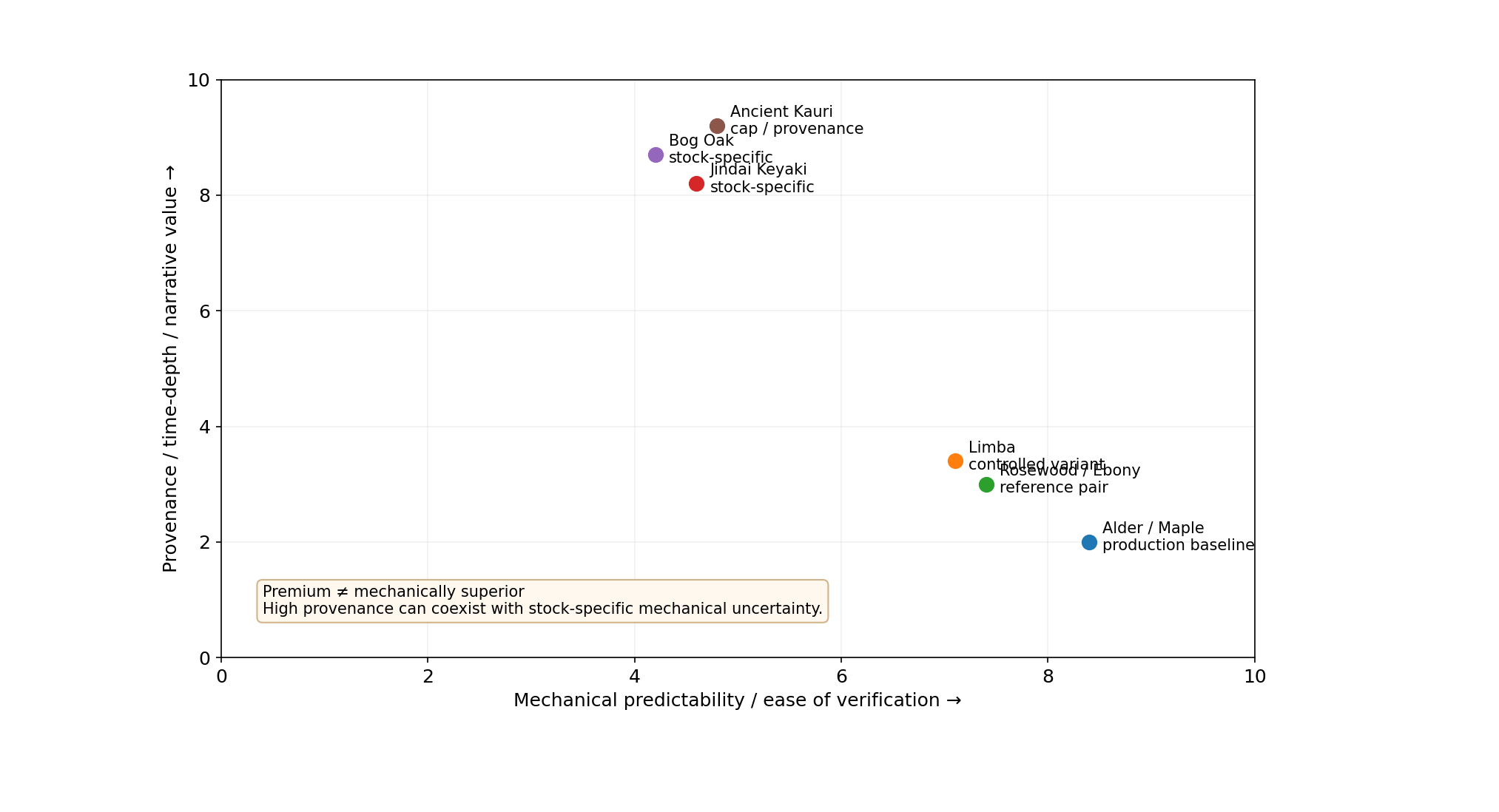
Bog Oak is oak that has undergone chemical and microbiological change after remaining buried for hundreds to thousands of years in wet, low-oxygen environments. A 2022 study of bog oak from the Venetian Plain found bacterial degradation and substantial shrinkage changes even within material that appeared intact; comparison with earlier work also shows that changes in density, hardness, and strength are not directionally simple, but depend on the sample and burial environment [13]. The claim that “a thousand-year-old oak must be mechanically superior” is therefore unsupported.
Bog Oak nevertheless fits EDDA for a different reason: the material itself can directly express the time-depth and provenance embedded in EDDA’s concept of heritage. Premium status is therefore not an acoustic ranking, but a classification of rarity, historical character, and stock-specific processing cost. Each blank must be evaluated individually for cracks, density, MC, and dimensional response before use.
7. Premium Body / Top — Jindai Keyaki and Ancient Kauri Are Not Romanticized Merely Because They Are Old
7.1 Jindai Keyaki — A Material with Literal Traces of Time, and Working Risk as Part of Its Heritage
The Japan Kogei Association describes Jindai as extremely old timber—literally material “from the age of the gods” (神代)—including Keyaki (Zelkova), Sugi, and Kuri that remained buried in the ground or submerged for long periods. It also notes that such timber is highly valued but requires exceptional care in working [14].
These characteristics explain both the appeal and the risk of Jindai Keyaki as an EDDA premium body. It is not an unsupported upgrade based on the idea that “old wood resonates better,” but unique stock with a provenance and deformation history. Before using it for a one-piece chambered body, sufficient finished width, cracks/checks, MC gradient, density, and chamber-wall thickness must be verified. A premium label never justifies forcing unsuitable stock into a build.
7.2 Ancient Kauri — A Direct Counterexample Showing That Older Material Can Have Lower MOE
In Freedland, Rowell, and Plackett’s comparison of approximately 30,000-year-old Ancient Kauri with modern Kauri, the burial environment altered cell-wall structure and the ancient material showed significantly lower MOE and proportional-limit-related values than modern wood. MOR was also lower, providing a direct counterexample to the idea that older material is automatically stronger or more elastic [15].
An Ancient Kauri cap in EDDA is therefore not a component intended to create “better tone because the wood is ancient,” but a top option that exposes the material’s time-depth and visual provenance. If used as a cap several millimeters thick, it can contribute to body mass and bending stiffness, so a thin decorative veneer and a structural cap must be recorded as different architectures [R2].
Figure 4. Framework for interpreting EDDA premium materials. Historical/provenance value and mechanical certainty are separate axes. Jindai [14], Bog Oak [13], Ancient Kauri [15]. |
8. Electronics — EDDA’s Heritage May Be More Explicit in the Circuit Than in the Wood
EDDA currently uses passive electronics as the standard, while the Recommended tier studies filter-based preamps such as the Lusithand Double NFP MKII and the Premium tier explores custom dual-filter systems [R1]. This hierarchy is not a price ranking in which “active is superior.” The passive baseline is a reference for comparing changes in the pickup and instrument structure, while filter systems are a separate architecture for revisiting the historical design questions found in Alembic and Wal under modern conditions.
In particular, the current Wal circuit adjusts the roll-off frequency of a low-pass filter for each pickup and uses a pull function to emphasize harmonics near the roll-off region [4]. Alembic Series I likewise treats pickup and electronics as one system and uses low-pass filters as its primary tone control [2]. EDDA references the historical significance of these topologies but does not copy proprietary circuits. Cutoff range, Q, output level, and pickup loading are to be designed independently for RavenForge requirements and evaluated in level-matched tests.
Heritage rule |
9. Standard / Recommended / Premium — Tiers of Research Risk and Variables, Not Sound Quality
Item | Standard | Recommended | Premium / Research |
Strings / Scale | 4-string / 34" | 4-string / 34" | 4-string / 34" |
Neck | 1-pc Maple | 3-pc Maple | 3-pc Maple / stock-selected |
Fingerboard | Rosewood | Ebony | Species-specified Ironwood or verified Bog Oak — Request |
Body | 3-pc Alder / Alder | Alder core + Limba wings | 1-pc chambered Jindai Keyaki — Request |
Top | Matching Alder | Flame Maple veneer | Ancient Kauri cap — Request |
Electronics | Passive | Double NFP filter | Custom dual-filter architecture |
Research role | production/reference baseline | controlled material/electronic variants | high provenance + high stock-specific uncertainty |
In this table, Premium does not mean “better sound.” Instead, moving farther from the standard increases procurement complexity, provenance requirements, material variability, machining risk, and the need for measurement. For Jindai, Bog Oak, and Ancient Kauri in particular, the history of each stock is part of its material condition, so design cannot end with species-average values.
10. Evidence Matrix — What Can We Currently Claim?
Claim | Assessment | Evidence | RavenForge wording |
Alembic/Wal demonstrate a bass heritage distinct from Fender-derived archetypes | Supported historical basis | Official histories / components [1–4] | Describe as a parallel lineage; make no claim of superiority across the market |
Alembic “invented active electronics first” | Too absolute | Earlier active-preamp example exists [5] | Pioneered integrated low-Z / active boutique-bass system |
Alder guarantees “vintage tone” | Not supported | Species label ≠ output [R2] | Low–medium density production/reference baseline |
Limba wings produce a warmer tone | Not established | Material data only [8] | Peripheral mass/stiffness variant; measure FRF |
3-pc Maple is always more stable than 1-pc | Not generalizable | Beam / material variability [R2] | Selection/symmetry option; matched test required |
Rosewood and Ebony have different fingerboard material properties | Supported | Direct fretboard study [12] | Use as established reference pair |
Bog Oak is mechanically superior because it is old | Not supported | Stock/degradation variability [13] | Provenance material; inspect every blank |
Ancient Kauri is stiffer because it is old | Contradicted by cited sample | Ancient-vs-modern study [15] | Primarily provenance/top hypothesis; measure cap |
Jindai is a premium acoustic upgrade | Not established | Craft terminology / stock variability [14] | Premium = rarity/history/processing, not tonal rank |
Filter electronics are merely “modern” and unrelated to vintage heritage | Incorrect historically | Alembic / Wal [1–4] | Filter systems are part of 1970s bass heritage |
11. EDDA Prototype Measurement Protocol
Literature and historical research can explain why a material deserves testing, but they cannot substitute for the behavior of a completed EDDA. Material A/B and electronics A/B should therefore be separated as far as possible and recorded in the following sequence.
Figure 5. EDDA material / electronics validation loop. RavenForge measurement plan linked to Material & Acoustics Research Log 01 [R2]. |
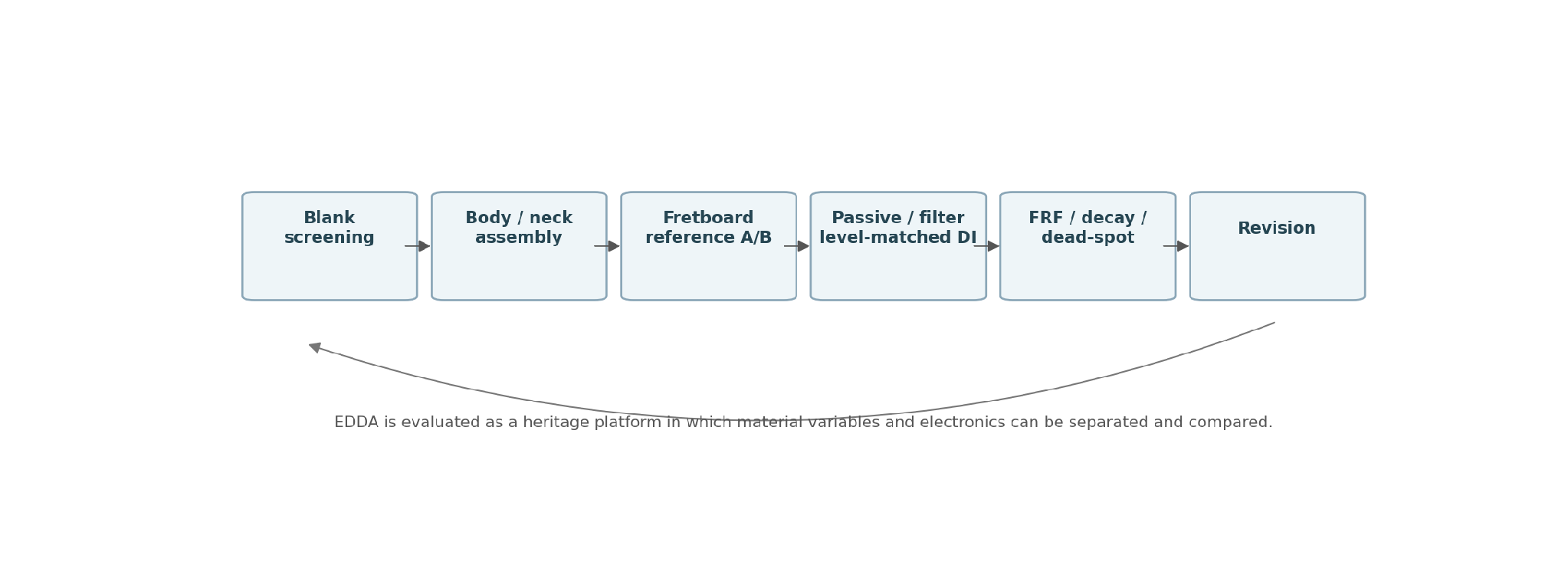
Stage | Record | Decision |
Raw body / neck blank | MC, dimensions, mass, density, grain/runout, cracks/checks | accept / reject / chamber plan |
Alder/Alder vs Alder/Limba body | mass, bridge-side FRF, main body modes | wing-material hypothesis |
1-pc vs 3-pc Maple neck | mass, relief, tap/FRF, torsional tendency, RH cycle | neck architecture baseline |
Rosewood vs Ebony matched neck | board mass/thickness, finished-neck FRF, fret conductance | fretboard reference A/B |
Passive vs filter electronics | same pickup, normalized output, DI spectrum/noise, control sweep | electronics-only comparison |
Premium stock | species/provenance, density, defects, MC gradient, machining notes | stock-specific go/no-go |
Assembled bass | neck/bridge conductance, partial decay, T60, dead spots | actual system response |
12. Current Conclusion — In EDDA, Heritage Is Not a Silhouette but an Unfinished Design Question
EDDA was not planned from the beginning as a vintage model. It emerged later from the realization—while following the histories of Alembic and Wal—that electric-bass heritage cannot be reduced to Fender-derived forms and passive recipes alone. Alembic treated low-impedance pickups and onboard electronics as an instrument-wide system, while Wal developed a separate design grammar through proprietary multi-coil pickups, per-pickup low-pass filters, and professional feedback [1–4]. What EDDA seeks to inherit is precisely that attitude of re-questioning the whole system.
Material selection is therefore deliberately kept free of exaggeration. Alder is a familiar and comparable body baseline; Limba wings are a controlled mass/stiffness variant. One-piece/three-piece Maple necks form a simple reference architecture, while Rosewood/Ebony are an established fingerboard pair with different material properties. Jindai Keyaki, Bog Oak, and Ancient Kauri, by contrast, are not granted mechanical superiority simply because they are old. If their value lies in provenance and time-depth, their properties must be re-measured stock by stock [13–15].
EDDA’s term improved-vintage does not mean “reproducing old sound more accurately.” It means isolating design questions from the past that remain valid and testing them again with current manufacturing precision and measurement methods. The result may favor Rosewood/passive in one case or Ebony/filter preamp in another. EDDA’s standard is that neither history nor material is consumed as decoration; both are treated as real engineering variables.
Current design position |
References
[1] Alembic, Inc. “A Brief History of Alembic.” Official company history. Alembic states that the company began in March 1969 and developed low-impedance pickups with onboard preamplification before building its own basses; first Alembic bass 72-01 in 1972. https://www.alembicguitars.com/history.html
[2] Alembic, Inc. “Series I Bass.” Official model documentation. Describes pickup/electronics as one system and uses low-pass filter tone controls. https://alembicguitars.com/seriesibass.html
[3] Wal Basses. “About Us / History.” Official history. Wal basses entered the scene in 1976 from John G. Perry’s custom commission; Ian Waller and Pete Stevens developed the instruments with professional player/producer feedback. https://walbasses.co.uk/about-us/
[4] Wal Basses. “Components.” Official pickup/preamp documentation. Matched coil pairs per string; individual electronic low-pass filters and harmonic boost functions. https://walbasses.co.uk/components/
[5] Moseley, W. G. “Alembic Distillate DMSB.” Vintage Guitar. Notes Burns TR2 (1962) as an earlier onboard-preamp example and Alembic’s major role from 1969 onward. https://www.vintageguitar.com/3920/alembic-distillate-dmsb/
[6] Alden, H. A. Hardwoods of North America. USDA Forest Products Laboratory, General Technical Report FPL-GTR-83 (1995). DOI: 10.2737/FPL-GTR-83.
[7] Meier, E. “Red Alder (Alnus rubra).” The Wood Database — representative air-dry density / MOE cross-check. https://www.wood-database.com/red-alder/
[8] ITTO / Tropical Timber. “Limba/Fraké (Terminalia superba).” Air-dry density, shrinkage, MOE, workability reference. https://www.tropicaltimber.info/specie/limbafrake-terminalia-superba/
[9] Meier, E. “Hard Maple (Acer saccharum).” The Wood Database — representative density / MOE cross-check. https://www.wood-database.com/hard-maple/
[10] Meier, E. “East Indian Rosewood (Dalbergia latifolia).” The Wood Database — representative density / MOE cross-check. https://www.wood-database.com/east-indian-rosewood/
[11] Meier, E. “Gaboon Ebony (Diospyros crassiflora).” The Wood Database — representative density / MOE cross-check. https://www.wood-database.com/gaboon-ebony/
[12] Liu, M.; Peng, L.; Lyu, S.; Lyu, J. “Properties of common tropical hardwoods for fretboard of string instruments.” Journal of Wood Science 66, 14 (2020). DOI: 10.1186/s10086-020-01862-7.
[13] Meneghello, C.; Maraschin, P.; Zanetti, M.; Urso, T. “Bog oak: Characteristics and characterization of a log from the Venetian Plain (Italy).” Journal of Archaeological Science: Reports 43, 103473 (2022). DOI: 10.1016/j.jasrep.2022.103473.
[14] Japan Kogei Association. “Woodwork & Bamboowork — Terms: Jindai.” Defines Jindai as very old buried/submerged timbers such as Keyaki, Sugi and Kuri; notes the material requires great care in working. https://www.nihonkogeikai.or.jp/en/woodwork-bamboowork
[15] Freedland, C.; Rowell, R. M.; Plackett, D. “Environmentally Induced Physical Changes in Ancient Kauri (Agathis australis) Wood.” Wood and Fiber Science (2007). Study comparing ca. 30,000-year-old and modern kauri; ancient material showed lower MOE and strength-related values.
[R1] RavenForge portfolio / current configuration showcase — internal revision, 2026-09-02. EDDA: 4-string / 34", 1-pc Maple + Rosewood + Alder/Alder standard; 3-pc Maple + Ebony + Alder/Limba recommended; Jindai Keyaki / Ironwood or Bog Oak / Ancient Kauri as Custom / Request premium materials.
[R2] RavenForge / Material & Acoustics Research Log 01. “Tonewood as a Structural Variable.” 2026-09-01.
[R3] RavenForge internal development note, 2026-09. EDDA was added after the initial EMBLA/ASKR concept as research into bass heritage expanded from Fender-derived vintage archetypes toward Alembic/Wal and other system-level lineages.
Source-status note |
Working research document · 2026.09.04