RAVENFORGE / MODEL MATERIAL SELECTION LOG — EMBLA
RAVENFORGE
Model Material Selection Log
EMBLA — Why Elm, Wenge, and a Laminated Neck?
From model identity to measurable material criteria
Document purpose |
Projects | RavenForge EMBLA — 34" modern / versatile bass platform |
Current body | 3-piece solid: Elm center tone block + Elm side wings |
Current neck | 5-piece laminated: Ash / Maple / Wenge family |
Current fretboard | Wenge standard · Rosewood recommended alternative |
Concept-first fretboard | Snakewood (Brosimum guianense) — special-stock candidate only |
Status | Design rationale established · prototype measurement pending |
1. Starting Point — How Should EMBLA Use “Material Character”?
EMBLA is currently positioned in the RavenForge configurator as “Modern & Versatile,” while earlier portfolio notes define it as a 34-inch all-rounder for session work, composition, and multiple genres [R1,R3]. Its material strategy therefore should differ both from ASKR, which prioritizes high string load and aggressive transient response, and from EDDA, which is oriented toward an improved heritage/American baseline.
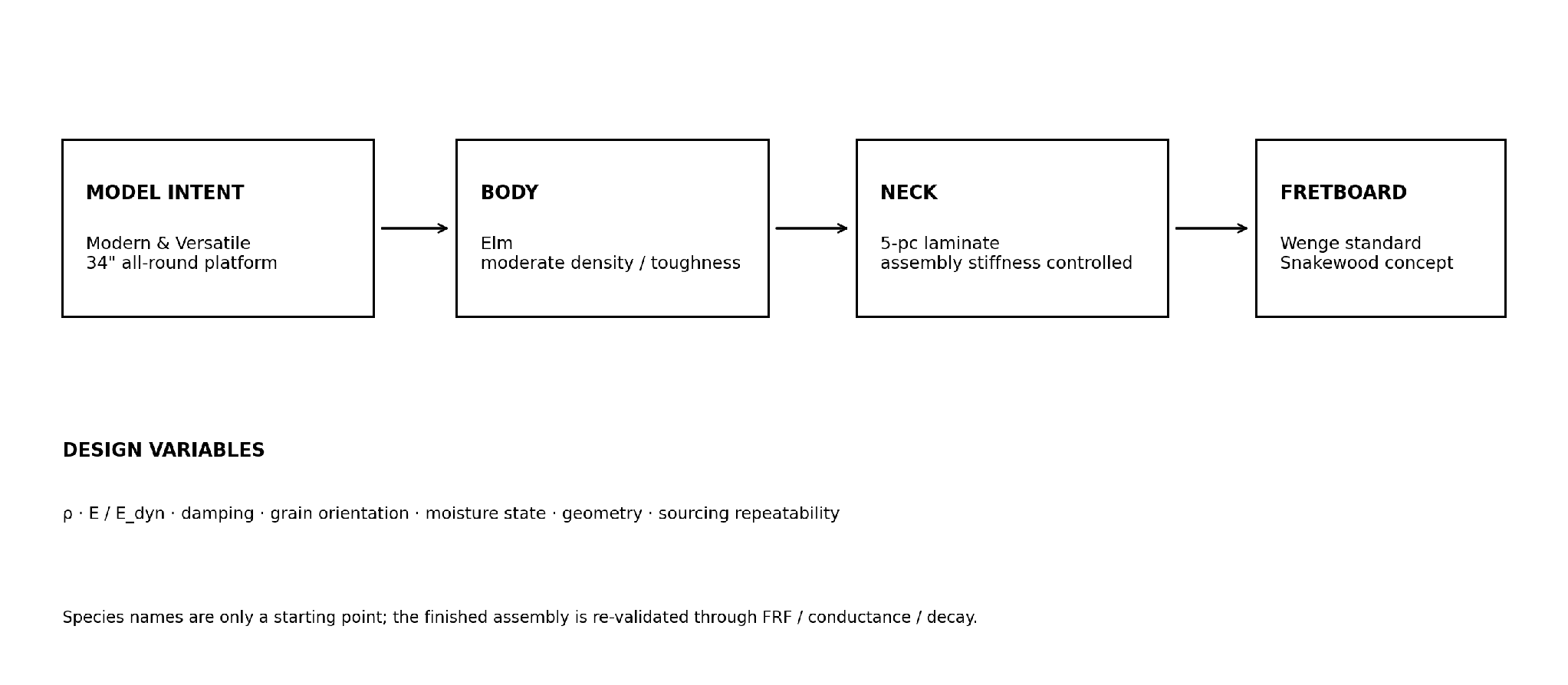
The goal is not a fixed “tone” assigned to a species. In the body, the target is sufficient toughness and structural consistency without pushing mass and stiffness to extremes. In the neck, lamination is used first to control stiffness and warping variables. At the fingerboard, a comparatively stiff and hard material is deliberately left as an active outer-layer variable of the neck assembly. This division follows the conclusion of Research Log 01 [R2].
Core viewpoint |
Figure 1. Decision structure for EMBLA material selection. RavenForge internal design framework · based on Material & Acoustics Research Log 01 |
1.1 The Link Between the Name and Elm Is a Design Narrative, Not a Proof
The etymology of Embla, the first woman in Norse mythology, is not settled. Academic literature presents derivation from Old Norse almr (“elm”) as one plausible interpretation, but alternatives involving a vine or two pieces of fire-making wood have also been proposed [1]. “Embla = elm” therefore should not be presented as a linguistic fact.
Connecting the model name with the standard body material nevertheless has value as design narrative. As long as that narrative does not conflict with the mechanical requirements, Elm can serve both EMBLA’s visual/mythological identity and an engineering role.
2. Body — Why Elm Is the EMBLA Baseline
The current configurator specifies a 3-piece solid EMBLA body, with Elm used both for the center tone block and the side wings [R1]. The standard is therefore not “an Elm core with lighter wings,” but a three-piece construction in one species that allows width, defect selection, and machining to be managed. Alder, Limba, Zelkova, and other woods remain custom variables rather than EMBLA’s default identity.
2.1 Elm Occupies a Useful Middle Ground as a Structural Wood
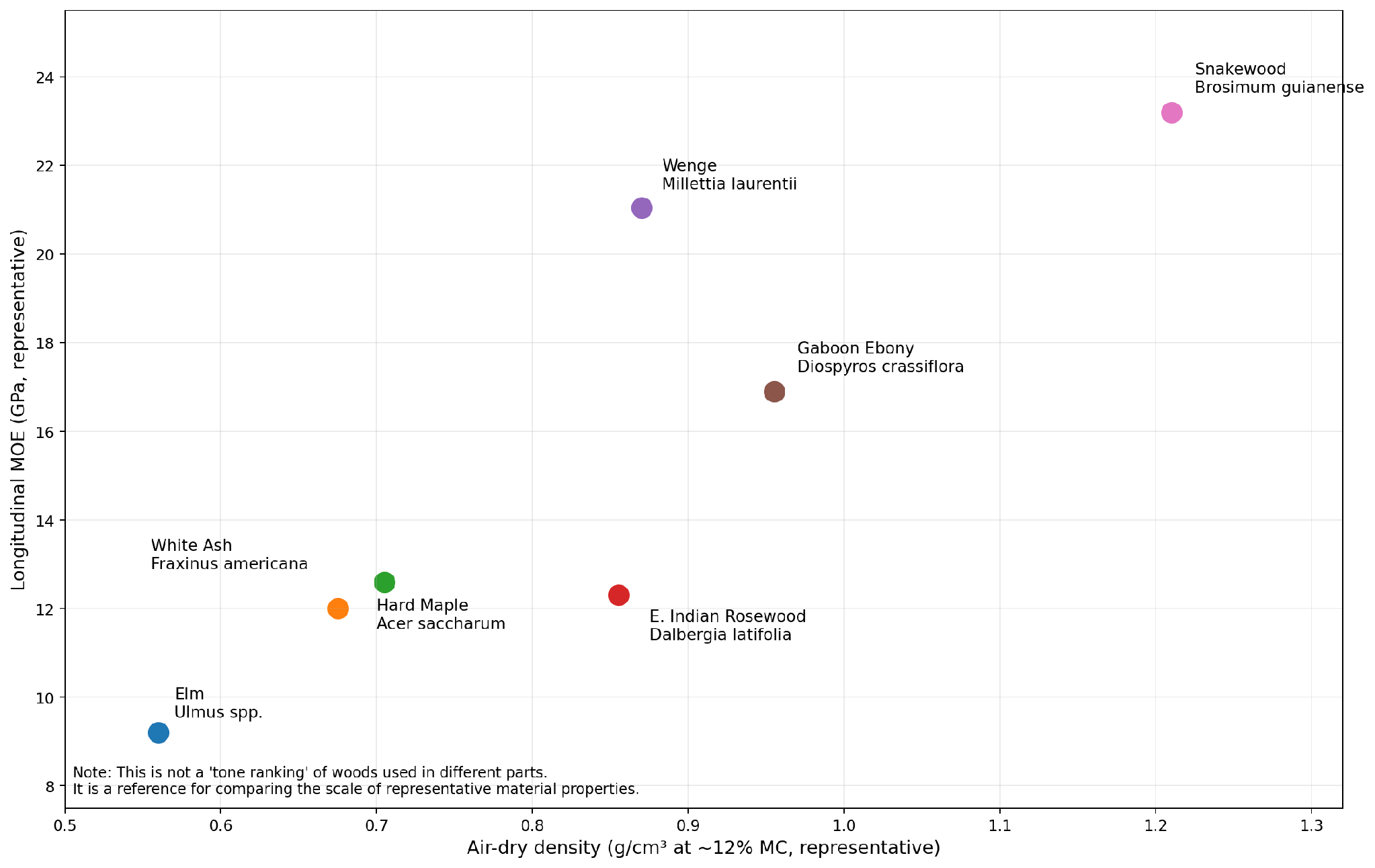
Ulmus spp. vary substantially by species, but USDA Forest Products Laboratory data place air-dry specific gravity roughly in the 0.50–0.66 range and MOE around 9.2–11.4 GPa. American elm is approximately 0.50 specific gravity with an MOE near 9.2 GPa, while rock/winged elm are denser and stiffer [2]. Elm is also described as difficult to split because of interlocked grain, with useful bending and shock resistance [2].
For EMBLA this creates a useful non-extreme baseline. It does not push total body mass and stiffness as high as Maple or some dense tropical woods, nor does it deliberately chase an exceptionally light body that would strongly shift the bridge-side boundary condition. This is not a claim that Elm guarantees any frequency-domain “tone”; it describes a practical range of density, stiffness, and toughness.
Figure 2. Representative density–MOE scale for EMBLA baseline materials, priority candidates, and comparison woods. Elm/Ash/Maple: USDA FPL + technical cross-check [2,12] · East Indian Rosewood/Gaboon Ebony: [12] · Wenge: CIRAD/ITTO [5] · Snakewood: Wagenführ et al. [3]. Cross-study representative values; not a tonal ranking. |
2.2 “Elm” Alone Is Not a Sufficient Production Specification
The exact Ulmus species, growth conditions, and moisture state of the stock currently on hand must be established at the blank level. Dry specific gravity and MOE vary widely even within Ulmus, and anisotropy and shrinkage depend on species and grain orientation [2]. The BOM therefore should not stop at “Elm”: at minimum it should record moisture content (MC), mass, dimensions, estimated density, grain/runout, visible defects, and acclimation history.
Design rule |
3. Fingerboard — The Original First-Choice Candidate Was Snakewood
When EMBLA’s fingerboard concept was first developed, the first-choice material was not Wenge but Snakewood, Brosimum guianense. The reason was not simply its rare figure. For a fingerboard — a thin layer located far from the neutral axis of the neck assembly — Snakewood can provide exceptionally high stiffness, density, and hardness.
Wagenführ et al. reported Snakewood heartwood at 12% MC with density around 1.1–1.4 g/cm³, bending strength of 241 MPa, MOE of 23.2 GPa, and hardness of 196 N/mm² [3]. In Brémaud et al.’s comparison of 98 wood types, Snakewood also had the highest specific gravity in the sample, about 1.31 [4]. These figures do not directly predict a “bright sound,” but they clearly indicate a material-property scale capable of materially changing neck-assembly bending stiffness, modal mass, and local contact stiffness at equal fingerboard thickness.
From the composite-beam viewpoint established in Research Log 01, the important variables are not the species name but E, ρ, damping, fingerboard thickness, and distance from the neutral axis. Snakewood was therefore selected for EMBLA not as a “high-restitution fingerboard,” but as a design hypothesis for a high-density, high-stiffness outer layer [R2].
3.1 Why It Did Not Become the Standard — Procurement Is Also a Design Variable
It would be inaccurate to say that “Snakewood cannot be used because it is CITES-listed.” Brosimum guianense is currently identified as non-CITES, and the IUCN assessment linked through Kew lists it as Least Concern (LC) [6,7]. International procurement is nevertheless not simple.
Guyana has repeatedly used National Log Export Policies to restrict raw-log exports of high-value or scarce species. Under the 2020–2025 3rd Phase policy, Letterwood/Snakewood remained in Schedule A and was subject to a 20% log-export levy for 2020–2023 and 22% for 2024–2025. The policy explicitly sought to limit raw-log exports of premium species and encourage domestic value-added processing [8]. Public materials associated with earlier policy phases also repeatedly discussed proposed log-form bans and other strong restrictions involving Snakewood, which helps explain why the market often uses the shorthand “export ban” [9].
What cannot be supported is a blanket claim that every form of Brosimum guianense is globally prohibited from export in 2026. The real problem is that practical availability can change sharply with country of origin, processing state, permits, phytosanitary requirements, and policy period. The most recent core public policy document located from the Guyana Forestry Commission is the 2020–2025 3rd Phase; this review did not identify a clearly documented 2026 successor policy. RavenForge therefore classifies Snakewood not as “legally unusable,” but as a material whose supply and documentation are too difficult to reproduce for standard production.
Period | Verified status | Design implication |
2016–2020 | Restrictive policy phase; public trade summaries discussed full-ban proposals for Snakewood logs | Do not treat raw-log supply as stable |
2020–2025 | GFC Schedule A: Snakewood log export levy 20% → 22% | Strong incentive toward local processing / value-added stock |
2026 review | No clear successor policy verified in sources reviewed | Re-check origin-country rules for each purchase |
Revised decision |
4. Wenge — Not Merely a Second Choice, but a Production-Ready Standard
Wenge is the current standard EMBLA fingerboard, with Rosewood retained as a recommended alternative [R1]. The move to Wenge was not because it perfectly reproduces Snakewood’s properties, but because it offers a more workable balance of high stiffness and hardness with fingerboard-sized stock that can realistically be obtained.
CIRAD/ITTO data list Wenge (Millettia laurentii) at an average air-dry density of about 0.87 g/cm³ and longitudinal MOE of about 21.05 GPa [5]. Its density is lower than Snakewood, but it still occupies a high stiffness/density region compared with many temperate hardwood fingerboard candidates. For EMBLA, the more precise description is not “fast tone,” but a material capable of providing substantial outer-layer stiffness while being available in more practical dimensions than Snakewood.
4.1 Wenge Is Not Automatically the Sustainability-Safe Alternative
Replacing the Snakewood procurement problem with Wenge does not make the choice automatically superior from a sustainability standpoint. CITES materials discuss Millettia laurentii as a non-CITES species that can be traded under rosewood-related commercial names, while conservation sources have assessed it as IUCN Endangered and identify over-exploitation as a major threat [10,11].
Accordingly, EMBLA’s standard Wenge should not mean “use any available stock.” Priority should be given to stock whose origin and legal supply chain can be verified. Where possible, FSC/PEFC or equivalent chain-of-custody documentation should be retained. If provenance is inadequate, another fingerboard wood such as Rosewood or Ebony should be used, with the exact botanical species recorded in the BOM. “Rosewood” as a trade name alone is insufficient both for CITES compliance and for material-property tracking.
4.2 Why Ebony Is Not the Default
Ebony is a fully reasonable option, but it was not locked in as EMBLA’s default. First, EMBLA is not a model whose goal is simply to maximize surface stiffness in the way an aggressively optimized ASKR variant might. Second, fingerboard material can shift neck modal response and dead-spot distribution, so “harder is always better” is not an adequate rule [R2]. Third, conservation and trade requirements vary strongly by species, making species-specific sourcing necessary.
Candidate | Mechanical intent | Procurement / compliance | EMBLA position |
Snakewood | Very high density / stiffness / hardness | Source-country policy risk; irregular stock | Concept-first / special request |
Wenge | High stiffness + workable fingerboard stock | Traceability required; conservation concern | Current standard |
Rosewood | Moderate alternative; species-dependent | Botanical species must be declared | Recommended alternative |
Ebony | High-hardness alternative | Species/source-dependent compliance | Optional |
5. Neck — Why a 5-Piece Ash / Maple / Wenge Laminate?
The current configurator specifies a 5-piece laminated neck as standard for EMBLA and ASKR, using an Ash / Maple / Wenge material family [R1]. The key point is not that “five pieces are automatically stronger than one.” If material E and overall section are unchanged, merely cutting a member into several strips and re-gluing it does not automatically increase EI [R2].
The advantage of lamination is the ability to manage blank variability. Grain/runout, density, resonance proxy, and moisture state can be screened lamella by lamella; left/right mass and stiffness distribution can be balanced; and defective stock can be rejected at a smaller scale. Because EMBLA is a 34-inch all-rounder, a 5-piece layout is used as the structural baseline rather than making 7/9/13-piece construction standard and adding mass and process complexity before measurements justify it.
Ash / Maple / Wenge are grouped as a material family not because each species is assigned a separate “tone role.” Maple and Ash are comparatively obtainable structural woods for which machining and lamella-pairing criteria can be developed, while Wenge can serve as a dense/stiff stripe or reinforcing member. Exact lamella order and width should still be set from measured blanks and the final stiffness target.
Design rule |
5.1 The Fingerboard and Neck Must Not Be Evaluated Separately
When a Wenge fingerboard is bonded to a 5-piece neck that also contains Wenge lamellae, the mass and stiffness of the completed neck assembly are governed by bonding position and section geometry, not by a simple count of species. Statements such as “Wenge appears twice, so the neck will be too bright” have no mechanical basis. The relevant values are the finished neck’s modal frequencies, damping, driving-point conductance, and fret-by-fret string decay [R2].
6. Top Wood — Matching Is the Baseline; Figured Tops Are Independent Variables
The current configurator does not require a separate top: “standard / matching top” is the baseline, while figured Elm is offered as an EMBLA-specific option. Flame/Quilted Maple, Wenge, Walnut, and other woods can also be selected as veneer or cap [R1]. This does not mean the top is assumed acoustically irrelevant.
A thin veneer can be treated mainly as an aesthetic variable, but a cap several millimeters thick can contribute to upper-body mass and bending stiffness and therefore may alter the body FRF. Cap builds should consequently be recorded as separate structural variants. Until A/B data exist, traditional claims such as “a Flame Maple cap adds highs” are deliberately avoided.
7. EMBLA #002 — How Should a Prototype That Differs from the Current Standard Be Interpreted?
The existing EMBLA #002 custom quote records a 2-piece Elm body, Flame Maple cap, Rosewood fingerboard, and a 5-piece Maple neck with a Wenge stripe [R4]. This differs from the current “3-piece Elm / Wenge” standard. Rather than treating that difference as a design contradiction, it is more useful to regard #002 as a comparable prototype variant created before the current material hypothesis was fixed.
Once #002 is completed, it will create several items that can be compared directly with a standard Elm/Wenge EMBLA using the same metrics. Because the complete geometry and hardware are not perfectly identical, this will not be a strict single-variable A/B test; however, measuring body mass, bridge/neck FRF, string decay, dead spots, and player response under the same protocol can provide empirical evidence for revisiting the default material choices.
Item | Current EMBLA standard | EMBLA #002 custom build | Research use |
Body | 3-pc Elm / Elm | 2-pc Elm | mass / body-mode comparison |
Top | matching / none | Flame Maple cap | cap contribution candidate |
Fingerboard | Wenge | Rosewood | neck-assembly response comparison |
Neck | 5-pc Ash/Maple/Wenge family | 5-pc Maple/Wenge stripe | architecture-family comparison |
7.1 Separate “Why It Was Chosen” from “What It Proved”
This document explains the design rationale for selecting these materials; it is not a result report claiming that the selection has already produced a better sound. The measured properties of Elm, Wenge, and Snakewood help narrow the candidates, but the actual decay and spectrum of a completed instrument with RavenForge geometry and hardware remain hypotheses until prototype measurement.
8. Evidence Matrix — What Can We Currently Say?
Claim | Assessment | Evidence | RavenForge wording |
Elm is a moderate-density, tough body material | Supported | USDA species data | Use as mechanical baseline; measure each blank |
Elm guarantees a “balanced tone” | Not supported | — | Do not claim |
Snakewood offers extreme stiffness/density for a fingerboard | Supported | Peer-reviewed mechanical data | High-E / high-ρ outer-layer hypothesis |
Snakewood is currently globally banned from export | Not established | Policy varies by origin/form | Describe source-country restrictions precisely |
Wenge is a practical high-stiffness standard fingerboard | Conditionally supported | CIRAD/ITTO + stock availability | Use with traceable sourcing |
Wenge is environmentally risk-free | Not supported | IUCN Endangered history | Require legality / provenance |
5-pc laminate is automatically stiffer than 1-pc | Not generalizable | Beam mechanics | Benefit is variability management |
9. Prototype Validation — What EMBLA Will Actually Measure
Applying the measurement framework from Research Log 01 turns material choice into a data chain from raw blank to completed instrument rather than a species-name checklist. This is particularly important because Elm varies substantially by species and specimen, while the high densities of Wenge and Snakewood make even small dimensional differences relevant to neck mass.
Stage | Measure | Why |
Elm blank | MC, mass, dimensions, density proxy, grain/runout | Reject unstable or outlier stock before machining |
3-pc body blank | mass, tap / impact FRF before & after glue-up | Observe assembly shift |
Neck lamella | MC, mass, resonance proxy, grain orientation | Pair lamellae; document asymmetry |
Glued 5-pc neck | bow, twist, mass, modal frequencies | Check whether lamination met target |
Fingerboard | species, thickness, mass, density proxy, provenance | Mechanical + sourcing record |
Finished neck | FRF, relief, damping estimate | Cumulative effect of machining / rod / board |
Assembled bass | neck/bridge conductance by fret | Locate structural resonances / dead spots |
String test | partial decay, T60, pickup DI spectrum | Connect mechanics to electrical output |
RH cycle | MC, relief, bow/twist, modal shift | Long-term reliability |
9.1 Conditions Under Which Snakewood Could Return
Snakewood does not need to be abandoned entirely. It can return as a special-build or experimental fingerboard only when all of the following are satisfied: (1) botanical identification as Brosimum guianense; (2) documented origin and legal harvest/export/re-export path; (3) processed stock compliant with the current rules of the origin country rather than raw log material; (4) sufficient acclimation of the fingerboard blank to manage cracking and warping risk; and (5) measurements that can be compared with the standard Wenge neck.
10. Current Conclusion — EMBLA Material Selection Translates “Balance” into Measurable Properties
Elm is not EMBLA’s standard body because RavenForge assumes an “Elm warm tone.” It is used because the Ulmus family offers a useful middle range of density and stiffness, good toughness, and practical selection advantages in a 3-piece construction, while also connecting coherently to the model’s mythological identity.
Snakewood remains mechanically attractive as the original first-choice fingerboard candidate. But a standard-production material needs more than good properties: usable dimensions, legal provenance, export-policy stability, and the ability to purchase comparable stock again over time all matter. Under those constraints Wenge became the current production standard, while Wenge itself still requires active management of traceability and conservation concerns.
The 5-piece Ash / Maple / Wenge neck is not decorative “laminate tone.” It is a manufacturing method for controlling neck-assembly variability. For EMBLA’s material philosophy to become more than a defensible hypothesis, it must ultimately return to measurements of FRF, conductance, decay, and long-term stability on completed prototypes.
Current design position |
References
[1] Bagge, S. (2008). H. M. Chadwick Memorial Lectures 18. Discussion of Askr / Embla tree-name etymology; Embla–elm remains a disputed possibility.
[2] USDA Forest Products Laboratory. Hardwood technical sheets for Ulmus spp. (Elm), Fraxinus spp. (Ash), and Acer spp. (Maple): specific gravity, MOE, strength, shrinkage, and working properties.
[3] Wagenführ, A. et al. (2007). Chemical, anatomical and technological properties of Snakewood [Brosimum guianense (Aubl.) Huber]. Wood Science and Technology 41:673–686. DOI: 10.1007/s00226-007-0149-2.
[4] Brémaud, I. et al. (2012). Characterisation and categorisation of the diversity in viscoelastic vibrational properties between 98 wood types. Annals of Forest Science 69:373–386. DOI: 10.1007/s13595-011-0166-z.
[5] CIRAD / ITTO Tropix. Wenge (Millettia laurentii): air-dry density ~0.87; longitudinal MOE ~21.05 GPa; mechanical and technological properties.
[6] Richter, H.G.; Dallwitz, M.J. Commercial timbers — Brosimum guianense. CITES status: not protected; density data and nomenclature.
[7] Royal Botanic Gardens, Kew — Plants of the World Online. Brosimum guianense: IUCN category LC (linked 2021 assessment).
[8] Guyana Forestry Commission (2020). Revised National Log Export Policy — 3rd Phase 2020–2025. Schedule A lists Letterwood / Snakewood at 20% levy (2020–23) and 22% (2024–25); policy aims to limit premium-species log export.
[9] Guyana Forestry Commission. National Log Export Policy public-participation archive and earlier policy phases; log export bans/restrictions used to promote conservation and local value-added processing.
[10] CITES Plants Committee / rosewood-trade background documents. Millettia laurentii is discussed among non-CITES-listed species traded under rosewood-related commercial names.
[11] CITES regional background information on Bubinga / Wenge; Millettia laurentii reported as IUCN Endangered and threatened by over-exploitation.
[12] Meier, E. The Wood Database — species data pages used as a cross-check for representative air-dry density and MOE: American Elm, White Ash, Hard Maple, East Indian Rosewood, Gaboon Ebony, Wenge, and Snakewood. Accessed 2026-09-01.
[R1] RavenForge Bass Configurator — current internal revision, 2026-08-31. EMBLA: Modern & Versatile; 3-pc Elm body, 5-pc Ash/Maple/Wenge neck, Wenge standard fretboard.
[R2] RavenForge / Material & Acoustics Research Log 01 (2026-09-01). Tonewood as a Structural Variable.
[R3] RavenForge portfolio / concept model notes. EMBLA: all-round session / composer platform; 34-inch base scale.
[R4] RavenForge EMBLA #002 custom quote — internal build specification. 2-pc Elm body, Flame Maple cap, Rosewood fingerboard, 5-pc Maple neck + Wenge stripe.
Source-status note |
Working research document · 2026.09.02