RAVENFORGE / MATERIAL & ACOUSTICS RESEARCH LOG
RAVENFORGE
Material & Acoustics Research Log
Tonewood as a Structural Variable
Fingerboard / Body / Neck — mechanical coupling, material properties and design implications
Document Purpose Re-examine claims that wood influences the sound of solid-body electric guitars and basses as a problem of material properties and structural dynamics rather than species-centered “tonewood” descriptions. The review focuses on fingerboard properties, the relative roles of body and neck, and the practical advantages and limitations of laminated necks, linking published evidence to lutherie decisions and defining measurements to be verified directly on RavenForge prototypes. |
Projects | RavenForge electric guitar / bass platforms |
Focus | Fingerboard mechanics, body–neck coupling, damping, modal response, laminated neck stability |
Evidence | Peer-reviewed acoustics / wood-science literature + controlled guitar experiments |
Status | Literature framework established · prototype validation pending |
1. Research Question — What Should “Tonewood” Describe?
Early design notes placed the practical priority of wood selection roughly at “fingerboard > body > neck.” The term “coefficient of restitution” was also used to describe the fast response associated with a fingerboard. Taken literally, however, these statements mix two different levels of analysis: the acoustic influence of a component in the complete instrument, and the extent to which a maker deliberately leaves material properties as active design variables.
The purpose of this review is not to force the literature to confirm an existing conclusion, but to separate what can be retained from what must be revised. In particular, claims such as “the body is always more important than the neck” or “a fingerboard with a higher coefficient of restitution produces a better attack” are difficult to defend from the current literature.
Key Perspective Tonewood is not a species label. It is a set of mechanical properties embedded in a coupled structure. |
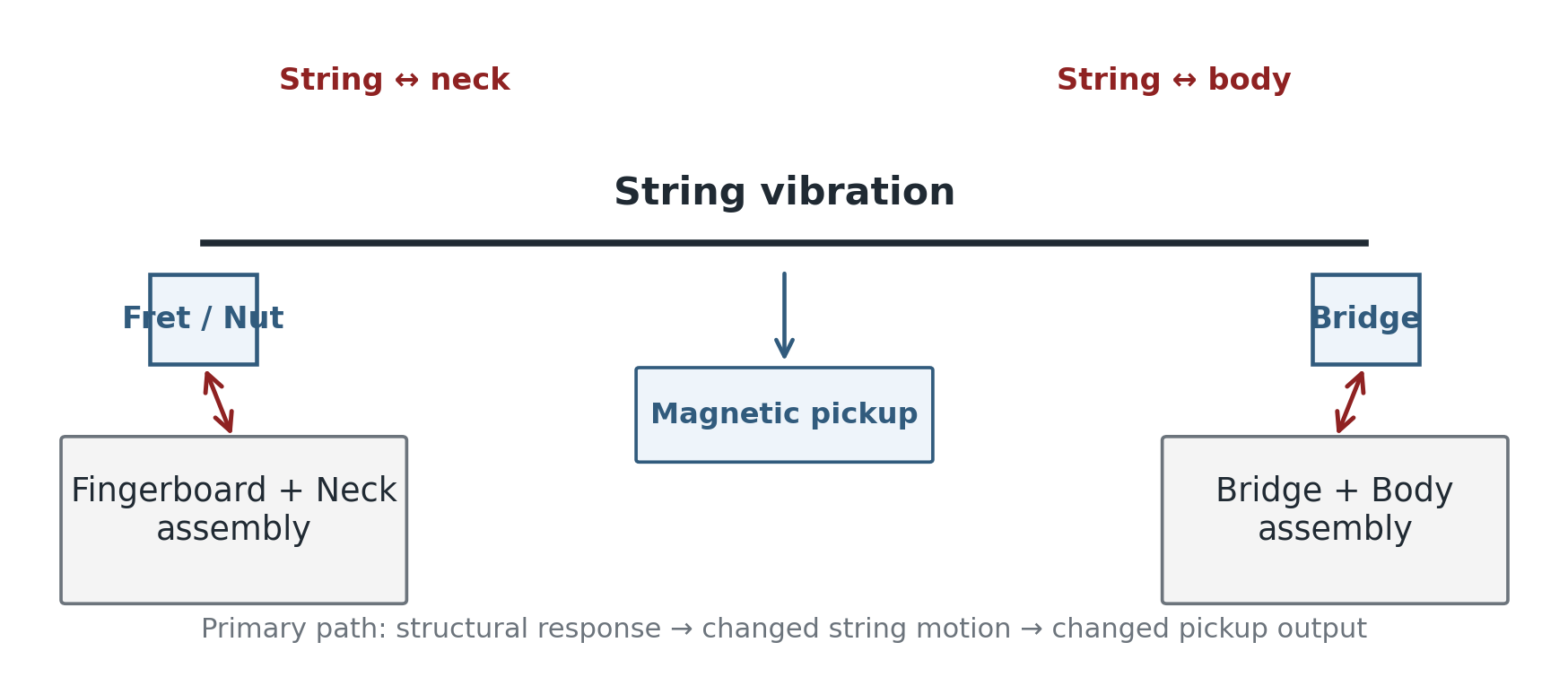
Figure 1. Primary mechanical path through which wooden structures can influence the final electrical output of a solid-body electric instrument.
RavenForge schematic · literature framework based on Fleischer (1999), Paté et al. (2014)
An electromagnetic pickup converts string motion into an electrical signal. Therefore, if wood affects the sound of an electric guitar, the primary path is not that the wood directly radiates the amplified sound; rather, the string exchanges energy with the instrument structure through the fret/nut and bridge, changing the motion of the string itself, and that altered motion appears in the pickup output [1,2].
2. String–Structure Coupling: Mechanical Admittance and Decay
How strongly a structure moves when a force is applied at a given point can be described by its driving-point admittance. In the frequency domain, Y(ω)=V(ω)/F(ω), and its real part, the conductance G(ω)=Re{Y(ω)}, is directly related to energy transferred into and dissipated by the structure at that frequency.
Paté, Le Carrou, and Fabre modeled the decay of a solid-body electric-guitar string as the combination of the string’s intrinsic damping and additional damping caused by mechanical coupling to the neck, and used measured guitar data to predict decay time [2]. Fleischer likewise observed a clear inverse relationship between neck mechanical conductance and string decay time at dead spots [1].
Design rule Do not begin by assuming a fixed “bright/dark” character for a species. Determine where a string partial overlaps a structural mode of the completed instrument and how large the conductance is at the coupling point. |
This model separates the proposition that material differences can exist from the much stronger proposition that outcomes can be predicted from a species name alone. Wood is one input that can alter structural modes, but the final modal frequencies and damping are properties of the complete assembly, including geometry, mass distribution, joints, hardware, truss rod, and reinforcement.
3. Fingerboard — Dynamic Properties of the Composite Neck, Not Restitution Alone
3.1 The Fingerboard Is Not Merely a Surface Layer
For a fretted note, the string’s endpoint force is transmitted through the metal fret into the fingerboard and neck. If the adhesive bond is sufficiently stiff and the parts act together within the small-deformation range, the fingerboard and neck can be approximated as a bonded composite beam. The relevant quantity is not only the Young’s modulus E of each layer, but also the layer’s distance from the neutral axis.
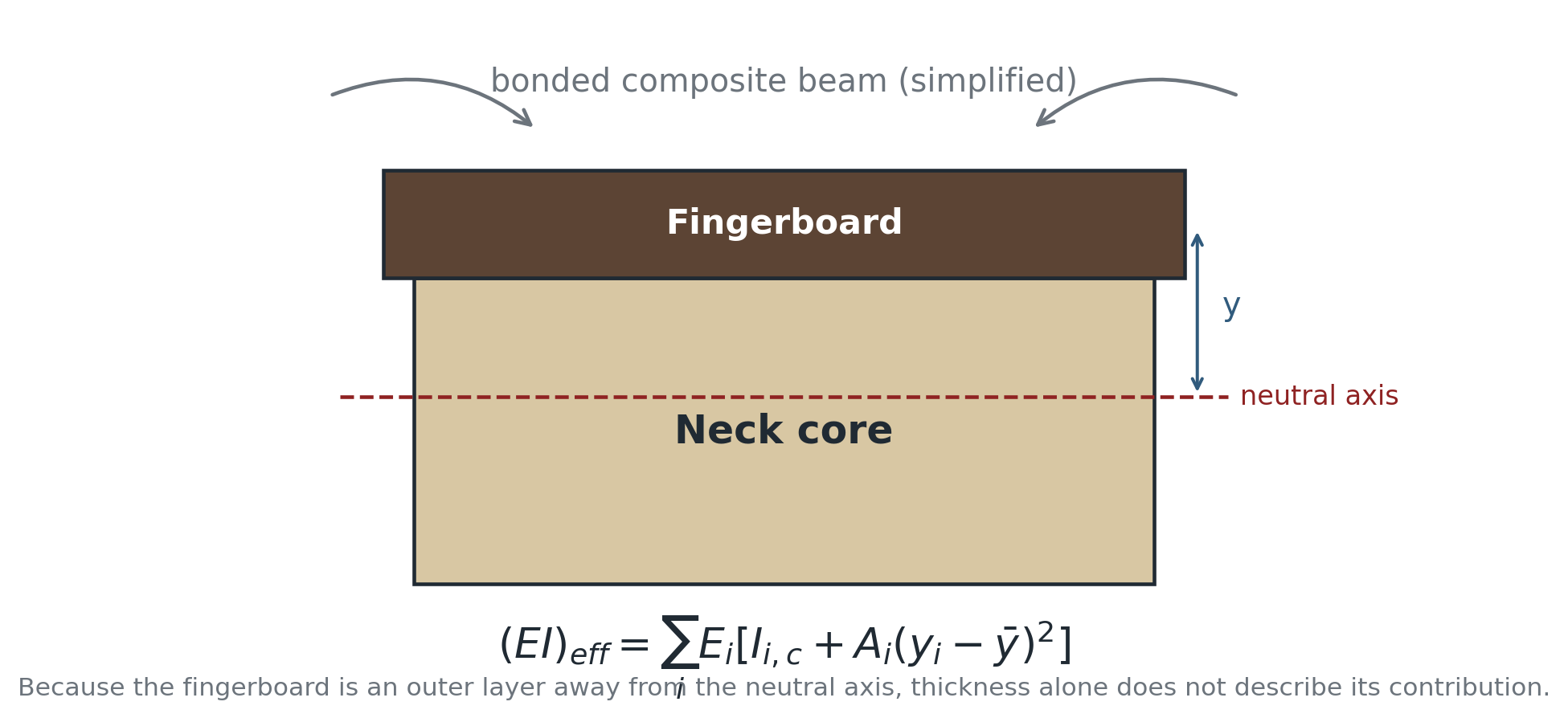
Figure 2. Simplified composite-beam model of the fingerboard and neck. Because the fingerboard is an outer layer away from the neutral axis, it can contribute to bending stiffness even when relatively thin.
RavenForge schematic · elementary composite-beam mechanics
The effective bending stiffness of a composite section can be represented conceptually as ΣEᵢ[Iᵢ,c + Aᵢ(yᵢ−ȳ)²]. Therefore, the fingerboard’s contribution cannot be judged only by asking what percentage of total neck thickness it occupies. Because it lies on the outside of the section, differences in E, density, and damping can alter the modes and mobility of the completed neck assembly.
Studies of the vibrational properties of wood repeatedly use dynamic Young’s modulus, specific dynamic modulus E′/ρ, loss tangent tanδ, shear modulus, and anisotropy as key descriptors [3–5]. These quantities are not formulas that directly predict the tone of a particular electric guitar, but they describe how a material stores and dissipates vibrational energy more directly than a coefficient of restitution does.
3.2 Why the Coefficient of Restitution Is Not a Primary Metric
The coefficient of restitution (COR) is a collision-system metric defined by the ratio of relative velocities before and after impact. Its value depends on the pair of contacting bodies, impact speed, surface condition, and contact deformation. A fretted string in normal playing, however, is not a simple object that repeatedly collides with and rebounds from the wooden fingerboard; it vibrates continuously with the fret as its endpoint and is coupled to the bonded fingerboard–neck structure.
This literature review found no peer-reviewed experimental evidence validating fingerboard COR as a primary predictor of electric-guitar attack, sustain, or spectrum. RavenForge therefore treats COR only as a secondary intuition for local impact behavior. Design records instead prioritize E_dyn, ρ, E/ρ, tanδ or modal damping, and the FRF/admittance of the completed assembly.
Revised assumption 01 The direct link “higher fingerboard COR = faster attack” is insufficiently supported. |
3.3 Direct Comparison: Ebony vs. Rosewood
Paté et al. built two guitars based on a Gibson Les Paul Junior DC-type specification and intentionally limited the principal changed lutherie parameter to the fingerboard material (ebony / rosewood) [6]. The measured fingerboard specimens were approximately ρ≈1180 kg/m³ and longitudinal E≈30.2 GPa for ebony, versus ρ≈751 kg/m³ and E≈23.0 GPa for rosewood. The authors nevertheless noted that the handmade process and natural wood variability prevented complete elimination of small differences outside the fingerboard.
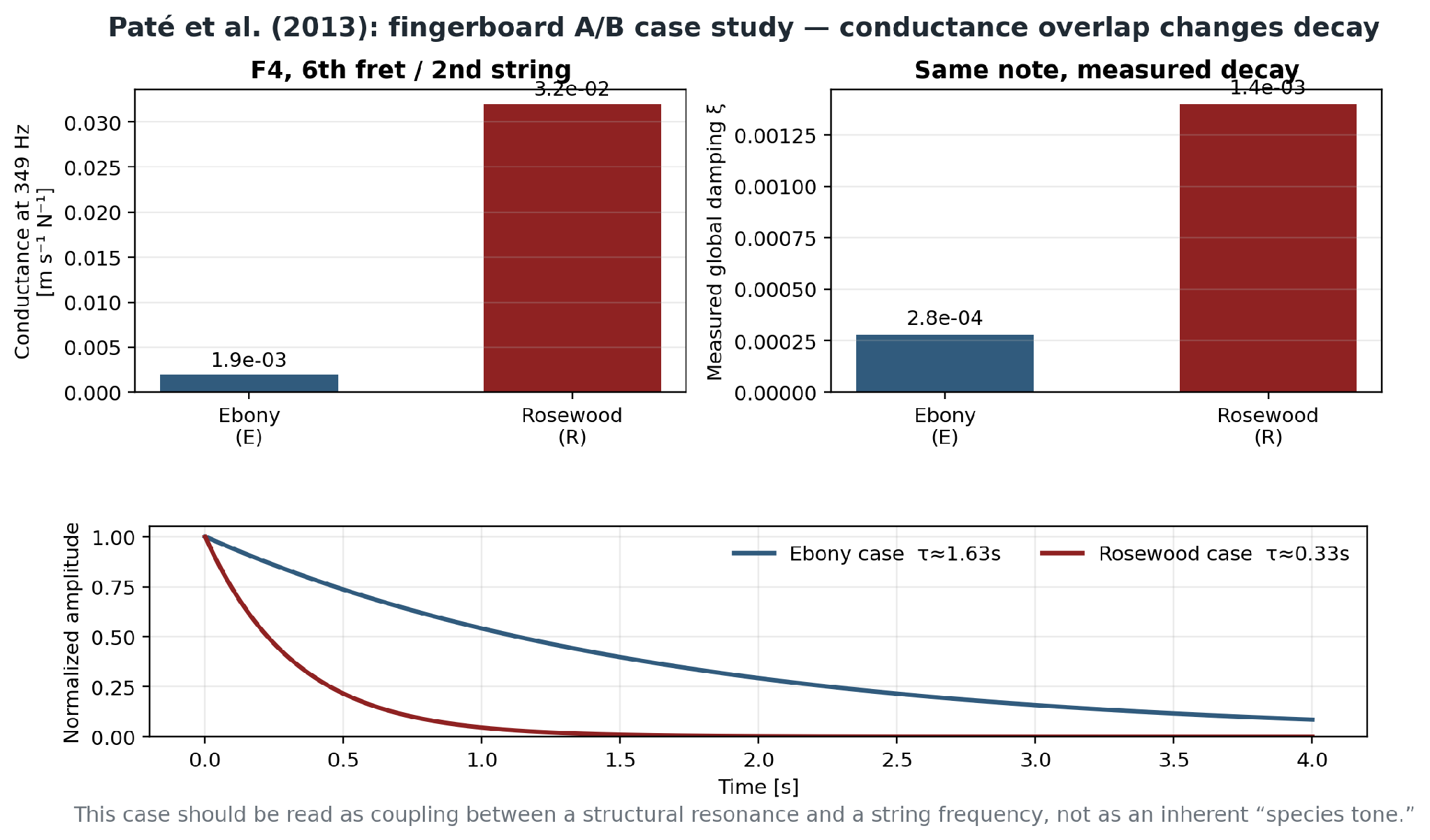
Figure 3. Redrawn F4 case from Paté et al. (2013). At the same position and note, a difference in conductance corresponded to a difference in damping.
Data redrawn from Paté, Le Carrou & Fabre, SMAC 2013 [6]
For F4 (349 Hz, 6th fret on the 2nd string), the ebony-fingerboard guitar showed a conductance of about 1.9×10⁻³ m·s⁻¹·N⁻¹, while the rosewood-fingerboard guitar showed about 3.2×10⁻² m·s⁻¹·N⁻¹; measured global damping was approximately 2.8×10⁻⁴ and 1.4×10⁻³, respectively [6]. The important point is not that “rosewood itself kills sustain,” but that the structural resonance of each guitar overlapped the string frequency differently.
In the 2015 perceptual study, ebony and rosewood did not separate cleanly into two groups in a free-sorting task based only on recordings. When guitarists directly played and evaluated the instruments, however, PRECISION emerged as the clearest differentiating descriptor, with ATTACK and BALANCE also showing some relevance. Notably, SUSTAIN was not the most prominent evaluation criterion [7].
Design rule Do not record fingerboard materials as “ebony = bright, rosewood = warm.” Record blank density, dynamic stiffness, damping, and fingerboard thickness, then verify how the modal response of the completed neck assembly changes. |
4. Body — A Large Structure That Changes the Bridge-Side Boundary Condition
The body can be described using the same mechanical-coupling model. One end of the string terminates at the bridge, and the bridge is coupled to the body. Changes in body mass, directional elastic moduli, internal damping, and geometry can change the bridge-side mechanical impedance/admittance and the structural modes of the complete instrument.
4.1 Controlled Ash vs. Walnut Body Study
Ray, Kaljun, and Straže compared ash and walnut bodies by alternately attaching the same hard-maple composite neck to two rectangular solid bodies [8]. Sharing the neck and major electronics/hardware is a strength of the design, but the study is limited by having only one body specimen per species, using a geometry unlike a normal playable body, and focusing mainly on open-string tests.
Item | Ash body | Walnut body | Interpretation Note |
Longitudinal E_L | 17.22 GPa | 8.63 GPa | Values of the specific specimens used |
1st modal frequency | 118.0 Hz | 108.2 Hz | Whole-instrument average |
2nd modal frequency | 203.1 Hz | 200.6 Hz | Difference is small |
3rd modal frequency | 438.0 Hz | 419.2 Hz | Whole-instrument average |
Body damping tanδ (mode 1) | 0.093 | 0.121 | Higher for walnut |
Body damping tanδ (mode 2) | 0.053 | 0.073 | Higher for walnut |
Body damping tanδ (mode 3) | 0.022 | 0.026 | Higher for walnut |
These results provide a direct example of body material changing modal frequencies and damping in the completed instrument. They do not justify generalizations such as “ash has better sustain” or “the body has more influence than the neck.” The study’s peer-review discussion also identified sample size, body geometry, player contact during real use, measurement position, and the open-string condition as important limitations.
Revised assumption 02 Do not retain an absolute ranking in which “the body always has a greater tonal influence than the neck.” The body is an important variable in the bridge-side structural response, but which frequencies and notes are most affected depends on the complete modal coupling. |
5. Neck — A Structure to Control First, Not a Structure of Minor Influence
Placing the neck later in the material-selection priority does not mean that its acoustic influence is small. On the contrary, the neck’s role in dead spots and sustain is one of the most directly demonstrated phenomena in solid-body electric instruments.
In Fleischer’s guitar and bass experiments, when the string frequency at a particular fret coincided with a structural resonance of the neck, the string strongly drove the neck and decayed abnormally quickly because of the additional energy loss [1]. Paté et al. likewise used neck conductance to predict string decay [2].
A universal “body > neck” ranking therefore conflicts with the research. At some low- and mid-frequency dead spots the neck can be the dominant path, while under other conditions body/bridge-side modes may matter more. The more physically meaningful question is not which component is always more important, but which structural mode couples to the current note or partial, and how strongly.
Key Perspective RavenForge gives neck species a lower material-selection priority not because the neck is less important, but because it is important enough that its target stiffness and stability are controlled first through architecture, geometry, and reinforcement rather than being left to a species “character.” |
6. Laminated Neck — Bonding Pieces Together Does Not Automatically Make It Stiffer
6.1 Parallel Lamination Does Not Automatically Increase EI
If a blank of the same species, the same E, and the same final cross-section is split longitudinally and then perfectly re-bonded, the theoretical bending stiffness EI does not increase substantially merely because glue lines were introduced. The statement “a 3-piece or 5-piece neck is automatically stiffer than a one-piece neck” is therefore inaccurate.
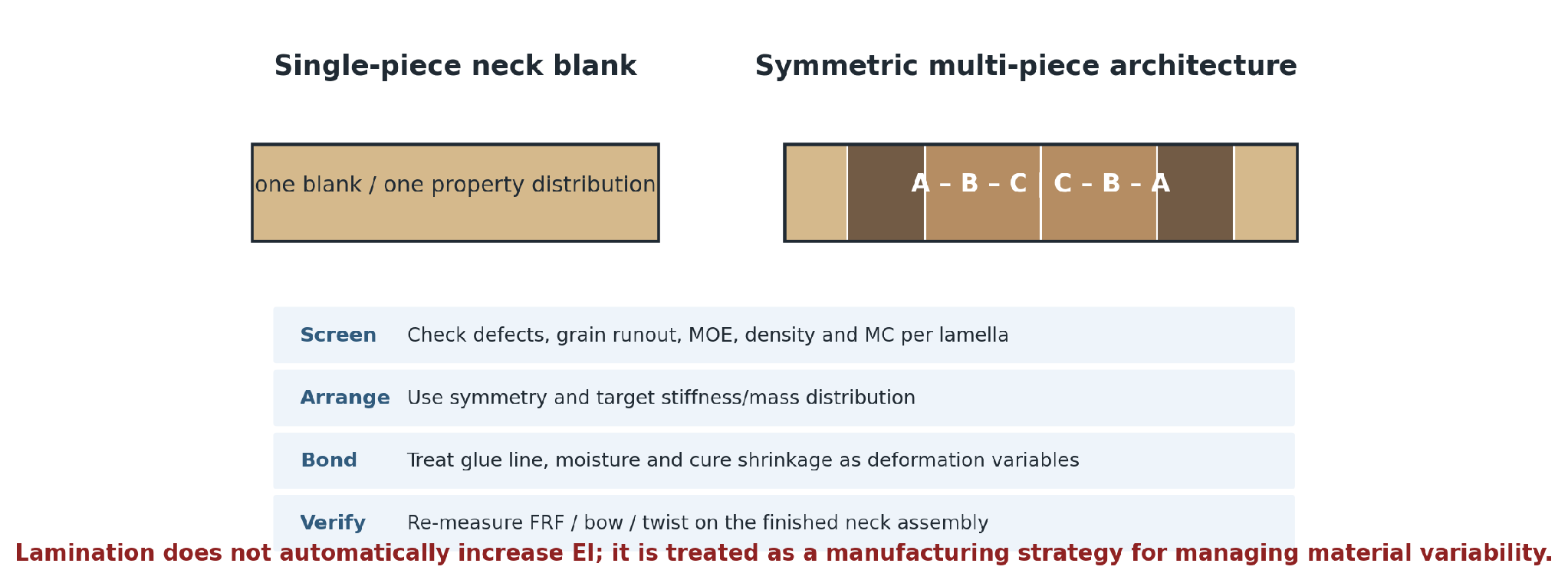
Figure 4. Lamination viewed not as an automatic increase in absolute stiffness, but as a manufacturing architecture that enables material screening, placement, and verification.
RavenForge schematic · wood-lamination literature [9,10]
The practical advantage is that dividing a blank into multiple lamellae allows defects, grain runout, moisture state, density, and MOE to be checked individually, and allows pieces to be arranged symmetrically or combined to target a desired mass and stiffness distribution. Lamination is therefore not a way to eliminate material variability; it is a process that makes that variability more manageable.
6.2 Poorly Matched Lamellae Can Increase Distortion
Research on face-glued structural lumber cannot be transferred directly to guitar necks, but it does demonstrate the importance of lamella pairing. Cook, Ghavidel, and Zhou reported average bow of 2.5 mm and twist of 1.8° when the initial dynamic-MOE difference between the two component planks was 20% or less; when the difference exceeded 20%, bow increased to 6.6 mm and twist to 3.1° [10].
The 20% figure must not be used as a guitar-neck acceptance criterion, because specimen size, species, bonding method, and loading conditions differ. The transferable principle is that arbitrarily bonding lamellae with substantially different behavior does not guarantee stability; pairing should consider stiffness and shrinkage behavior.
Rindler et al. also showed that, in thin wooden bi-layers, adhesive moisture and curing characteristics as well as the rigid/flexible behavior of the bond line can affect warping [9]. This is why the glue line cannot simply be treated as structurally irrelevant in a laminated neck.
Design rule Multi-piece neck ≠ automatic stability. |
6.3 Long-Term Stability: Quarter-Sawn Is Not an Absolute Rule
Chen et al. compared classical-guitar-neck specimens from 17 wood species under long-term string load and changing humidity conditions [11]. Mahogany and cedro showed relatively small and consistent deflection changes, while black walnut and alder were promising among the European-grown candidates. Quarter-sawn specimens tended to be more stable than flat-sawn specimens, but for most species the difference was not statistically significant.
These results reinforce the need to evaluate the actual blank’s moisture behavior and specimen-to-specimen variability rather than rank species as universally best or worst. In a RavenForge design using a truss rod, carbon/titanium reinforcement, and a laminated architecture together, the stiffness, mass, damping, and modal frequencies of the completed neck assembly are more direct design variables than the species name alone.
7. Redefining “Fingerboard > Body > Neck”
The literature does not support Fingerboard > Body > Neck as a universal ranking of acoustic influence. The neck assembly can be a very strong variable at dead spots, and the body can alter the bridge-side modal response. Relative influence depends on frequency, geometry, and coupling conditions.
Within the manufacturing process, however, the priority can be redefined as a statement about how deliberately the intrinsic properties of wood are left as active design variables. RavenForge first constrains the neck body through architecture and reinforcement, and then uses a wider range of material-property choices in the fingerboard and body.
Perspective | Priority / Conclusion | Meaning |
Structural stability | Neck architecture > Fingerboard > Body | Control string load, humidity response, and twist first |
Dead spot / sustain | Prioritize the neck assembly including the fingerboard | Check conductance at the fret position and mode coincidence |
Active material variable | Fingerboard >= Body > Neck species | Species character of the neck core is intentionally constrained |
Universal tonewood influence | No single ranking is defensible | Depends on frequency, structure, and coupling conditions |
Current design position Fingerboard >= Body > Neck species is not a ranking of “which part is heard more.” It is a manufacturing priority for where intrinsic material properties are deliberately left active after neck architecture has been controlled. |
8. Evidence Matrix — What Can We Actually Claim?
Claim | Current Assessment | Evidence Level | Notes |
Structural resonances alter string decay | Supported | High | Conductance–decay model and measurements |
Neck resonances can be a primary cause of dead spots | Supported | High | Measured on guitars/basses |
Changing fingerboard material can alter neck response | Supported | Moderate–High | Purpose-built A/B experiment + industrial samples |
Players can perceive fingerboard differences | Conditionally supported | Moderate | Clearer in direct-playing tasks |
COR predicts fingerboard tone | Insufficient evidence | Low | No direct validation study identified |
Body wood can alter modal response | Supported | Moderate | A/B study exists; sample and geometry limitations |
The body is always more important than the neck | Not supported | — | Conflicts with dead-spot research |
Lamination itself automatically increases EI | Cannot be generalized | — | Not true when section and E are unchanged |
Lamination is useful for managing material variability | Conditionally supported | Moderate–High | Requires appropriate pairing, symmetry, and bond quality |
Quarter-sawn is always more stable | Cannot be generalized | Moderate | Trend exists, but species-specific significance is limited |
Tone can be predicted from species name alone | Insufficient evidence | Low | Assembly effects and specimen variability are large |
Traditional descriptions such as “maple is bright” or “mahogany is warm” may be useful as experiential shorthand, but they should not be presented as scientific rules by which a species name guarantees a particular spectrum or attack. Density, E, damping, and grain orientation vary widely even within a species, and modal-parameter variability has been measured among nominally identical industrially manufactured guitars [12].
9. RavenForge Prototype Measurement Protocol
The literature alone cannot determine which material combinations will produce which outcomes in an actual RavenForge instrument. Prototype development will therefore accumulate measurements along the chain blank → assembly → instrument rather than recording only species names.
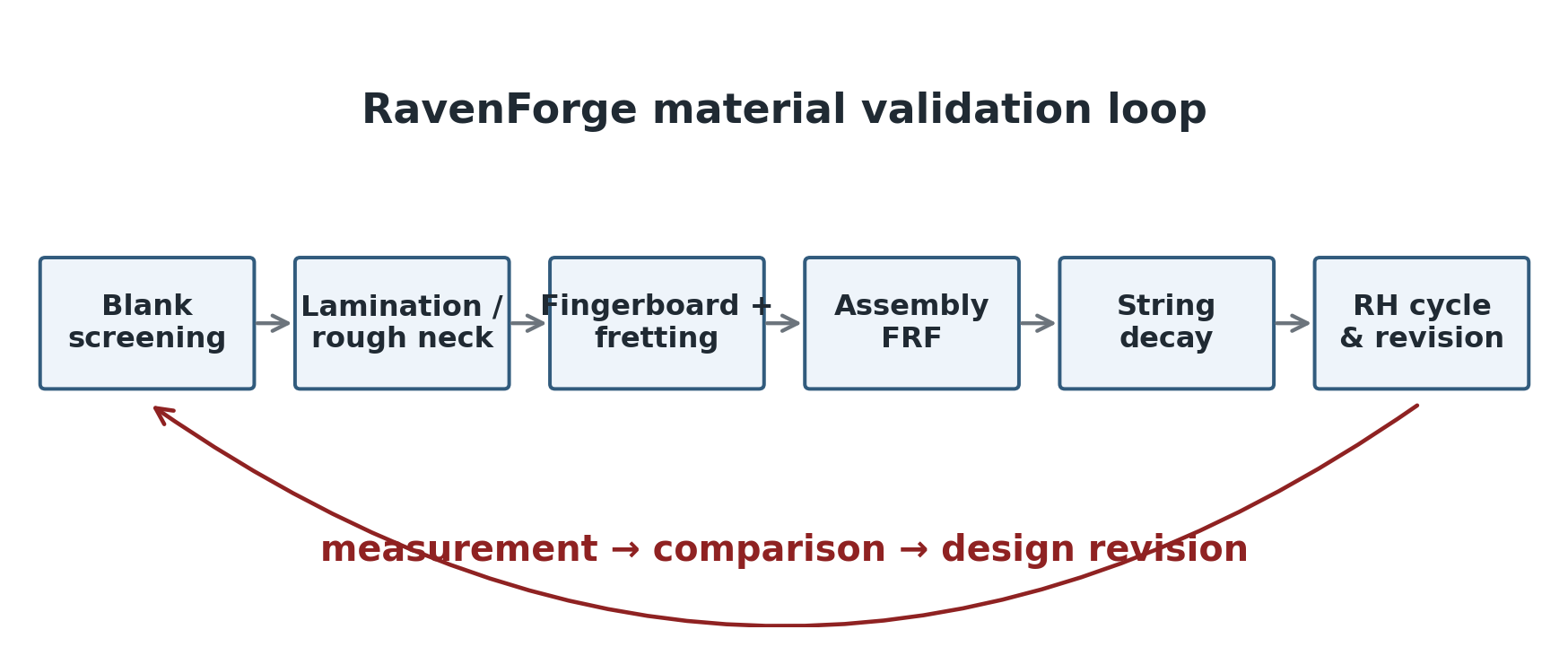
Figure 5. RavenForge material-validation loop. Conclusions from the literature are re-tested against measurements from completed instruments.
RavenForge measurement workflow
Stage | Recorded Values | Purpose |
Raw blank | MC, mass, dimensions, density, grain/runout | Record incoming specimen variability |
Lamella / fingerboard | dynamic MOE or resonance proxy, density | Pairing and material classification |
Glued neck blank | mass, tap/FRF, bow, twist | Structural changes after bonding |
Finished neck | modal frequencies, damping, relief | Cumulative effects of machining, rod, and reinforcement |
Assembled instrument | driving-point FRF / conductance by fret | Candidate dead-spot locations |
String test | partial decay τ / T60, pickup DI spectrum | Actual string response |
RH cycle | MC, relief, bow, twist, modal shift | Long-term stability |
9.1 First-Priority A/B Experiments
- Fingerboard A/B: keep neck architecture and profile as identical as possible, vary only fingerboard material and thickness, and compare conductance by fret with string-partial decay.
- Body A/B: use the same completed neck assembly and bridge/hardware, swap only the body, and compare bridge-side FRF with string decay.
- Neck architecture A/B: compare 1-piece / 3-piece / 5-piece constructions with the same fingerboard, profile, and truss rod, using multiple specimens for each architecture.
- Environmental cycle: cycle between defined relative-humidity conditions and record recovery and residual changes in relief, bow, twist, and modal frequencies.
Repeatedly plucking one instrument provides repeated measurements, not independent wood specimens. To make claims about a species or architecture itself, multiple blanks/necks are ultimately required for each condition. This principle prevents an interesting result from one prototype from being immediately generalized into a universal rule.
10. Current Conclusion — Species Is Not the Answer; It Is a Structural Variable
The largest change produced by this review is not a change of position on whether wood matters, but a change in the unit used to describe that influence. In a solid-body electric instrument, the effect of wooden structures appears through string–structure coupling, and the ultimately relevant quantities are the stiffness, mass, damping, modal frequencies, and mechanical admittance of the completed structure.
The fingerboard is worth actively managing as the outer layer of a composite structure bonded to the neck, but its role is not explained by the coefficient of restitution alone. The body is a major material variable that can alter bridge-side modal response, but it is not assumed to dominate the neck in all cases. Because the neck can play a major role in frequency-specific dead spots and sustain, RavenForge instead controls it first through architecture and reinforcement.
A laminated neck does not automatically provide a “stronger neck with better tone.” Its advantage is the ability to screen and arrange lamella properties and manage manufacturing variation so that a target assembly can be approached more repeatably. Poor pairing or bonding conditions can instead increase warp, so the critical factor is the process and its verification, not lamination by itself.
Current conclusion The species is not the tone. |
Accordingly, RavenForge will express the former “fingerboard > body > neck” statement as follows: Fingerboard >= Body > Neck species — not a hierarchy of acoustic influence, but a priority for leaving material properties as active design variables after neck architecture has been controlled.
Appendix A. Key References
[1] Fleischer, H. (1999). Diagnosing dead spots of electric guitars and basses by measuring the mechanical conductance. Journal of the Acoustical Society of America, 105(2). DOI: 10.1121/1.426224.
[2] Paté, A., Le Carrou, J.-L., & Fabre, B. (2014). Predicting the decay time of solid body electric guitar tones. Journal of the Acoustical Society of America, 135(5), 3045–3055. DOI: 10.1121/1.4871360.
[3] Obataya, E., Ono, T., & Norimoto, M. (2000). Vibrational properties of wood along the grain. Journal of Materials Science, 35, 2993–3001. DOI: 10.1023/A:1004782827844.
[4] Wegst, U. G. K. (2006). Wood for sound. American Journal of Botany, 93(10), 1439–1448. DOI: 10.3732/ajb.93.10.1439.
[5] Brémaud, I., El Kaïm, Y., Guibal, D., Minato, K., Thibaut, B., & Gril, J. (2012). Characterization and categorization of the diversity in viscoelastic vibrational properties between 98 wood types. Annals of Forest Science, 69, 373–386. DOI: 10.1007/s13595-011-0166-z.
[6] Paté, A., Le Carrou, J.-L., & Fabre, B. (2013). Ebony vs. Rosewood: experimental investigation about the influence of the fingerboard on the sound of a solid body electric guitar. Proceedings of the Stockholm Musical Acoustics Conference, 182–187.
[7] Paté, A., Le Carrou, J.-L., Navarret, B., Dubois, D., & Fabre, B. (2015). Influence of the Electric Guitar’s Fingerboard Wood on Guitarists’ Perception. Acta Acustica united with Acustica, 101(2), 347–359. DOI: 10.3813/AAA.918831.
[8] Ray, T., Kaljun, J., & Straže, A. (2021). Comparison of the Vibration Damping of the Wood Species Used for the Body of an Electric Guitar on the Vibration Response of Open-Strings. Materials, 14(18), 5281. DOI: 10.3390/ma14185281.
[9] Rindler, A., Vay, O., Hansmann, C., & Konnerth, J. (2019). Adhesive-related warping of thin wooden bi-layers. Wood Science and Technology, 53, 1015–1033. DOI: 10.1007/s00226-019-01124-w.
[10] Cook, S., Ghavidel, A., & Zhou, J. (2024). Dimensional stability and mechanical performance of face-glued spruce-pine-fir and Douglas-fir studs. Drewno, 67(214). DOI: 10.53502/wood-193420.
[11] Chen, B., Goovaerts, P., Willen, S., Walraet, J., Deklerck, V., Zhan, T., Van Paepegem, W., Van Acker, J., & Van den Bulcke, J. (2025). Monitoring the long-term stability of classical guitar necks: evaluating the potential of European-grown wood species in musical instrument manufacturing. Wood Science and Technology, 59(4), Article 71. DOI: 10.1007/s00226-025-01675-1.
[12] Paté, A., Le Carrou, J.-L., & Fabre, B. (2015). Modal parameter variability in industrial electric guitar making: Manufacturing process, wood variability, and lutherie decisions. Applied Acoustics, 96, 118–131. DOI: 10.1016/j.apacoust.2015.03.023.
Appendix B. Limitations of Interpretation
- Large controlled studies in electric guitar/bass that change only one component are scarce. Results from individual studies should not be generalized into fixed characteristics of an entire wood species.
- Wood shows substantial within-species variation in density, MOE, damping, grain orientation, and moisture response. Specimen-level measurement is necessary.
- The fingerboard A/B study is meaningful, but residual variability remains in handcrafted instruments. Unit-to-unit variability has also been observed in industrial samples.
- The body A/B study benefits from sharing the same neck, but is limited to one specimen per body species, a rectangular body geometry, and tests centered on open strings.
- Studies of structural laminated lumber and thin bi-layers are not direct experiments on guitar necks. They are used here for principles of pairing, moisture, adhesive, and symmetry management, not as numerical acceptance criteria.
- Final perceived sound is also influenced by pickups, electronics, strings, setup, player interaction, and the amplification chain. This document addresses only the mechanical path associated with wood and structure.
Working research document · 2026.09.01