RAVENFORGE / DESIGN METHODOLOGY RESEARCH LOG — B02
RAVENFORGE
Design Methodology Research Log
B02 — Voicing Before Specification
소리의 언어를 측정 가능한 설계 요구사항으로 변환하는 방법
문서 목적 RavenForge의 모델 개발을 부품 목록에서 시작하지 않고, 연주자가 원하는 sonic intent와 사용 맥락을 먼저 정의한 뒤 이를 지각적 언어 → 측정 가능한 target → subsystem requirement → 실제 specification으로 단계적으로 변환하는 설계 방법론을 정립한다. Torillo의 “voice design / sonical presets”처럼 소리의 캐릭터를 먼저 제시하는 커스텀 제작 사례를 검토하되, 제작자의 wood–tone 서술을 과학적 인과관계로 그대로 채택하지 않는다. 또한 QFD와 systems engineering의 requirements flow-down 개념을 도입해 RavenForge의 `concept → target response → specification → prototype validation` 체계를 구축한다. |
Code | B02 |
Focus | sonic intent · perceptual descriptor · target response · requirement allocation · specification traceability |
Evidence | timbre perception · QFD / systems engineering · documented luthier case studies |
RavenForge link | ASKR / EMBLA / EDDA concept → measurable target → architecture → prototype |
Downstream logs | A03 / A04 / C01 / C02 / A05 |
Status | Methodology framework established · model-specific target values pending validation |
1. 연구 질문 — 소리를 만들 것인가, 사양표를 조립할 것인가
커스텀 악기 설계는 쉽게 “어떤 wood, 어떤 pickup, 어떤 preamp를 넣을 것인가”에서 시작한다. 그러나 이 순서는 부품 자체를 목표로 착각하게 만들 수 있다. 동일한 pickup도 위치와 load가 달라지면 응답이 달라지고, 동일한 wood species도 assembly의 mass·stiffness·damping과 coupling 조건에 따라 다른 결과를 낸다. A01과 A02에서 이미 확인했듯 RavenForge의 실제 causal chain은 component name이 아니라 string/structure dynamics, spatial sampling, magnetic transduction과 electrical loading의 결합으로 구성된다 [R1,R2].
B02의 질문은 반대 방향이다. 먼저 “어떤 악기를 만들고 싶은가”를 sonic / musical / ergonomic language로 정의하고, 그 언어 중 실제 설계에 사용할 수 있는 부분을 measurement target으로 operationalize한 뒤, 필요한 architecture와 component specification을 역산할 수 있는가? 이 접근은 하나의 부품 조합을 정답으로 미리 고정하는 것이 아니라, 목표와 사양 사이의 traceability를 유지하는 방법론이다.
핵심 관점 Specification is an implementation, not the intent. RavenForge에서 wood, pickup, preamp, scale과 control topology는 목표가 아니라 목표를 구현하기 위한 candidate solution이다. |
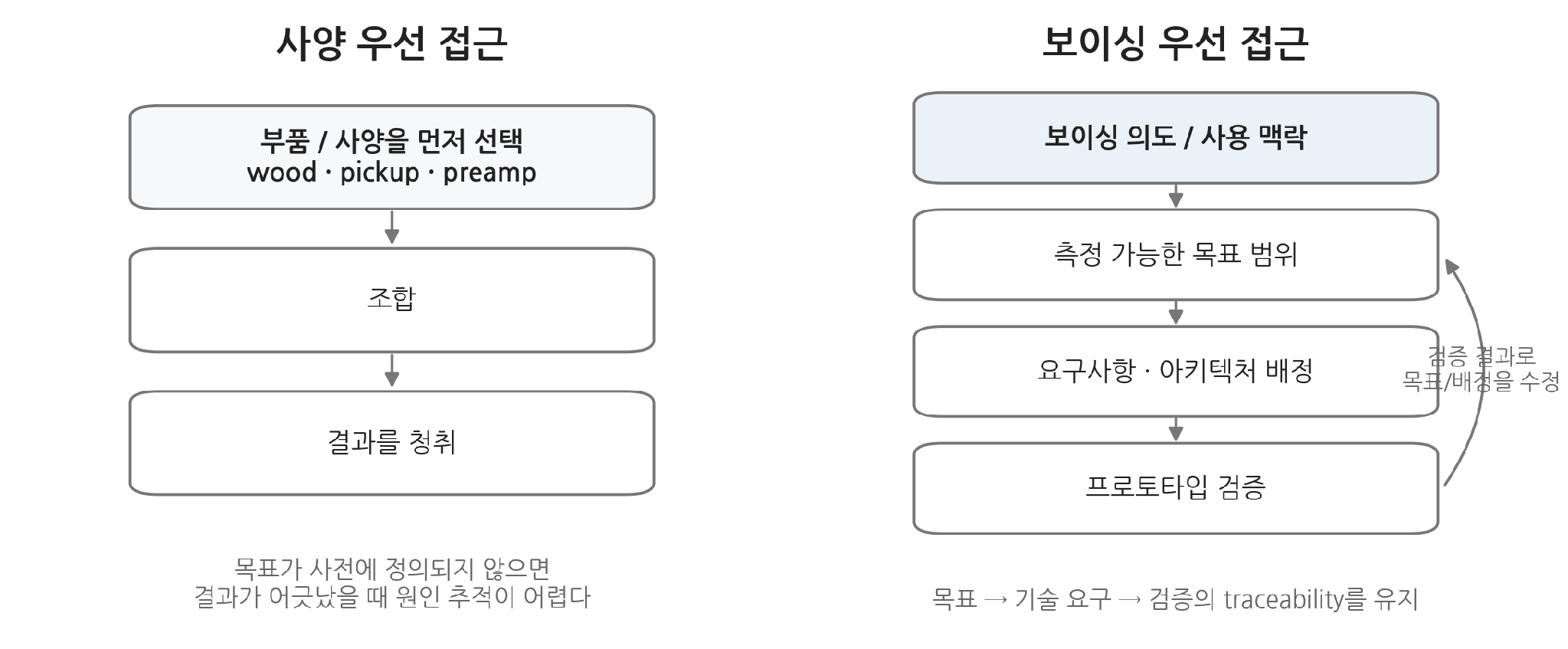
Figure 1. 사양 우선 접근과 보이싱 우선 접근의 차이.
RavenForge methodology schematic. The right-hand loop is inspired by requirements decomposition / design-solution validation, not copied from a luthiery standard [3–5].
2. “Voicing”의 범위 — acoustic plate tuning과 electric-instrument design을 혼동하지 않는다
“Voicing”은 acoustic-guitar making에서 top thickness, bracing, modal behaviour 등을 조정하는 구체적인 제작 문맥으로 오래 사용되어 왔다. 반면 electric guitar/bass 업계에서는 target character, pickup/electronics/wood 조합, 고객 맞춤형 sound design을 가리키는 더 넓고 비표준적인 용어로도 쓰인다. B02는 후자의 의미를 무비판적으로 과학용어처럼 사용하지 않는다.
RavenForge에서 B02의 voicing은 “특정 부품을 tonewood 직관으로 선택하는 행위”가 아니라, desired musical result를 design requirement로 변환하는 product-development process로 정의한다. 즉 acoustic plate voicing의 직접 확장이 아니라 systems-design method다.
용어 경계 Voicing before specification ≠ “먼저 나무를 두드려 소리를 듣는다.” B02에서 voicing은 player / model intent → perceptual target → measurable requirement → specification → validation의 순서를 뜻한다. |
3. 지각 언어를 그대로 사양으로 번역할 수 없는 이유
3.1 Timbre는 다차원적이다
Grey의 고전적인 multidimensional scaling 연구에서는 악기 timbre의 perceptual differences가 하나의 밝고/어두운 축만으로 설명되지 않았고, spectral energy distribution, transient behaviour, high-frequency attack energy와 관련된 여러 차원이 나타났다 [1]. McAdams 등도 synthesized musical timbre를 분석해 log-rise time, spectral centroid, spectral variation/irregularity와 연관된 공통 dimensions와 instrument-specific attributes를 분리했다 [2].
따라서 “aggressive”, “fast”, “open”, “tight”, “warm” 같은 단어를 특정 하나의 주파수나 하나의 부품으로 곧바로 치환하면 안 된다. 예를 들어 perceived brightness는 spectral centroid 또는 psychoacoustic sharpness와 상관될 수 있지만, distorted guitar 연구에서는 harmonic amount와 distortion 조건이 brightness perception을 단순하게 만들지 않는다는 결과도 있다 [6,7].
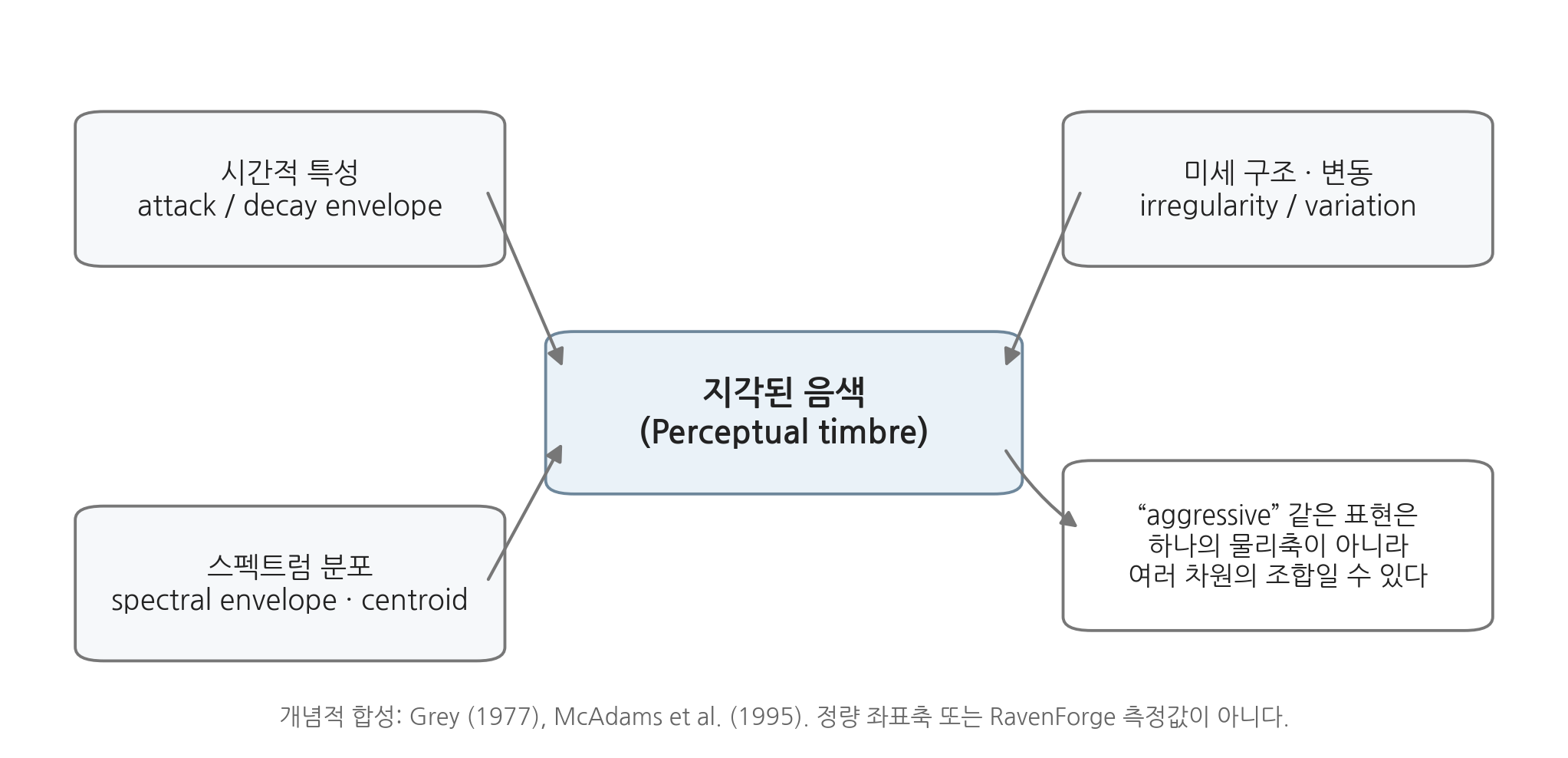
Figure 2. 보이싱 목표를 단일 톤 축으로 환원하지 않는 이유.
Conceptual synthesis from Grey (1977) and McAdams et al. (1995). The surrounding blocks summarize repeatedly reported timbral dimensions; they are not orthogonal measurement axes or RavenForge bass data [1,2].
설계 원칙 Perceptual descriptor ≠ single physical metric. “Bright = spectral centroid”, “punch = attack time”, “aggressive = upper harmonics” 같은 등식은 검증 전에는 hypothesis로만 기록한다. |
3.2 연주자 언어를 engineering language로 바꾸는 단계
RavenForge는 고객 또는 모델 concept의 단어를 삭제하지 않는다. 오히려 그 언어를 출발점으로 보존하되, 바로 BOM으로 보내지 않고 중간층을 만든다. 첫 번째 층은 perceptual construct, 두 번째 층은 candidate measurable proxy, 세 번째 층은 system-level target, 마지막 층이 subsystem / component requirement다.
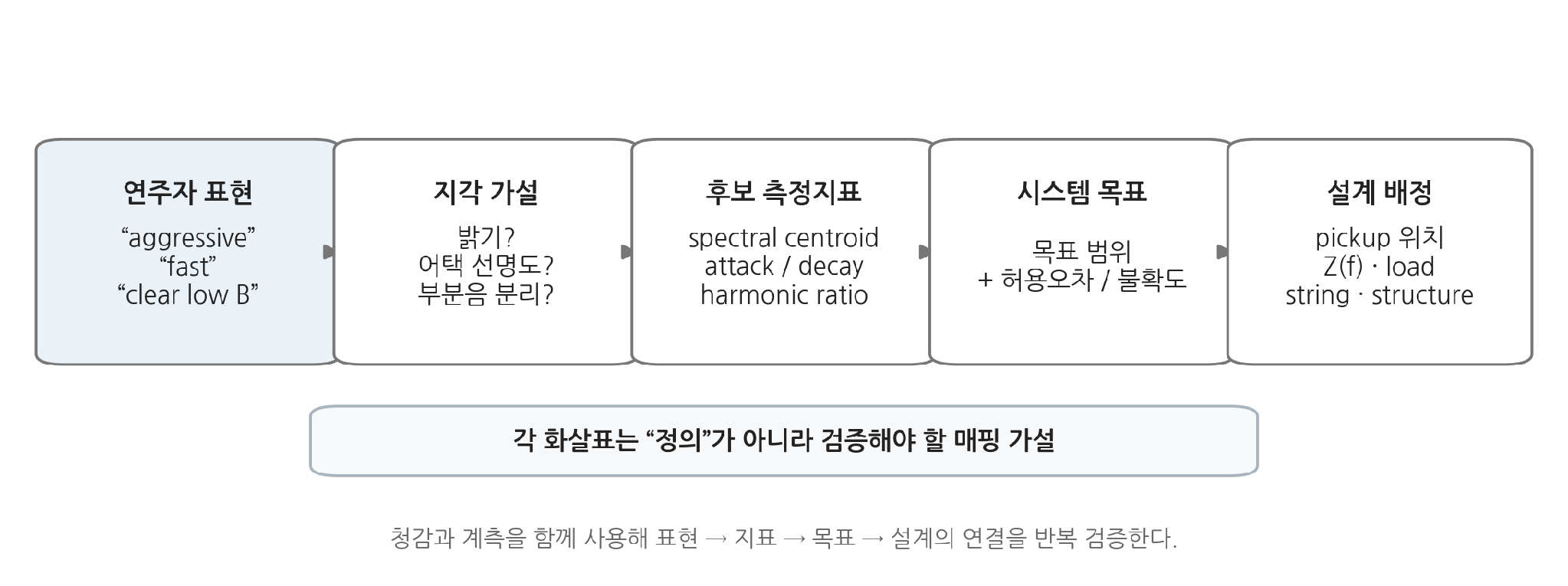
Figure 3. 연주자 언어에서 실제 specification으로 내려가는 translation cascade.
RavenForge working model. Arrows are hypotheses until objective and perceptual validation establish a useful relationship.
예를 들어 “clear low B”는 곧바로 “37 inch + 특정 pickup”을 뜻하지 않는다. RavenForge에서는 먼저 low-register note에서 partial separation, decay stability, attack consistency, excessive resonance/boom의 유무처럼 관찰 가능한 문제로 분해하고, 그 다음 scale/string, structure, pickup coordinate, pickup Z(f), loading 중 어느 subsystem이 해당 문제를 가장 직접적으로 제어하는지 검토한다. 마지막으로 prototype에서 실제 effect size를 확인한다.
4. Requirements-first design — QFD와 systems engineering에서 가져올 수 있는 것
4.1 고객의 언어를 기술요구로 변환한다
Quality Function Deployment(QFD)는 customer requirements를 engineering characteristics와 design targets로 번역하기 위한 product-development framework다. Hauser & Clausing의 House of Quality는 customer language와 engineering measures를 한 matrix에 놓고 목표값과 trade-off를 명시하는 접근을 설명하며 [3], Akao의 QFD는 이를 제품개발 전 단계로 확장한다 [4]. RavenForge는 QFD 전체 절차를 그대로 도입하지 않고, “voice of player → measurable design target”이라는 핵심 구조를 채택한다.
4.2 요구사항에서 component까지 traceability를 유지한다
NASA Systems Engineering Handbook의 logical decomposition / design solution definition은 상위 stakeholder expectations와 technical requirements를 subsystem 수준으로 분해한 뒤 alternative solutions를 비교하고, 최종 design solution이 요구사항을 만족하는지 다시 검증하도록 한다 [5]. B02에서 중요한 것은 우주항공 절차 자체가 아니라 WHAT과 HOW를 분리하는 원칙이다.
RavenForge adaptation WHAT = model / player가 원하는 musical and perceptual behaviour. HOW = scale, pickup position, magnet/coil architecture, loading, material/structure, hardware, setup. HOW가 WHAT보다 먼저 고정되면 specification cargo cult가 된다. |
5. Case Study — Torillo의 “sonical dimensions / voice design”
Torillo Custom Basses는 공식 페이지에서 자신들이 “sonical dimensions”로 사고한다고 밝히고, Signature Tone / Tone Design / Full Custom Voice의 세 단계로 customization intensity를 나눈다. Tone Design에는 Fusion, Pfuture, Tonmeister, Jfuture, Orkus처럼 먼저 sonic characterization을 붙인 preset이 있고, 그 아래 wood, pickup, passive circuit specification이 배치된다 [8]. Full Custom Voice는 “voice design”과 customer-preference specification을 전면에 둔다 [8,9].
이 구조는 B02의 case study로 의미가 있다. 최소한 상품/제작 커뮤니케이션의 순서에서 sonic character가 component list보다 상위에 놓일 수 있음을 보여준다. Torillo의 “The P in your head”, “Your session tool”, “Metal axe” 같은 wording은 technical specification 이전에 use-case / voice concept를 제시하는 실무 예다.
그러나 Torillo는 동시에 wood를 가장 중요한 component라고 서술하고 wood choice가 개인의 voice를 발견하게 한다고 주장한다 [8,9]. 이 부분은 manufacturer philosophy이며, 특정 species → 특정 measured response라는 scientific evidence가 아니다. RavenForge는 프로세스 구조는 case study로 참고하지만 wood-tone causality는 별도로 검증한다.
Case-study rule Torillo proves that “voice-first customization” is a real luthiery practice. It does not prove that its chosen wood-to-tone mappings are physically unique or universally valid. |
6. Parallel Cases — “Sound first”라는 제작 언어는 어떻게 쓰이는가
6.1 Bacci — “Sound first. Shape second.”
Bacci의 현재 Marleo bass 소개는 “Sound first. Shape second.”라는 문구와 함께 먼저 원하는 sound를 상정하고 bass를 그 주위에 구축한다고 설명하며, 이후 pickup, circuit, scale, strings를 “configure your voice” 항목으로 제시한다 [10]. 이 역시 component configurator보다 sonic intent를 위에 두는 명시적인 industry example이다.
6.2 교육적 voicing — 측정과 기록을 포함해야 한다
Galloup School의 2025 curriculum은 Instrument Acoustics and Voicing 수업에서 wood selection뿐 아니라 dynamic testing, record keeping, computerized analysis를 포함하고, voicing knowledge를 실제 build에 적용하도록 구성한다 [11]. 대상에는 acoustic-oriented voicing이 포함되지만, “voicing = 직관”이 아니라 measurement와 record를 병행하는 교육 구조라는 점이 B02에 중요하다.
이 세 사례는 동일한 scientific method를 공유한다고 볼 수 없다. Torillo와 Bacci는 manufacturer-defined sonic customization 사례이고, Galloup은 교육 프로그램이다. RavenForge는 이들을 evidence of practice로만 사용하고, 실제 methodology의 검증 근거는 perceptual science와 requirements engineering에서 가져온다.
7. RavenForge Sonic Brief — 목표음을 문서화하는 최소 단위
각 새 모델 또는 custom order는 BOM보다 먼저 Sonic Brief를 작성한다. Sonic Brief는 광고 문구가 아니라 이후 측정과 설계 변경을 추적할 parent requirement다. 한 단어의 tone adjective 대신 최소한 use context, desired contrast, unwanted behaviour, reference condition, measurement hypothesis를 함께 기록한다.
Field | 기록 예시 | 역할 |
Use context | low-tuned metal / clean DI / filter-based heritage | 어떤 조건에서 목표를 평가할지 고정 |
Perceptual intent | fast, aggressive, articulate | 연주자/모델 언어 보존 |
Reference contrast | more upper-partial definition than baseline; less boom | 절대 adjective보다 비교 기준 제공 |
Candidate metrics | Hn/H1, spectral centroid, attack/decay, loaded resonance | 검증 가능한 proxy 설정 |
Constraints | mass, ergonomics, procurement, passive/active compatibility | 톤 목표 때문에 다른 requirement를 파괴하지 않음 |
Validation | level-matched A/B + objective measurement | 최종 판단 channel 분리 |
Measurement boundary Candidate metric은 “톤의 정의”가 아니다. Objective proxy는 청감 판단을 대체하지 않고, 청감 결과는 원인 추적을 대체하지 않는다. |
8. Requirement Allocation — 어떤 subsystem이 목표를 담당하는가
상위 sonic target을 바로 component name으로 내리지 않고, 먼저 subsystem level에 allocation한다. A01/A02의 현재 지식만으로도 pickup position은 spatial sampling, pickup electrical parameters는 A03의 Z(f), external load는 A04, buffer는 A05, string/structure는 mechanical response와 연결된다는 역할 구분이 가능하다. 서로 다른 subsystem이 비슷한 perceptual outcome에 동시에 기여할 수 있으므로 “한 부품 = 한 톤” 관계를 만들지 않는다.
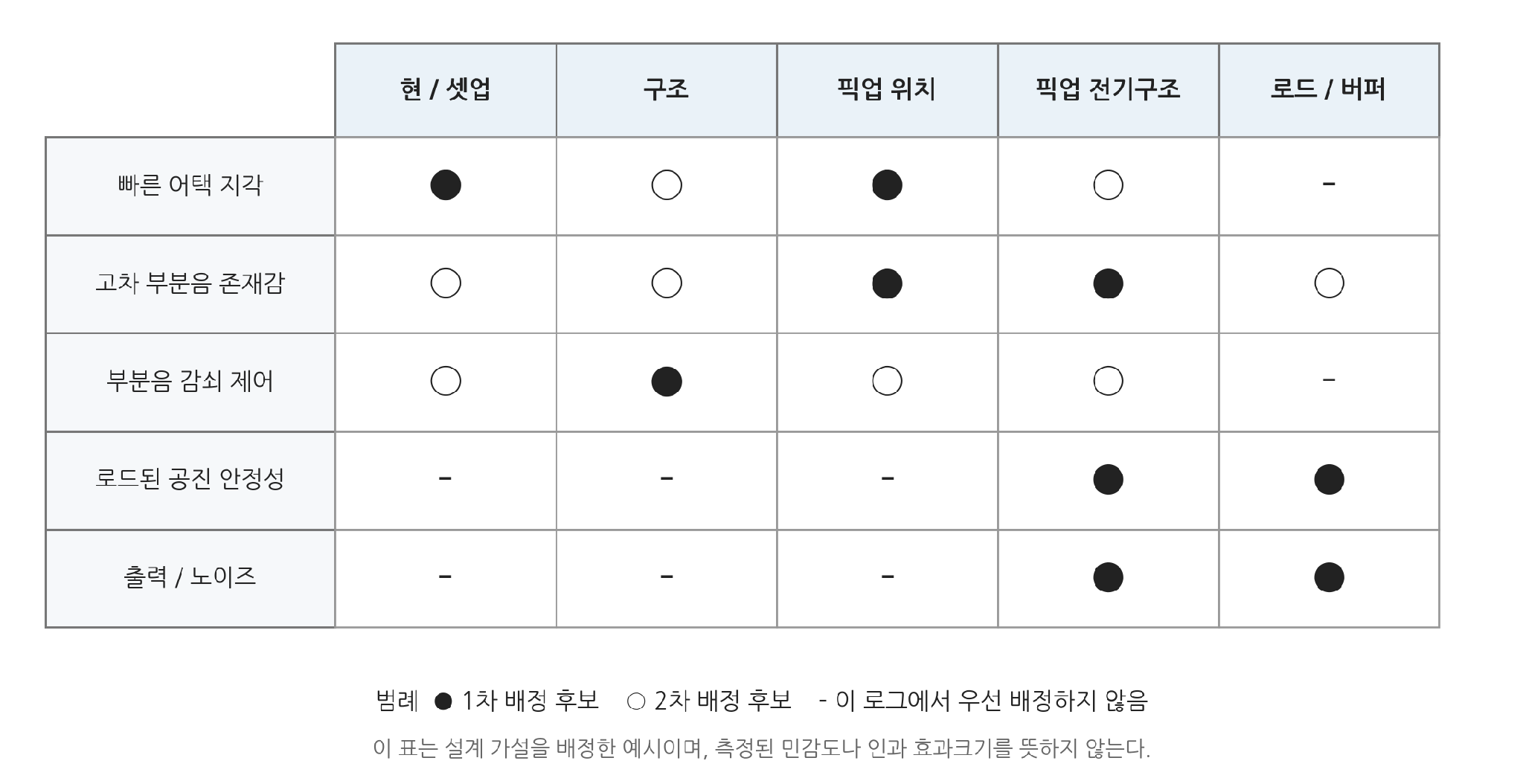
Figure 4. RavenForge requirement-allocation matrix 예시.
Symbols indicate candidate responsibility only. They are not measured sensitivities. Final allocation must be revised using A03/A04/C01/C02 data.
예를 들어 upper-partial presence는 pickup position과 pickup architecture가 직접적인 후보지만, plucking/setup과 구조적 decay도 관측 spectrum을 바꾼다. Loaded-resonance stability는 pickup Z(f)와 load/buffer에 우선 배정할 수 있다. 이 표의 목적은 모든 변수가 모든 것을 바꾼다고 말하는 것이 아니라, 첫 실험을 어디서 시작할 것인가를 정하는 것이다.
9. RavenForge 적용 — ASKR, EMBLA, EDDA를 spec sheet가 아니라 target system으로 본다
9.1 ASKR — “aggressive”를 bridge-near pickup이라는 부품문장으로 끝내지 않는다
ASKR의 rock/metal-oriented concept과 bridge-near pickup은 B02의 좋은 적용 사례다. A02는 bridge-near position이 어떤 geometric harmonic weighting을 만들 수 있는지 제공하지만 [R2], “aggressive” perception 자체를 보장하지 않는다. B02에서는 aggressive / fast / low-register separation을 Sonic Brief에 남기고, C01에서 pickup-coordinate effect를, A03/A04에서 pickup/load response를 분리해 확인한다.
따라서 ASKR의 최종 pickup coordinate는 “Dingwall-like 위치”, “bridge에 최대한 가까운 위치”가 아니라 target response를 만족하면서 harmonic null, low-register level, magnetic gap, ergonomic routing constraints까지 통과한 coordinate가 된다.
9.2 EMBLA — passive character와 active repeatability를 서로 다른 requirement로 관리한다
EMBLA에서 passive / buffered / preamp architecture는 “고급 옵션”의 서열이 아니다. Passive mode에서 남기고 싶은 pickup-load interaction과 active mode에서 줄이고 싶은 cable/load variability를 각각 requirement로 정의할 수 있다. 같은 “open”이라는 adjective를 사용하더라도 passive resonance peak와 buffered broadband response는 완전히 다른 technical implementation일 수 있으므로 사양보다 목표를 먼저 명시해야 한다.
9.3 EDDA — heritage도 component recipe가 아니라 response / control grammar로 정의한다
EDDA가 Fender-derived recipe를 그대로 재현하지 않고 Alembic/Wal 계열의 system-level heritage까지 연구하는 것과 같은 논리가 B02에 적용된다. “vintage = Alder/Maple/Rosewood”를 specification으로 시작하기보다 passive baseline, filter control range, pickup/electronics interaction 같은 design question을 상위 requirement로 둔다. 그러면 material 선택과 electronics choice는 heritage concept을 구현하는 여러 수단 중 하나가 된다.
10. 근거 매트릭스 — B02에서 어디까지 주장할 수 있는가
Claim | Assessment | Evidence | RavenForge wording |
Timbre는 하나의 물리량으로 충분히 표현된다 | Not supported | Grey / McAdams [1,2] | multidimensional perceptual target |
Customer/player language를 engineering target으로 변환하는 절차는 product design에 존재한다 | Supported | QFD [3,4] | Sonic Brief → measurable target |
상위 requirement와 component specification 사이 traceability가 필요하다 | Supported framework | NASA SE [5] | WHAT → HOW flow-down |
Brightness는 spectral centroid 하나와 항상 동일하다 | Too strong | timbre / distorted-guitar studies [1,2,6,7] | centroid = candidate correlate |
“Aggressive”는 upper harmonics가 많다는 뜻이다 | Not established | descriptor mapping insufficient | multi-metric hypothesis + listening |
Torillo는 sonic presets / voice design을 실제 제품구조에 사용한다 | Supported as practice | Torillo official [8,9] | industry case study |
Torillo의 wood-tone mapping이 과학적으로 검증됐다 | Not established | manufacturer claim only [8,9] | do not import causality |
Bacci는 sound-first language를 명시적으로 사용한다 | Supported as practice | Bacci official [10] | parallel case study |
목표음에서 유일한 component set을 역산할 수 있다 | Not supported | many interacting variables | generate alternatives + trade study |
Objective measurement만으로 final voicing을 결정할 수 있다 | Not supported | perceptual target is listener-dependent [1,2] | measurement + listening |
청감만으로 원인을 추적할 수 있다 | Not supported | requirements / measurement logic [3–5] | traceable measurements required |
11. B02 기반 Prototype Voicing Validation Protocol
B02의 핵심은 “좋은 소리를 측정값으로 대체”하는 것이 아니라, target → implementation → result 사이의 gap을 추적 가능하게 만드는 것이다. 따라서 prototype validation은 objective measurement와 perception test를 병렬 channel로 운영한다.
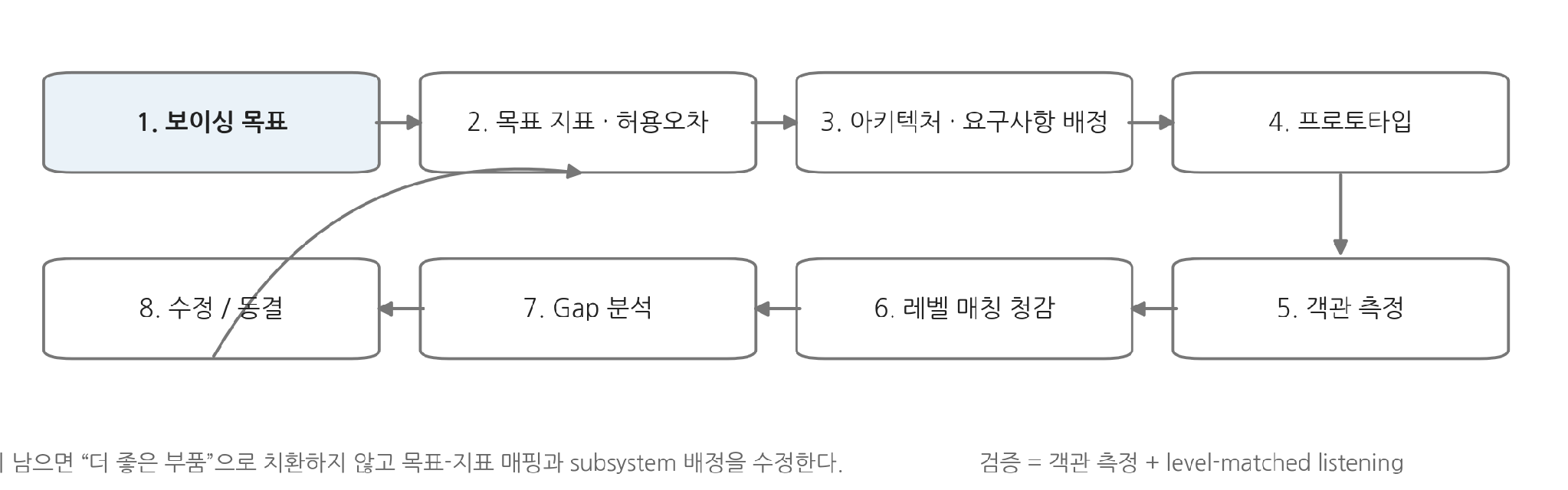
Figure 5. B02에서 파생한 RavenForge 보이싱 검증 루프.
A target is frozen only after the implementation is measured and perceptually checked under controlled conditions. Engineering workflow, not a universal psychoacoustic standard.
Stage | Record / condition | Decision |
Sonic brief | use context, descriptor, desired contrast, unwanted behaviour | parent requirement lock |
Reference capture | baseline instrument / current prototype, level-matched DI | comparison anchor |
Metric hypothesis | spectral / temporal / decay / resonance candidates | what to measure, not what to believe |
Requirement allocation | string/structure/position/Z/load/buffer responsibility | experiment order |
Prototype A/B | one primary variable changed; other conditions locked | effect isolation |
Objective test | FFT/STFT, harmonic ratios, decay, impedance/FRF as relevant | measured effect |
Listening test | level-matched, randomized when practical, same performance or reamp | perceptual effect |
Gap analysis | target achieved? side effects? conflict with mass/ergonomics/cost? | revise mapping / target / architecture |
Specification freeze | only validated variables become BOM/CAD rules | traceable design rule |
Re-test | production prototype under real strings/setup/load | external validity |
실험 원칙 One variable per question, not one variable per instrument. A prototype can contain many differences, but each claimed causal decision must be tied to a controlled comparison or explicitly labeled as unresolved. |
12. 현재 결론 — “좋은 부품”을 고르는 일이 아니라 목표를 추적 가능한 요구사항으로 만드는 일
B02에서 RavenForge가 채택하는 핵심 변화는 spec sheet의 순서다. 기존 제작 문화에서 흔한 `wood → pickup → preamp → 기대하는 tone`의 흐름을 금지하는 것이 아니라, 그것을 최종 implementation 단계로 내린다. 먼저 model / player가 원하는 musical behaviour를 정의하고, 지각적으로 무엇을 의미하는지 질문하고, 측정 가능한 proxy를 세운 뒤, 관련 subsystem에 requirement를 allocation한다.
이 방식은 “science가 tone을 숫자로 완전히 정의한다”는 주장과도 다르다. Timbre perception은 multidimensional이고 listener/context에 따라 달라질 수 있다 [1,2]. 따라서 measurement는 perception을 대체하지 않는다. 반대로 adjective와 청감만으로는 어떤 설계변수가 실제 차이를 만들었는지 추적하기 어렵다. RavenForge는 두 채널을 하나의 validation loop 안에 둔다.
현재 설계 입장 Concept → Sonic Brief → Perceptual construct → Candidate metric → System target → Requirement allocation → Specification → Prototype → Measurement + listening → Revision. A component earns its place because it satisfies a requirement, not because it carries a prestigious name or inherited tone story. |
13. 다음 연구 — A03으로 넘기는 것
Code | Research question | B02에서 넘기는 변수 |
A03 | Magnetic Pickups as RLC Systems | pickup Z(f), resonance, Q, turns / gauge / topology |
A04 | Electrical Loading of Passive Pickups | pot, cable capacitance, input impedance |
C01 | Pickup Position FFT Mapping | A02 spatial target와 B02 target-response validation |
C02 | Pickup Loading Measurement | A04 loaded-response validation |
A05 | Active Buffers and Input Impedance | high-Z sensing / low-Z output isolation |
참고문헌
[1] Grey, J. M. “Multidimensional perceptual scaling of musical timbres.” Journal of the Acoustical Society of America 61(5), 1270–1277 (1977). DOI: 10.1121/1.381428.
[2] McAdams, S.; Winsberg, S.; Donnadieu, S.; De Soete, G.; Krimphoff, J. “Perceptual scaling of synthesized musical timbres: Common dimensions, specificities, and latent subject classes.” Psychological Research 58(3), 177–192 (1995). DOI: 10.1007/BF00419633.
[3] Hauser, J. R.; Clausing, D. “The House of Quality.” Harvard Business Review, May 1988. QFD / customer-requirement to engineering-target framework.
[4] Akao, Y. Quality Function Deployment: Integrating Customer Requirements into Product Design. Productivity Press, 1990.
[5] NASA. NASA Systems Engineering Handbook, NASA/SP-2016-6105 Rev 2 (2016). Sections 4.3 Logical Decomposition and 4.4 Design Solution Definition.
[6] Tsumoto, K.; Marui, A.; Kamekawa, T. “Predictors for the Perception of ‘Wildness’ and ‘Heaviness’ in Distorted Guitar Timbre.” 142nd AES Convention, Paper 9748 (2017).
[7] Tsumoto, K.; Marui, A.; Kamekawa, T. “The effect of harmonic overtones in relation to ‘sharpness’ for perception of brightness of distorted guitar timbre.” Proceedings of Meetings on Acoustics 29, 035002 (2017). DOI: 10.1121/2.0000380.
[8] Torillo Custom Basses. “Creations / Series / Sonical Presets.” Official maker documentation, accessed 2026-09. https://www.torillo-bass.com/creations/
[9] Torillo Custom Basses. “About Torillo — Philosophy & Vision / Woods.” Official maker documentation, accessed 2026-09. https://www.torillo-bass.com/about/
[10] Bacci Guitars. “Marleo Parato Bass — Sound first. Shape second. / Configure your voice.” Official maker documentation, accessed 2026-09. https://bacciguitars.com/parato/bass/
[11] Galloup School of Guitar Building and Repair. 2025 Catalog — Instrument Acoustics and Voicing curriculum: dynamic testing, record keeping, computerized analysis, and application in building.
[R1] RavenForge / Signal & Transduction Research Log A01. “From Mechanical Vibration to Electrical Signal.” 2026.09.05.
[R2] RavenForge / Signal & Transduction Research Log A02. “Pickup Position and Harmonic Sampling.” Verified Korean revision, 2026.09.06.
[R3] RavenForge / Liberal Arts Research Log L02. “The Instrument as an Extension of the Body.” 2026.09.03.
출처 상태 및 해석 범위 B02는 세 종류의 evidence를 구분한다. Timbre-perception literature는 perceptual target이 다차원적이라는 근거를 제공하고, QFD / systems engineering은 stakeholder language를 technical requirement와 specification으로 내리는 일반 설계 방법을 제공한다. Torillo, Bacci, Galloup은 luthiery practice 사례이며, 그들의 개별 wood-tone 또는 component-tone 인과 주장을 scientific evidence로 사용하지 않는다. RavenForge Sonic Brief, requirement-allocation matrix와 validation loop는 이 자료들을 악기 R&D에 적용하기 위해 도출한 internal engineering framework다. |
Working research document · 2026.09.08