RAVENFORGE / SIGNAL & TRANSDUCTION RESEARCH LOG — A02
RAVENFORGE
Signal & Transduction Research Log
A02 — Pickup Position and Harmonic Sampling
정규화된 현 좌표에서 프렛별 공간 샘플링까지
문서 목적 전기 기타·베이스의 magnetic pickup position을 “bridge = bright / neck = warm” 같은 tone adjective로만 설명하지 않고, vibrating string의 특정 spatial coordinate를 읽는 sampling geometry로 정의한다. A01에서 확립한 signal chain 가운데 이번 회차는 pickup-coordinate sampling을 분리하되, ideal string의 mode shape factor와 실제 induced voltage를 동일시하지 않는다. Point-sensor 위치계수, fret 변화에 따른 normalized coordinate, plucking-point excitation, finite sensing kernel, multi-pickup spatial mixing, magnetic-field geometry와 real-string effects를 문헌으로 검증하고, RavenForge ASKR·EMBLA 및 향후 3PU layout에서 사용할 공통 coordinate model과 C01 measurement protocol을 구축한다. 특정 pickup 좌표나 sensing width를 아직 최적값으로 확정하지 않는다. |
Code | A02 |
Focus | pickup coordinate · harmonic node/null · fret dependence · pluck coordinate · finite sensing kernel · multiscale / multi-pickup geometry |
Evidence | JAES / JASA / IEEE Transactions on Magnetics / American Journal of Physics · musical-acoustics references |
RavenForge link | ASKR slanted multiscale pickup · EMBLA pickup coordinates · future 3PU spatial complementarity |
Downstream logs | B02 next in sequence · C01 spatial FFT validation · A03/A04 electrical pickup & loading models |
Status | Technical audit integrated · analytical baseline established · pickup-specific field / prototype validation pending |
1. 연구 질문 — 픽업 위치는 무엇을 바꾸는가
Pickup을 body에서 몇 mm 이동하면 실제로 바뀌는 첫 번째 변수는 “treble”이나 “warmth”가 아니라 vibrating string의 mode shape를 읽는 spatial coordinate다. Paiva, Pakarinen & Välimäki는 pickup position, finite sensitivity width, multi-pickup mixing을 서로 분리 가능한 spatial effects로 모델링했고 [2], Mohamad, Dixon & Harte는 실제 electric-guitar recording의 spectral pattern에서 pickup position과 plucking point를 역추정할 수 있음을 보였다 [3]. 이 결과는 pickup location이 단순한 주관적 tone adjective가 아니라 정량화 가능한 spectral signature를 갖는다는 점을 지지한다.
다만 A02의 첫 번째 audit correction은 중요하다. 이상적인 string mode의 sin(nπx/L)은 pickup의 완성된 voltage response가 아니다. 그것은 string motion에 대한 geometric spatial factor다. 실제 coil voltage에는 string motion의 시간 미분, magnetic flux sensitivity, field geometry와 이후 electrical transfer function이 추가된다 [2,4,5]. 따라서 A02는 “어디를 읽는가”를 다루고, transduction gain과 electrical filtering은 A03/A04로 넘긴다.
핵심 관점 Pickup position is a spatial coordinate before it is a tone adjective. 그러나 sin(nπr)는 real pickup voltage의 완성 transfer function이 아니라 ideal string mode에 대한 geometric sampling factor다. |
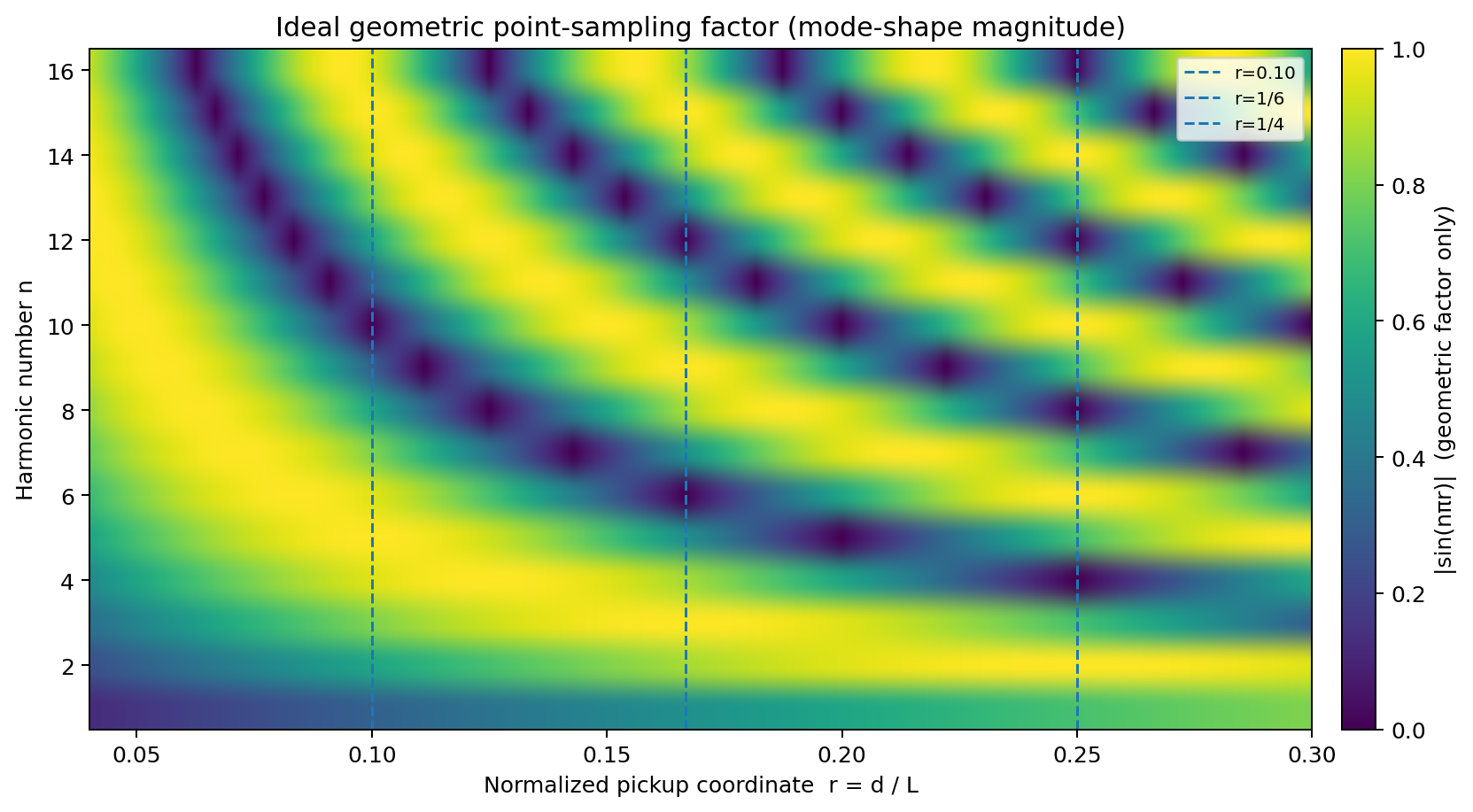
Figure 1. 이상적 현 모드에 대한 점 샘플링 기하학적 위치계수.
Color scale = |sin(nπr)|. This is a mode-shape magnitude map only — not predicted pickup voltage, EQ response, or measured RavenForge data. Dashed coordinates are examples, not recommendations [1–3].
2. 이상적 점 샘플링 — sin(nπr)는 “위치계수”다
2.1 좌표 정의
계산 혼동을 줄이기 위해 bridge를 x=0으로 둔다. 현재 speaking length를 L, bridge에서 pickup effective center까지의 거리를 d라고 하면 normalized pickup coordinate는 r=d/L이다. 이상적인 fixed-end flexible string의 n번째 transverse mode shape는 다음과 같이 쓸 수 있다 [1].
φ_n(x) = sin(nπx/L)
Infinitesimal point sensor가 x=d에서 string motion을 읽는다고 가정하면 mode n에 대한 spatial factor는 다음과 같다 [2,3].
H_pos(n,d) ∝ φ_n(d) = sin(nπd/L) = sin(nπr)
이 식은 spatial amplitude factor다. 예를 들어 pickup을 선형화된 velocity-sensitive transducer로 근사하면 n번째 component의 induced signal에는 대략 ω_n에 비례하는 시간미분 항과 pickup-specific magnetic sensitivity가 추가된다. 따라서 |sin(nπr)| heatmap을 실제 output-voltage spectrum으로 읽어서는 안 된다 [2,4].
검증 수정사항 A02에서 “pickup response = sin(nπr)”라고 쓰지 않는다. 정확한 표현은 “ideal mode에 대한 point-sampling spatial factor ∝ sin(nπr)”이다. 실제 voltage response는 magnetic transduction과 electrical response를 추가로 포함한다. |
2.2 이상 모델의 정확한 null 조건
이상적인 point sensor / fixed-end string 조건에서 n번째 mode의 spatial node가 pickup center와 일치하려면 n·r=m, 즉 r=m/n이어야 한다. 여기서 m은 1…n−1의 정수다. 예를 들어 r=1/4이면 4th, 8th, 12th… mode가 ideal geometric model에서 node를 갖는다. 이 관계는 매우 유용하지만 “1/4가 좋은 위치”라는 설계 규칙을 뜻하지 않는다.
Normalized r | Ideal first exact null | Interpretation |
0.10 = 1/10 | n = 10 | 10th, 20th… mode node under ideal point model |
0.1667 ≈ 1/6 | n = 6 | 6th, 12th… node |
0.20 = 1/5 | n = 5 | 5th, 10th… node |
0.25 = 1/4 | n = 4 | 4th, 8th, 12th… node |
arbitrary r | low-order exact null may not exist | near-node / local minimum으로 해석 |
설계 원칙 A harmonic node is a consequence, not a sweet spot. RavenForge는 ratio 자체를 “좋은 위치”로 채택하지 않고, target response에서 특정 partial의 suppression이 실제로 필요한지 B02에서 먼저 판단한다. |
3. 위치에 따른 빗살형 공간 가중 — bridge / neck 표현을 다시 정의한다
Pickup position effect는 conventional EQ처럼 고정된 Hz 지점을 boost/cut하는 필터와 동일하지 않다. Mode number에 따라 sin(nπr)의 maxima/minima가 반복되기 때문에 harmonic domain에서 comb-like spatial weighting으로 볼 수 있고, 실제 note의 modal frequencies와 결합하면 spectral coloration으로 나타난다 [2].
Bridge-near sampling이 흔히 “bright”로 들리는 이유도 pickup이 고음을 새로 생성하기 때문이 아니다. Bridge 부근에서는 low-order transverse displacement 자체가 작고, 낮은 order의 exact spatial node가 나타나는 위치가 더 멀어져 normalized upper-partial / fundamental ratio가 상대적으로 커질 수 있다. 반대로 neck 쪽 coordinate에서는 낮은 order mode가 node 또는 minimum에 가까워질 수 있다 [2].
수정된 가정 Bridge = bright / neck = warm은 perceptual shorthand다. RavenForge CAD variable은 bridge-referenced d(mm), normalized r=d/L, mode-dependent spatial factor와 pickup-specific sensing kernel이다. |
4. 프렛에 따른 변화 — 같은 픽업도 음마다 정규화 좌표가 달라진다
Pickup은 body에 고정되어 있어도 fretting은 speaking length를 바꾼다. Ideal equal temperament에서 fret F의 speaking length는 L_F=L_0·2^(−F/12)이고, bridge-referenced pickup distance d가 고정되어 있으면 normalized coordinate는 r_F=d/L_F가 된다 [3].
L_F = L_0 · 2^(−F/12) r_F = (d/L_0) · 2^(F/12)
따라서 동일한 pickup이 open string, 5th fret, 12th fret에서 읽는 geometric harmonic pattern은 달라진다. Mohamad et al.의 fretted-note experiment도 fixed pickup의 spectral suppression pattern이 fret에 따라 변하는 것을 이용한다 [3]. 실제 instrument에서는 compensated saddle 때문에 nominal scale과 sounding length가 약간 다를 수 있으므로 C01에서는 각 string의 실제 saddle→fret speaking length를 사용한다.
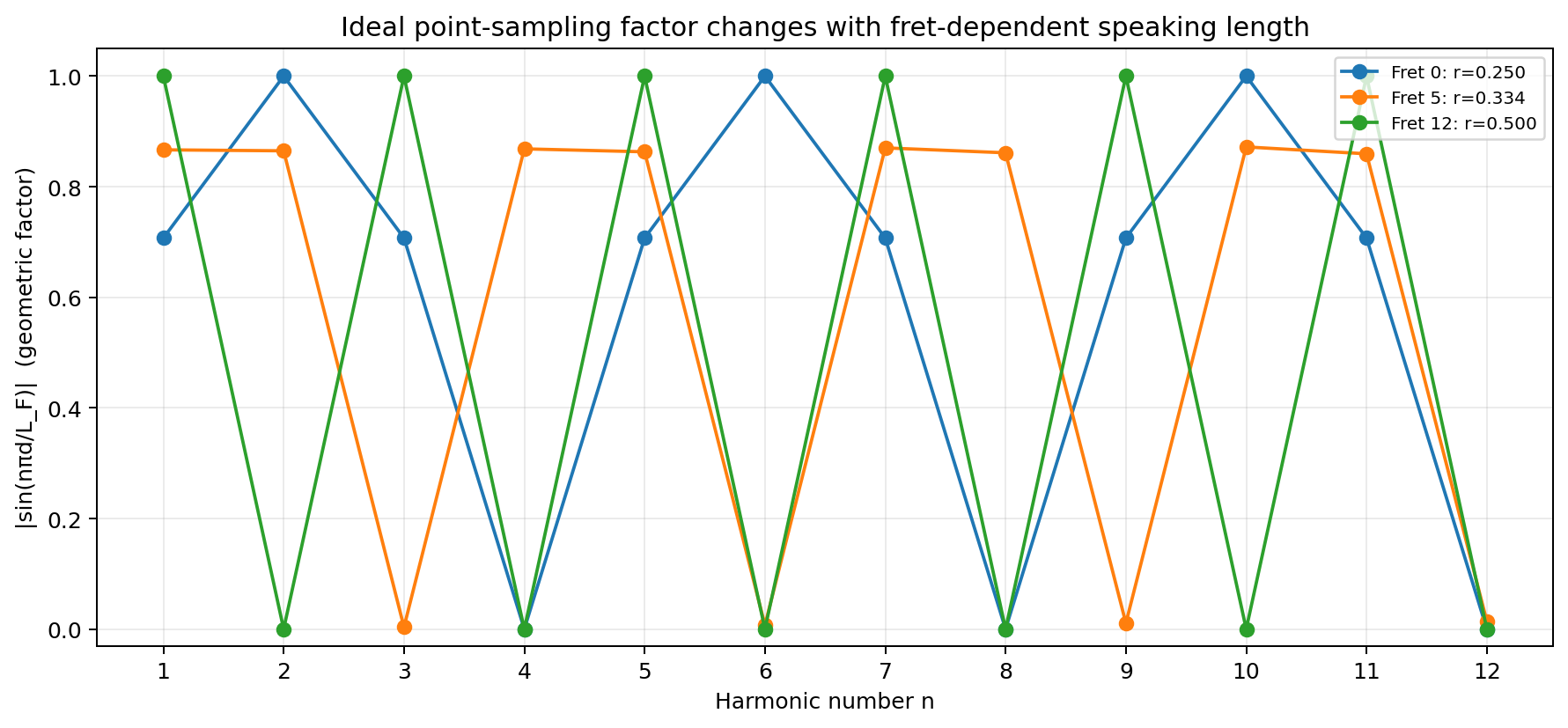
Figure 2. 같은 물리적 픽업이 프렛에 따라 만드는 서로 다른 이상적 기하학 샘플링 패턴.
Example uses d=L₀/4 and H=|sin(nπd/L_F)|. Curves are geometric factors only, not pickup voltage. Real compensated speaking lengths must be measured per string [3].
설계 원칙 An open-string “sweet spot” cannot be generalized to the whole fretboard. RavenForge pickup map은 최소 string × fret × harmonic coordinate를 포함한다. |
5. 플럭 위치 — 가진 좌표와 픽업 좌표를 분리한다
Observed harmonic amplitude에는 pickup position뿐 아니라 excitation이 이미 들어 있다. Mohamad et al.의 idealized derivation처럼 string을 특정 지점에서 triangular displacement로 pluck했다고 가정하면 n번째 displacement coefficient는 pluck coordinate ξ_q=q/L에 대해 대략 다음 위치 의존성을 갖는다 [3].
C_n ∝ sin(nπξ_q) / [n² ξ_q(1−ξ_q)] (ideal triangular-displacement pluck)
여기에 point-sampling factor sin(nπξ_p)가 곱해지고, linearized velocity-sensitive sensor라는 추가 가정을 두면 시간미분 때문에 harmonic-order envelope가 한 차수 바뀌어 개념적으로 다음과 같은 형태가 된다. 상수항과 pickup-specific magnetic gain은 생략한다.
V_n ∝ sin(nπξ_q) · sin(nπξ_p) / n (ideal string + point sensor + velocity approximation)
즉 pluck point와 pickup point는 서로 독립적인 spatial notches를 만들고 spectrum에서 곱으로 결합할 수 있다. FFT에서 특정 harmonic이 약하다는 사실만으로 pickup node라고 판정하면 안 되는 이유다. C01에서는 pluck coordinate, displacement, release direction과 plectrum geometry를 반드시 반복 가능하게 만든다.
C01 검증 범위 Pluck position is a second spatial coordinate, not background noise. Fret sweep에서는 “physical q 고정”과 “normalized ξ_q 고정”을 서로 다른 test로 정의한다. |
6. 유효 감지 폭 — 실제 픽업은 점 센서가 아니다
Paiva et al.은 pickup이 한 점이 아니라 중심 P 주위의 finite sensitivity function g(u)를 통해 string motion을 공간적으로 적분한다고 모델링한다 [2]. 일반화하면 n번째 mode에 대한 spatial response는 다음과 같은 kernel integral로 쓸 수 있다.
H_g(n) = ∫ g(u) · sin[nπ(ξ_p + u/L)] du
가장 단순한 symmetric rectangular kernel, 즉 g(u)=1/W for |u|≤W/2를 가정하면 RavenForge의 analytical baseline은 다음처럼 분리된다.
H_rect(n) = sin(nπξ_p) · sinc[nπW/(2L)] sinc(z)=sin(z)/z
이 식의 중요한 의미는 두 가지다. 첫째, finite width는 high-order mode를 더 강하게 평균화하여 spatial low-pass envelope를 만든다. 둘째, kernel이 pickup center를 기준으로 선형·대칭이라면 sin(nπξ_p)=0인 central ideal node 자체는 그대로 유지된다. 따라서 “finite width가 그 자체로 node 위치를 옮긴다”라고 쓰면 부정확하다. Actual minimum이 이동하거나 완전한 zero가 무너지려면 field asymmetry, off-axis string position, nonlinear flux relation, 3D polarization 또는 non-ideal boundary/mode shape 같은 추가 조건이 필요하다 [2,4,5].
또한 physical housing width, pole diameter, blade thickness를 W_eff와 동일시할 근거는 없다. Paiva et al.은 center-weighted Hamming 또는 truncated-exponential sensitivity를 modeling candidate로 제시한다 [2]. Effective sensing width는 magnetic geometry, string gap과 fringe field를 포함하는 pickup-specific parameter로 취급한다.
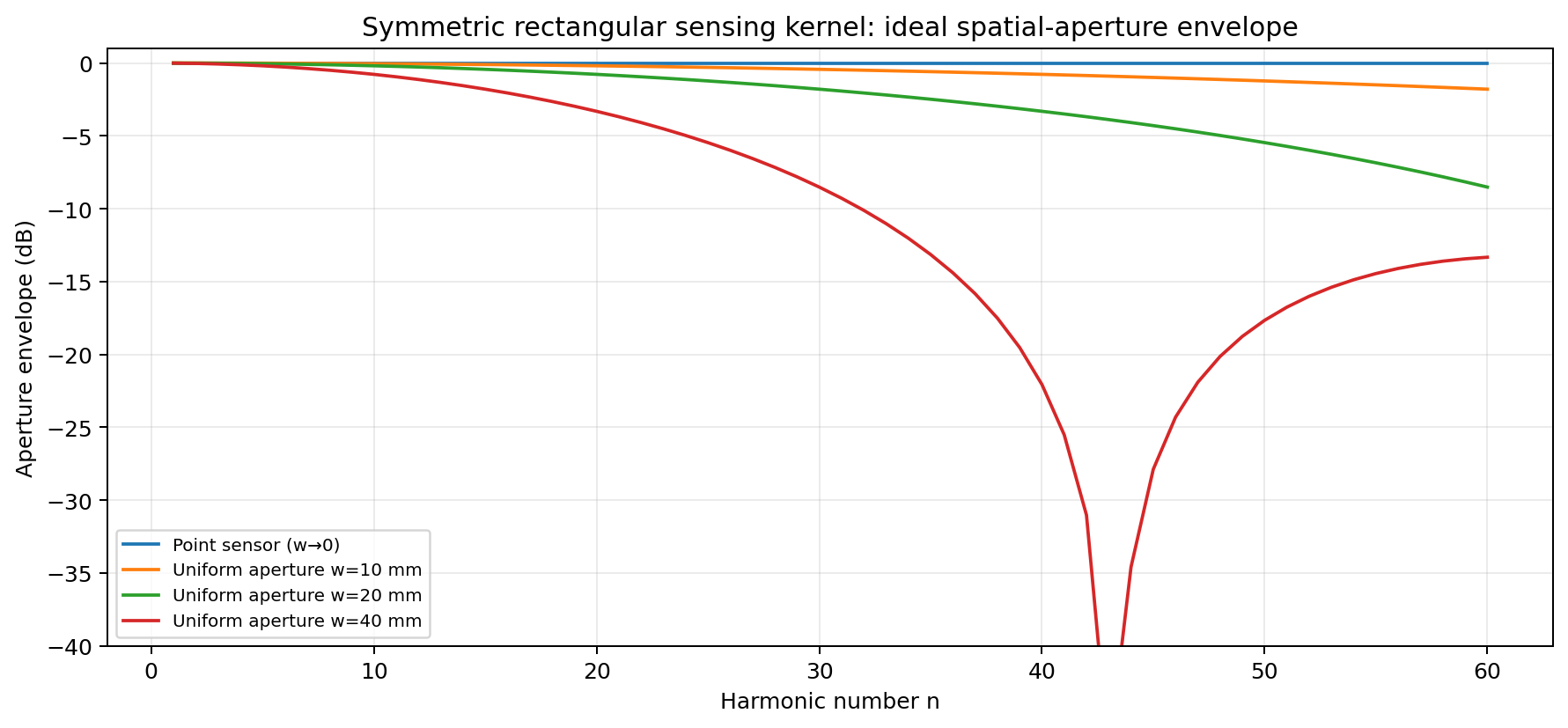
Figure 3. 대칭 직사각형 감지 커널의 이상화된 공간 개구 응답.
34-inch L=863.6 mm analytical example. Widths are illustrative W parameters, not measured pickup apertures. In this symmetric linear model the central position node is preserved while high-order modes are attenuated [2,3].
설계 원칙 Housing width ≠ effective sensing width. Pole diameter ≠ universal sensing width. Blade thickness ≠ universal sensing width. W_eff는 field map 또는 spectrum fit으로 pickup별 추정·검증한다. |
7. 자기장 형상 — 공간 샘플링도 픽업 고유의 자기장 안에서 일어난다
Point/finite-kernel model은 유용하지만 real magnetic pickup의 sensitivity는 permanent magnet, pole/blade, ferromagnetic string과 coil이 만드는 3D magnetic system에서 발생한다. Horton & Moore와 Lemarquand & Lemarquand의 모델은 string position이 coil-linked flux를 변화시키는 과정을 magnetic-field geometry로 다룬다 [4,5].
따라서 string–magnet gap, pole/blade alignment와 vibration polarization은 A02/C01의 confounder다. Pickup height를 바꾸면 level만 바뀌는 것이 아니라 field gradient, nonlinear response와 string에 가해지는 magnetic force까지 동시에 달라질 수 있다. Feinberg & Yang은 non-uniform magnetic field가 guitar string의 두 transverse natural-frequency mode를 split할 수 있음을 실험과 모델로 보였다 [6]. 이 효과의 크기는 pickup/magnet/string/gap에 의존하므로 universal 수치로 일반화하지 않는다.
설계 원칙 Pickup x-sweep 동안 string–magnet gap, pickup tilt, pole/blade alignment를 고정한다. Magnetic back-action은 physically real하지만 pickup-specific이므로 quantitative specification은 C01/별도 field test로 넘긴다. |
8. 멀티 픽업 혼합 — 공간적 부호와 전기적 위상을 구분한다
두 ideal point sensors의 spatial terms만 비교하면 signed mode-shape factor는 합 또는 차로 결합될 수 있다. 동일 gain, 동일 transduction phase, 동일 electrical response를 가정한 in-phase spatial baseline은 다음과 같다.
S₊(n) = sin(nπr₁)+sin(nπr₂) = 2 sin[nπ(r₁+r₂)/2] · cos[nπ(r₁−r₂)/2]
그러나 real instrument의 combined voltage는 이것보다 복잡하다. Pickup j의 wiring polarity p_j, magnetic polarity, complex electrical transfer G_j(f), load와 coil phase가 모두 개입한다. 개념적으로는 Y_n=Σ p_j·G_j(f_n)·H_j(n)·A_n처럼 적어야 한다. 따라서 “out of phase = cancellation”은 불충분한 표현이다. 어떤 harmonic이 얼마나 상쇄되는지는 spatial sign과 electrical phase/amplitude가 모두 결정한다 [2].
3PU 설계 원칙 Single-pickup spatial shortlist는 magnitude map으로 가능하지만 2PU/3PU combination은 signed spatial factor + pickup별 complex electrical transfer를 사용한다. A02는 spatial part를 정의하고 G_j(f)는 A03/A04로 넘긴다. |
9. 실제 현 — 비조화성과 공간 노드를 혼동하지 않는다
Real steel string의 bending stiffness는 modal frequencies를 정확한 integer multiple에서 벗어나게 만들어 inharmonicity를 만든다 [1,2]. 이것은 spectral notch가 Hz 축에서 완전한 harmonic grid와 어긋나는 중요한 이유지만, stiffness 자체가 fixed-end mode의 spatial node coordinate를 자동으로 이동시킨다고 말해서는 안 된다. Idealized stiff-string model에서도 boundary condition에 따라 mode shape는 sinusoidal 형태에 매우 가까울 수 있으며, 먼저 변하는 것은 modal frequency다.
Spatial mode shape와 node 위치가 실제로 ideal prediction에서 벗어나는 경로는 non-ideal fret/nut/bridge termination, structure coupling, local stiffness, 3D/elliptical transverse motion, asymmetric magnetic sensitivity 등이 더 직접적이다. 따라서 C01 FFT에서는 “정확한 n·f₀ bin”에 harmonic을 강제로 읽지 말고 각 modal peak를 local search로 추적한다. Ideal node coordinate와 실제 spectral minimum의 차이는 별도 residual로 기록한다.
검증 수정사항 Dispersion primarily warps modal frequencies; it does not by itself justify moving the ideal spatial node coordinate. Frequency inharmonicity와 spatial mode-shape deviation을 분리해 기록한다. |
10. RavenForge 좌표 모델 — 현 × 프렛 × 픽업 좌표를 저장한다
RavenForge에서는 pickup geometry를 body상의 하나의 center-mm로 끝내지 않는다. i번째 string, fret F, pickup j에 대해 실제 speaking length Lᵢ,F와 bridge saddle에서 해당 string의 effective sensing center까지의 distance dᵢ,j를 기록한다.
rᵢ,j,F = dᵢ,j / Lᵢ,F Hᵢ,j,F(n) = sin(nπrᵢ,j,F) (ideal signed spatial factor)
Ideal equal temperament에서는 Lᵢ,F=Lᵢ,0·2^(−F/12)로 계산할 수 있지만 compensated bridge에서는 실제 saddle-to-fret sounding length를 측정값으로 사용한다. Slanted pickup과 multiscale에서는 dᵢ,j와 Lᵢ,0가 string별로 동시에 달라질 수 있으므로 housing center 하나로 layout을 설명하는 것은 불충분하다.
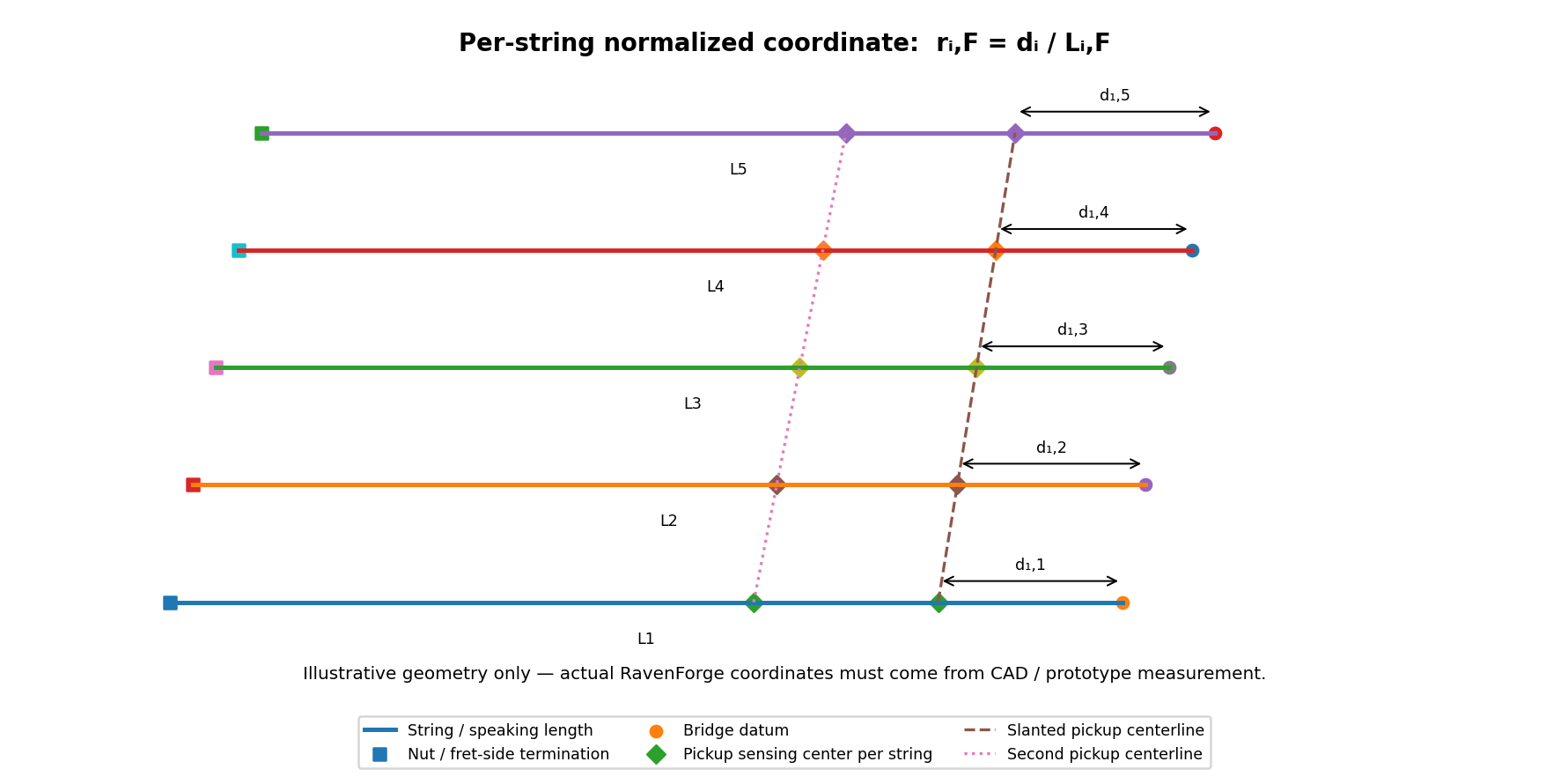
Figure 4. 멀티스케일 + 슬랜트 픽업에서 현별 dᵢ와 Lᵢ를 분리하는 RavenForge 좌표 정의.
Illustrative geometry only. Slant does not automatically equalize normalized coordinates; each string requires its own measured dᵢ/Lᵢ. Actual ASKR CAD coordinates are not plotted here.
Record field | Meaning | Why it matters |
dᵢ,j (mm) | string i saddle datum → pickup j effective center | routing / CAD physical coordinate |
Lᵢ,F (mm) | actual speaking length at fret F | compensation / multiscale 반영 |
rᵢ,j,F | dᵢ,j / Lᵢ,F | fret-dependent sampling coordinate |
W_eff,i,j | effective longitudinal sensing width | finite-aperture model |
gap / tilt | string–magnet gap / pickup orientation | sensitivity & back-action confound |
polarity / G_j(f) | wiring sign / electrical transfer | 2PU / 3PU combination |
멀티스케일 설계 원칙 A slanted pickup is not automatically “correct for multiscale.” Equal physical bridge distance and equal normalized coordinate are different design targets. RavenForge stores dᵢ/Lᵢ per string and chooses the slant from the intended sampling relation. |
11. RavenForge 적용 — ASKR, EMBLA, 향후 3PU
11.1 ASKR — 37–34인치 멀티스케일을 현별 샘플링 맵으로 본다
ASKR는 string마다 scale length가 다르고 pickup도 slanted geometry를 사용하므로 한 housing 안에서도 각 string의 normalized coordinate가 다를 수 있다. 따라서 “bridge-near”라는 single adjective 대신 string × fret × harmonic map을 만든 뒤, B02에서 정의한 target partial relation을 가장 잘 만족하는 coordinate family를 CAD 후보로 선택한다.
현재 A02에서는 ASKR의 실제 dᵢ를 임의로 채우지 않는다. current CAD에서 saddle별 geometry를 추출하고 실제 compensated speaking length를 사용해 open / 5th / 12th fret 및 주요 low-register note를 먼저 map한다.
11.2 EMBLA — 평행 프렛에서도 프렛 의존성은 남는다
EMBLA처럼 geometry가 단순한 34-inch platform에서도 같은 pickup의 normalized coordinate는 fret에 따라 변한다. 따라서 open-string fraction 하나로 “neck/bridge balance”를 판단하지 않고 실제 사용 register에서 repeated deep minimum이 나타나는지 확인한다.
11.3 향후 3PU — 공간적 다양성과 전기적 조합을 분리한다
3PU에서는 세 pickup이 서로 다른 spatial information을 제공하는지 먼저 single-pickup map으로 평가하고, pairwise / 3-way combination은 signed spatial factor와 A03/A04에서 얻을 complex electrical transfer를 결합해 검증한다. 시각적 균등 spacing이나 “neck/middle/bridge 세 캐릭터”만으로 위치를 정하지 않는다.
B02 연결 A02는 coordinate → ideal spatial relation을 제공한다. B02 — Voicing Before Specification에서는 target response를 먼저 정하고, 그 목표를 만족하는 candidate coordinate를 A02 map에서 역산한다. |
12. 근거 매트릭스 — 기술 검증 결과 반영
Claim | Assessment | Evidence | RavenForge wording |
Pickup position은 harmonic spectrum에 spatial signature를 남긴다 | Verified | Paiva [2]; Mohamad [3] | coordinate를 설계변수로 기록 |
H_pos∝sin(nπd/L)는 real pickup voltage 전체를 뜻한다 | Needs correction | ideal string / pickup models [2–4] | geometric spatial factor로만 사용 |
Ideal point-node condition r=m/n | Verified under assumptions | fixed-end point-sensor model [1–3] | ideal null hypothesis |
Fret이 바뀌면 fixed pickup의 normalized coordinate가 바뀐다 | Verified | geometry + fretted-note experiment [3] | per-fret map |
Pluck point도 harmonic null pattern을 만든다 | Verified | Mohamad [3] | q/L을 별도 coordinate로 통제 |
Finite sensing width는 high-order response를 평균화한다 | Verified model | Paiva [2]; Mohamad [3] | spatial low-pass tendency |
Symmetric finite width 자체가 central ideal node를 이동시킨다 | Incorrect | kernel symmetry analysis / Paiva framework [2] | symmetric linear model에서는 node 유지 |
Housing / pole / blade physical width = W_eff | Unsupported | 3D magnetic geometry [2,4,5] | pickup별 fit / field map 필요 |
String stiffness가 ideal spatial node를 직접 이동시킨다 | Not generalizable | musical acoustics / dispersion [1,2] | frequency inharmonicity와 mode-shape deviation 분리 |
두 pickup의 magnitude만 더하면 combination을 예측할 수 있다 | Incorrect | multi-pickup mixing [2] | signed spatial + complex G_j(f) |
Magnetic pickup은 string motion에 전혀 영향을 주지 않는다 | Incorrect universal assumption | Feinberg & Yang [6] | gap-dependent back-action confound |
JASA 2017의 3.53 mm는 universal pickup-position accuracy다 | Incorrect framing | Mohamad [3] | 특정 guitar/dataset/algorithm의 mean absolute error |
Slanted pickup은 자동으로 multiscale normalized coordinate를 맞춘다 | Not established | RavenForge geometric inference | dᵢ/Lᵢ per string 확인 |
현재 ASKR/EMBLA 좌표가 최적이다 | Not established | C01 data pending | B02 + C01 required |
13. A02 기반 C01 프로토타입 측정 프로토콜
A02의 analytical model은 “어떤 spatial effect를 기대할 것인가”를 제공하지만 production coordinate는 measurement repeatability를 통과해야 한다. 특히 Mohamad et al.의 single-pickup position mean absolute error 3.53 mm는 그들의 guitar, strings, recording setup과 inversion algorithm에서 얻은 결과이며 RavenForge의 measurement resolution이나 허용공차로 그대로 사용할 수 없다 [3]. C01 acceptance threshold는 RavenForge fixture의 R&R 결과를 본 뒤 정한다.
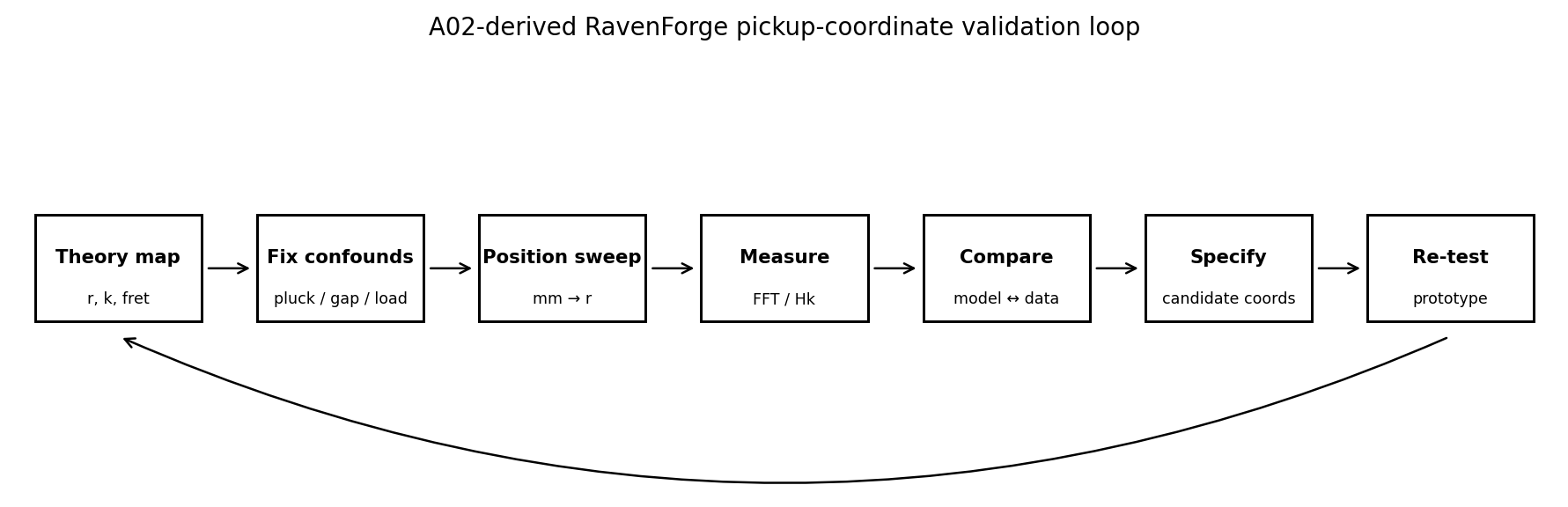
Figure 5. A02에서 파생한 RavenForge 픽업 좌표 검증 루프.
Engineering workflow only. The experiment must first resolve its own repeatability before millimetre differences become design specifications.
Stage | Record / condition | Decision |
Geometry survey | actual saddle→pickup dᵢ, Lᵢ,F, pickup gap / tilt | coordinate lock |
String condition | same model/gauge/age, tuning, intonation, temperature log | string confound control |
Pluck-fixture R&R | same q, displacement, direction, plectrum width/thickness; 20–30× | release variance |
Pickup lock | same pickup unit, gap, pole/blade alignment, orientation | magnetic confound control |
Electrical lock | same high-Z DI/buffer or fixed load, cable, gain, ADC | A03/A04 confound control |
Coarse position sweep | 5–10 mm pilot steps across routable range | large spatial gradient map |
Fine sweep | only where effect > repeatability; 2–5 mm candidate steps | production-resolution test |
Fret / string matrix | open / 5 / 12 anchors + model-specific registers; all strings where possible | fret/multiscale map |
Time-window analysis | attack and early-decay windows stored separately | dynamic dependence |
Modal peak tracking | local peak near each predicted partial, not fixed n·f₀ bin | inharmonicity handling |
Normalization | absolute DI level + H_n/H_1 + optional total-energy normalized metrics | avoid single normalization bias |
Uncertainty | release / reinstall / analysis variance + confidence interval | effect vs noise |
Prototype re-test | final routed position with normal electronics | system-level confirmation |
Sample rate와 FFT size는 physics의 필수값이 아니라 measurement design이다. RavenForge baseline으로 96 kHz / 24-bit를 사용할 수 있지만, pickup-position inference 자체가 96 kHz를 요구하는 것은 아니다. Raw waveform은 항상 보존하고, Hann window와 충분한 time span을 사용해 local modal peak를 추적한다. Fundamental-normalized ratio만 저장하면 fundamental 자체가 spatial minimum에 가까운 경우 해석이 왜곡될 수 있으므로 absolute DI level도 함께 보존한다.
측정 원칙 No millimetre claim before R&R. Model prediction보다 먼저 σ_release, σ_reinstall, σ_analysis를 구하고, observed position effect가 combined uncertainty보다 충분히 큰 경우에만 CAD tolerance 또는 production coordinate로 승격한다. |
14. 현재 결론 — 픽업 위치는 “한 점의 톤”이 아니라 조건부 공간 샘플링 기하학이다
A02의 verified baseline은 명확하다. Ideal string의 mode shape는 pickup coordinate에 따라 sin(nπr)의 spatial factor를 제공하고, fretting은 speaking length를 바꿔 같은 physical pickup의 normalized coordinate를 계속 변화시킨다. Plucking point는 별도의 excitation coordinate이며, finite sensing kernel은 high-order spatial response를 평균화한다. 그러나 real pickup voltage는 이 geometric layer에 magnetic transduction과 electrical transfer가 추가된 결과다 [2–5].
따라서 RavenForge는 “bridge / neck”, “sweet spot”, “몇 mm 움직이면 밝아진다”를 설계 근거로 직접 사용하지 않는다. Pickup coordinate는 string별 d, actual speaking length, fret-dependent r, W_eff, gap과 combination state를 함께 기록하고, production coordinate는 C01 repeatability와 prototype measurement를 통과해야 한다.
현재 설계 입장 Pickup position is a conditional spatial sampling geometry, not a fixed tone point. The ideal sin(nπr) map supplies the geometric baseline; pickup-specific magnetic transduction, electrical transfer and measurement uncertainty determine how much of that baseline survives in the real instrument. |
15. 다음 연구 — B02와 C01로 넘기는 것
Code | Research question | A02에서 넘기는 변수 |
B02 | Voicing Before Specification | target harmonic relation → candidate normalized coordinate |
C01 | Pickup Position FFT Mapping | ideal map vs measured spectrum, W_eff, fret/string matrix, uncertainty |
A03 | Magnetic Pickups as RLC Systems | pickup-specific G_j(f), R/L/C, resonance, Q |
A04 | Electrical Loading of Passive Pickups | pot / cable / input impedance와 G_j(f) 변화 |
C02 | Pickup Loading Measurement | loaded transfer-function validation |
참고문헌
[1] Fletcher, N. H.; Rossing, T. D. The Physics of Musical Instruments. Springer. Stretched-string modes, stiffness and musical-acoustics reference.
[2] Paiva, R. C. D.; Pakarinen, J.; Välimäki, V. “Acoustics and Modeling of Pickups.” Journal of the Audio Engineering Society 60(10), 768–782 (2012). Pickup position, sensitivity width, mixing, dispersion, nonlinear magnetic behavior and electrical response.
[3] Mohamad, Z.; Dixon, S.; Harte, C. “Pickup Position and Plucking Point Estimation on an Electric Guitar via Autocorrelation.” Journal of the Acoustical Society of America 142(6), 3530–3540 (2017). DOI: 10.1121/1.5016815. Reports 3.53 mm mean absolute error for single-pickup position under the study’s own instrument, dataset and algorithmic conditions.
[4] Horton, N. G.; Moore, T. R. “Modeling the Magnetic Pickup of an Electric Guitar.” American Journal of Physics 77(2), 144–150 (2009). DOI: 10.1119/1.2990663.
[5] Lemarquand, G.; Lemarquand, V. “Calculation Method of Permanent-Magnet Pickups for Electric Guitars.” IEEE Transactions on Magnetics 43(9), 3573–3578 (2007). DOI: 10.1109/TMAG.2007.891671.
[6] Feinberg, J.; Yang, B. “Natural-frequency splitting of a guitar string caused by a non-uniform magnetic field.” Journal of the Acoustical Society of America 144(5), EL460–EL464 (2018). DOI: 10.1121/1.5080465.
[7] Lindroos, N.; Penttinen, H.; Välimäki, V. “Parametric Electric Guitar Synthesis.” Computer Music Journal 35(3), 18–27 (2011). DOI: 10.1162/COMJ_a_00066.
[R1] RavenForge / Signal & Transduction Research Log A01. “From Mechanical Vibration to Electrical Signal.” 2026.09.05.
[R2] RavenForge internal research sequence. A02 → B02 / C01 → A03/A04 → C02.
출처 상태 및 해석 범위 A02는 published physical model, published experiment와 RavenForge engineering inference를 구분한다. sin(nπd/L)은 ideal point-sampling geometric factor이며 real pickup voltage 전체가 아니다. Rectangular finite-width sinc relation과 multiscale per-string coordinate는 문헌 framework를 CAD/measurement에 적용한 analytical models다. Symmetric linear sensing kernel에서는 central ideal node가 유지되므로 finite width만으로 node shift를 주장하지 않는다. Mohamad et al.의 3.53 mm는 universal tolerance가 아니라 해당 연구의 mean absolute error이며, RavenForge C01 threshold는 자체 R&R 이후 정한다. Magnetic back-action은 물리적으로 지지되지만 pickup-specific이고, coil RLC와 external loading은 A03/A04에서 분리한다. |
Working research document · 2026.09.06