RAVENFORGE / LIBERAL ARTS RESEARCH LOG — L02
RAVENFORGE
Liberal Arts Research Log
L02 — The Instrument as an Extension of the Body
From body schema and technological transparency to player-relative instrument geometry
문서 목적 |
Code | L02 |
Focus | Body schema · embodiment relation · musician–instrument coupling · affordance · ergonomics · player-relative geometry |
Evidence | Phenomenology / postphenomenology · embodied music cognition · Applied Ergonomics · posture / biomechanics studies · anthropometric standards |
RavenForge link | neck profile · scale / multiscale · string spacing · body geometry · bridge / strap / COM · player-relative fret position |
Downstream logs | A02 next in sequence · future human-factors C-series validation |
Status | Literature framework established · RavenForge prototype validation pending |
1. 연구 질문 — 악기는 언제 외부 물체에서 “연주 가능한 신체”로 바뀌는가
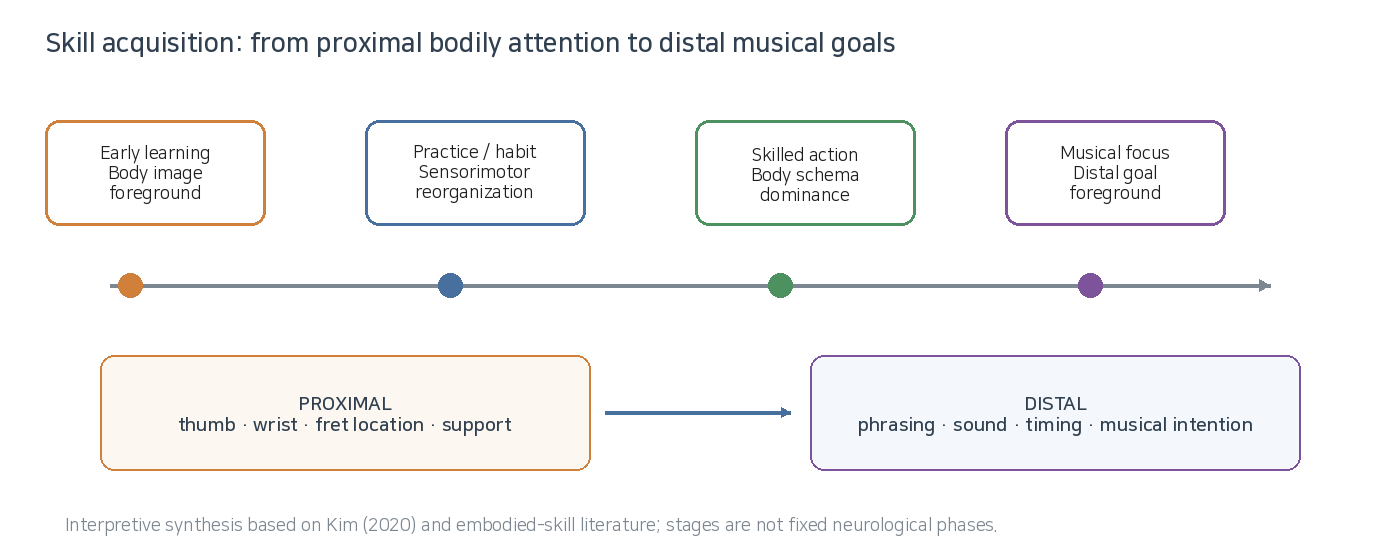
악기를 처음 배울 때 연주자의 주의는 손가락 위치, 손목 각도, 현 위치, 악기 지지와 같은 proximal bodily state에 집중된다. 숙련이 진행되면 이러한 조작의 상당 부분이 habitual action으로 이동하고, 주의는 sound, phrasing, timing과 같은 distal musical goal로 이동할 수 있다. Kim은 instrumental skill acquisition을 body image와 body schema의 역동적 관계, 그리고 proximal에서 distal로의 attentional shift로 분석한다 [3].
따라서 L02에서 RavenForge가 묻는 질문은 단순히 “이 악기는 편한가?”가 아니다. 더 직접적인 질문은 “이 geometry가 연주자가 악기 자체를 계속 조작·지지·교정하는 데 주의를 쓰게 하는가, 아니면 그 주의를 musical action으로 이동시킬 수 있게 하는가?”이다.
핵심 관점 |
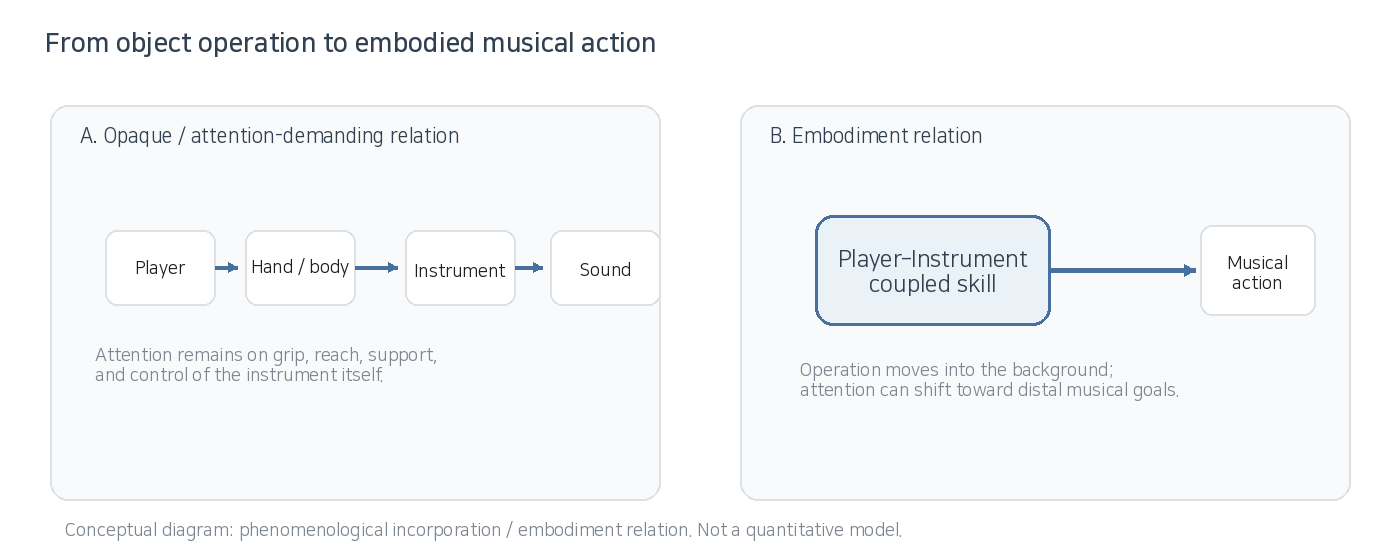
Figure 1. 외부 물체의 조작에서 embodiment relation으로 이동하는 개념적 구조. RavenForge schematic · phenomenological framework based on Merleau-Ponty, Ihde, Kim and Nijs [1–4]. |
2. Body Schema — Merleau-Ponty, habit, 그리고 “I can”
2.1 Body image와 body schema
현대적 해석에서 body image는 자신의 신체를 지각·판단·의식하는 층위와 관련되고, body schema는 숙련된 행동 아래에서 작동하는 pre-reflective sensorimotor organization에 가깝다 [3]. 연주자가 매 순간 모든 손가락 위치를 계산하지 않아도 특정 프렛과 현을 찾아가는 것은 이러한 habitual motor organization의 좋은 사례다.
Merleau-Ponty의 핵심은 신체를 단순한 공간 속 물체가 아니라 “내가 할 수 있는 것(I can)”의 중심으로 본다는 데 있다 [1]. 악기 설계에 옮기면 치수는 정적인 comfort dimension이 아니라 어떤 fretting, muting, reaching, shifting action을 연주자에게 즉시 가능하게 하는 조건으로 읽을 수 있다.
2.2 Tool incorporation — cane가 문자 그대로 신체가 되는 것은 아니다
Merleau-Ponty의 blind man’s cane 사례에서 숙련된 사용자는 지팡이의 끝을 별도의 물체처럼 계산하기보다 그 끝을 통해 세계의 위치와 표면을 탐색한다 [1]. 이때 incorporation은 도구가 생물학적으로 신체가 된다는 의미가 아니라, 도구를 포함한 새로운 action space가 habitual body schema 안에서 작동한다는 현상학적 주장이다.
현대 실험에서도 반복적인 tool use가 이후 free-hand movement kinematics와 body representation에 영향을 줄 수 있다는 결과가 보고됐다 [6]. 다만 이를 근거로 “기타가 동일한 신경학적 방식으로 신체 일부가 된다”고 직접 일반화하지 않는다. RavenForge에서는 phenomenological incorporation과 empirical body-representation plasticity를 서로 다른 evidence level로 기록한다.
Design rule |
Figure 2. 숙련 과정에서 proximal bodily attention이 distal musical goal로 이동하는 개념적 모델. Interpretive synthesis based on Kim (2020) [3]. Stages are conceptual, not fixed neurological phases. |
3. Embodiment Relation — Ihde와 technological transparency
Don Ihde의 postphenomenology에서 embodiment relation은 technology를 통해 세계를 경험하면서 technology 자체가 경험의 foreground에서 물러나는 관계다. 이를 도식화하면 (Human–Technology) → World로 표현할 수 있다 [2]. 음악기술 연구에서는 충분히 숙련된 musician–instrument relation을 이러한 transparency와 연결해 설명한다 [3,4].
여기서 transparency는 physically unobtrusive와 같은 말이 아니다. 작고 가볍고 얇은 악기라고 자동으로 transparent하지 않으며, 반대로 두꺼운 neck도 특정 player의 habitual grip과 안정적으로 결합한다면 연주 중 지속적인 attention bottleneck이 되지 않을 수 있다.
Design rule |
4. Musician–Instrument Coupling — affordance는 악기 안에 고정되어 있지 않다
Krueger는 musical affordance를 음악과 환경이 제공하는 action possibility로 다루며, 음악적 활동을 brain–body–music의 통합된 system으로 설명한다 [5]. Nijs, Lesaffre & Leman 역시 musical instrument를 musician의 “natural extension”이라는 관점에서 다루며 performer–instrument interaction을 연구한다 [4].
따라서 동일한 37-inch scale도 모든 player에게 동일한 affordance를 제공하지 않는다. hand span, forearm length, habitual thumb strategy, instrument pose와 task가 달라지면 동일 geometry가 요구하는 reach와 movement도 달라진다. “37 inch = ergonomic” 또는 “37 inch = unergonomic”이라는 문장보다, 특정 player context에서 어떤 movement strategy와 compensation을 요구하는가가 더 직접적인 질문이다.
Revised assumption |
5. Ergonomics as Body–Instrument Coupling — comfort보다 interaction geometry
Marmaras & Zarboutis는 1997년 existing electric guitar models에서 연주자의 fatigue나 difficulty를 증가시키는 특성을 식별하고 ergonomic requirements를 도출한 뒤 새 electric guitar를 설계했다. 세 기존 모델과의 비교에서 새 디자인이 better user fit을 보였다고 보고했다 [7]. 이는 conventional electric-guitar geometry 자체가 이미 인간공학적 optimum이라는 가정을 지지하지 않는다.
Genani, Dekker & Molenbroek의 electric-guitar 연구도 survey, user observation, biomechanical analysis와 laboratory measurement를 통해 bad posture와 high wrist flexion을 주요 문제로 다루고 새로운 ergonomic guitar를 제안했다 [8]. 중요한 것은 특정 역사적 outline을 유지하는 것이 아니라 neck position, support와 instrument orientation을 human–instrument interface의 변수로 취급했다는 점이다.
Classical-guitar support 연구에서는 동일한 악기에서도 support dimension과 positioning에 따라 posture, comfort와 self-efficacy 평가가 달라졌다 [9]. 특히 subjective comfort와 postural-risk score가 완전히 같은 방향으로 움직이지 않았다는 점은 “편하게 느껴진다 = biomechanically optimal”이라는 직접 등식을 피해야 한다는 근거가 된다.
Rousseau 등의 systematic review는 musician posture 연구에서 visual assessment와 3D analysis 등이 사용되지만 “physiological posture”의 정의가 일관되지 않고, playing posture impairment와 pain 사이의 강한 연관성을 가정할 근거가 부족하다고 정리했다 [10]. 따라서 RavenForge의 human-factors log는 injury prevention을 직접 주장하지 않고 prototype interaction을 비교하는 engineering validation으로 제한한다.
Evidence boundary |
6. Myth of the “Full-Size Ergonomic Baseline”
6.1 “작은 바디는 로우 프렛을 멀게 한다”는 인과관계의 문제
인터넷에서는 종종 `small body → neck이 바깥으로 이동 → first fret이 멀어짐 → full-size body가 ergonomic`이라는 논리가 제시된다. 그러나 body outline의 전체 길이·면적 자체는 player-relative first-fret coordinate를 직접 결정하지 않는다. 실제로 body geometry가 영향을 줄 수 있는 경로는 support point, seated contact datum, bridge position, strap coordinates, center of mass와 equilibrium orientation을 통해 instrument pose를 바꾸는 것이다.
따라서 더 방어 가능한 causal chain은 `body geometry → support / contact / balance → player-relative instrument pose → fret reach`이다. 특정 compact design이 bridge나 contact datum을 잘못 배치해 first position을 멀게 만들 수는 있지만, 이는 compact outline의 필연적 결과가 아니다. 같은 이유로 conventional full-size outline도 first-position reach를 자동으로 개선하지 않는다.
6.2 “Full-size”는 ergonomic category인가
이번 조사에서 확인한 electric-guitar ergonomics 연구와 anthropometric standard는 사용자를 anatomical landmark, body dimension, posture, instrument position, support와 load distribution으로 기술한다 [7–11]. ISO 7250-1은 technological design을 위한 human body measurement definitions와 landmarks를 제공하지만 “full-size guitar/bass body”를 ergonomic category로 정의하지 않는다 [11].
따라서 RavenForge에서는 “full-size”를 역사적·시장적 size description으로는 사용할 수 있어도, 표준화된 인간공학 변수 또는 neutral ergonomic baseline으로 취급하지 않는다. 전통적 outline이 오랜 기간 사용되었다는 사실은 familiarity와 manufacturing lineage의 근거가 될 수 있으나 anthropometric optimization을 입증하지 않는다.
Design rule |
7. Player-Relative Instrument Geometry — 바디 크기가 아니라 scale이 몸에 어디에 놓이는가
RavenForge에서는 low-fret reach를 body length가 아니라 player coordinate system에서 정의한다. 오른손잡이 player의 fretting-side shoulder landmark를 S, instrument reference datum의 player-relative translation을 t, neck orientation을 R(θ), instrument 내부에서 fret n의 좌표를 pₙ이라 두면, player-relative fret coordinate는 다음과 같이 쓸 수 있다.
p_Fn,player = t + R(θ) · p_Fn,instrument
그리고 shoulder에서 fret n까지의 reach vector는 r_S→Fn = p_Fn,player − p_S, 실제 거리 proxy는 D_S,Fn = ||r_S→Fn||로 기록할 수 있다. 이것은 기존 논문의 직접 식이 아니라, L02 문헌에서 확인한 geometry / posture / anthropometry 변수를 RavenForge CAD 및 prototype measurement에 적용하기 위해 도출한 engineering coordinate model이다.
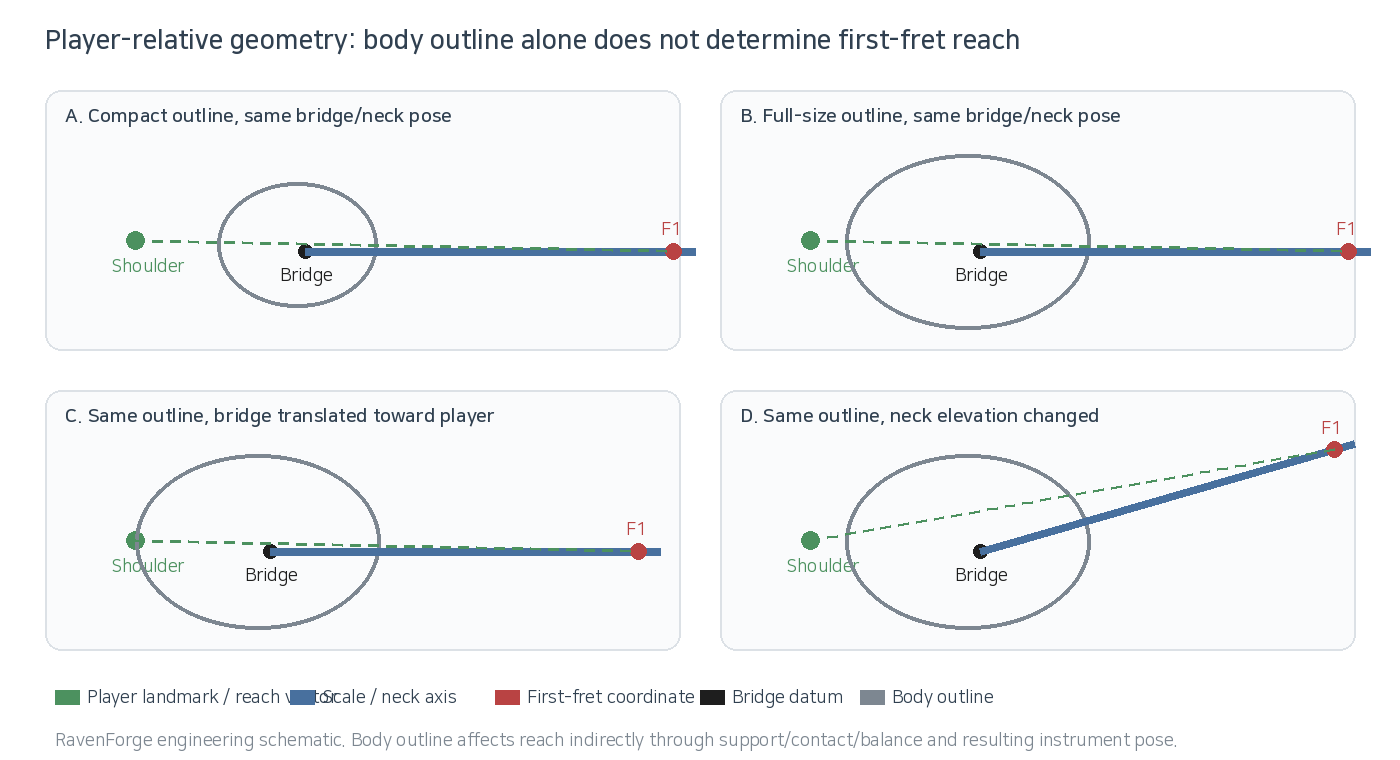
이 모델에서 body area나 overall body length는 독립항으로 등장하지 않는다. body는 bridge/contact/strap datum과 orientation을 바꾸는 방식으로 t와 R(θ)에 간접적으로 영향을 준다. 따라서 서로 다른 body outline에서도 bridge와 neck pose가 player frame에서 동일하면 first-fret coordinate는 동일할 수 있고, 같은 outline에서도 bridge translation이나 neck elevation이 달라지면 reach가 달라질 수 있다.
Figure 3. body outline 자체와 player-relative first-fret reach를 분리하는 RavenForge geometry schematic. Legend is embedded in the figure. Blue = scale axis; red = F1; green = player landmark/reach; black = bridge; grey = body outline. RavenForge engineering model, not experimental data. |
7.1 Scale length와 instrument placement도 분리한다
Equal temperament에서 34-inch(863.6 mm)의 nut→F1 거리는 약 48.47 mm이고 37-inch(939.8 mm)는 약 52.75 mm로, nut 주변의 첫 fret spacing 차이는 약 4.28 mm다. 반면 bridge가 player frame에서 같은 위치에 고정된다고 가정하면 bridge→F1의 longitudinal position 차이는 약 71.92 mm가 된다. 두 수치는 서로 다른 질문을 나타낸다.
따라서 “37 inch라 1프렛이 4 mm 더 멀다”와 “같은 bridge datum에서 scale 전체가 약 72 mm 더 길게 전개된다”를 혼동하면 안 된다. 실제 reach를 평가하려면 scale length와 함께 bridge player-coordinate, body contact, strap suspension 및 neck elevation을 측정해야 한다.
8. RavenForge Application — body–instrument coupling variable로 다시 정의한다
Design variable | L02에서의 의미 | Prototype measurement |
Neck profile | thumb–palm–finger interaction | thumb position / wrist angle / subjective effort |
Neck width / string spacing | fretting·muting·crossing affordance | finger spread / accuracy / hand strategy |
Scale length | player-relative fret distribution | shoulder→F1/F5/F12 |
Multiscale / fret fan | wrist·forearm trajectory | wrist deviation / shift path |
Body contour / size | torso·thigh contact interface | pose repeatability / contact datum |
Bridge body-coordinate | scale 전체 translation | bridge→torso / shoulder→F1 |
Upper horn / strap point | standing suspension geometry | neck elevation / horizontal position |
Center of mass | equilibrium orientation / neck dive | support correction / unloaded rotation |
Instrument mass | prolonged support load | posture drift / perceived effort |
Control placement | right-hand task interruption | reach excursion / task time |
8.1 ASKR — 37–34 inch multiscale을 “길다/짧다”가 아니라 player-relative geometry로 평가한다
ASKR의 37–34 inch multiscale은 conventional 34-inch bass보다 low-string speaking length가 길지만, 이것만으로 “1프렛이 너무 멀다” 또는 “multiscale이라 더 ergonomic하다”고 결론내리지 않는다. 최소한 bridge player-coordinate + strap support + seated contact datum + neck elevation + fret fan을 함께 기록하고, shoulder→F1/F5/F12 및 wrist/elbow/shoulder response를 비교한다.
첫 사용의 낯섦 역시 별도 변수다. embodied-skill literature는 새로운 instrument relation이 반복 practice와 adaptation을 거쳐 변할 수 있음을 지지하지만 [3,4], 이를 “불편한 설계도 익숙해지면 된다”는 면책 논리로 사용해서는 안 된다. 초기 unfamiliarity와 반복 세션 이후에도 남는 unnecessary compensation을 구분해야 한다.
ASKR validation rule |
8.2 EMBLA 및 future RavenForge designs
EMBLA의 neck feel도 profile thickness 하나로 환원하지 않는다. neck width, string spacing, body balance와 neck orientation이 함께 habitual hand strategy를 만든다. 향후 compact body를 설계하더라도 “compact ergonomic body”라는 label을 먼저 붙이지 않고, traditional full-size body 역시 neutral baseline으로 두지 않는다. 양쪽 모두 같은 player-relative coordinate와 task protocol로 비교한다.
9. Evidence Matrix — L02에서 어디까지 주장할 수 있는가
Claim | Assessment | Evidence | RavenForge wording |
Habitual skill은 body schema와 연결된다 | Supported framework | Merleau-Ponty / Kim [1,3] | habitual sensorimotor organization |
Tool use가 body representation을 바꿀 수 있다 | Supported | Cardinali et al. [6] | plasticity evidence; guitar-specific generalization 금지 |
숙련된 instrument가 transparent하게 경험될 수 있다 | Supported conceptually | Ihde / Kim / Nijs [2–4] | reduced attention to operation |
Musician–instrument를 coupled system으로 볼 수 있다 | Supported framework | Krueger / Nijs [4,5] | player × instrument interaction |
Affordance가 모든 player에게 동일하다 | Incorrect | affordance framework [5] | morphology / skill / task context 기록 |
Conventional full-size body가 ergonomic optimum이다 | Not supported | ergonomic redesign studies [7,8] | conventional ≠ ergonomic reference |
Compact body는 본질적으로 F1을 멀게 한다 | Not generalizable | RavenForge geometry inference | measure player-relative F1 |
큰 body가 악기를 오른쪽으로 밀어 항상 유리하다 | Depends on geometry | support/contact logic [7–9] | standing/seated datum 별도 측정 |
Subjective comfort만으로 optimum을 판단할 수 있다 | Not supported | support study [9] | subjective + objective channels |
특정 posture가 pain의 직접 원인이다 | Not established | systematic review [10] | no clinical causality claim |
Multiscale은 보편적으로 ergonomic하다 | Not established | direct comparative evidence insufficient | RavenForge validation required |
처음 낯설면 non-ergonomic이다 | Not sufficient | skill-acquisition framework [3,4] | familiarity ≠ long-term embodiment |
10. L02-derived Human-Factors Prototype Measurement Protocol
문헌은 instrument–player interaction이 중요하다는 근거를 제공하지만 RavenForge의 최적 치수값을 직접 제공하지 않는다. 따라서 prototype에서는 동일 player가 여러 geometry를 경험하는 within-subject engineering comparison을 우선하고, population-level ergonomic proof와 내부 design screening을 구분한다.
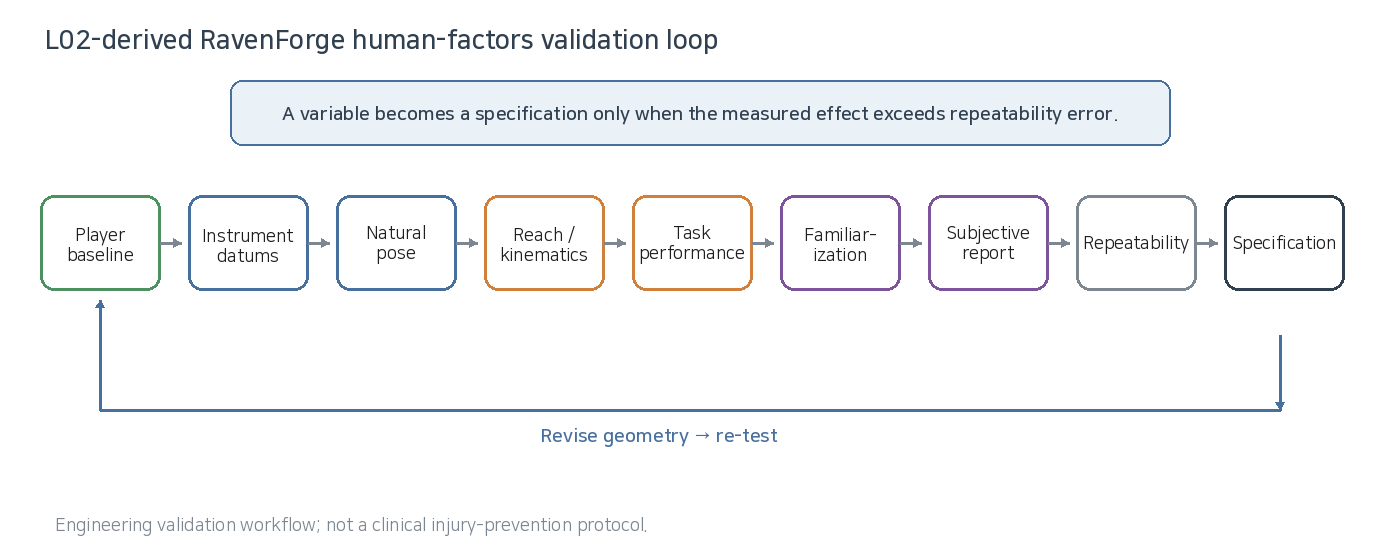
Figure 4. L02-derived RavenForge human-factors validation loop. A variable becomes a specification only when the observed effect exceeds measurement and repetition error. Engineering workflow; not a medical protocol. |
Stage | Record | Decision |
Anthropometry | stature, shoulder breadth, upper-arm / forearm length, hand span, key landmarks | player context |
Instrument datums | bridge, nut, F1/F5/F12, strap points, contact points, COM | instrument reference |
Standing pose | bridge / neck player-coordinate, elevation / yaw | standing geometry |
Seated pose | thigh / torso contact datum, bridge position | seated geometry |
Low-fret task | shoulder→F1/F5, elbow / shoulder / wrist angles | first-position demand |
Position shift | F1↔F12 trajectory, time, error | scale navigation |
Right-hand task | playing zone→control reach | control ergonomics |
Balance test | unloaded neck tendency, corrective support | neck-dive / support demand |
Extended block | pose drift, subjective effort | sustained interaction |
Familiarization | repeated sessions | immediate vs adapted response |
Transparency report | instrument awareness / task focus | exploratory phenomenological metric |
Gauge R&R | repeated landmark / angle measurement | measurement noise floor |
Measurement rule |
2026년 bass-guitar support 연구는 15명의 experienced bassist에 motion capture, postural assessment와 musculoskeletal modelling을 적용하고, 세 가지 support configuration을 anthropometric percentile별로 시뮬레이션했다 [12]. 이 연구가 RavenForge body design의 직접 정답을 주는 것은 아니지만, bass ergonomics를 “body size”가 아니라 support geometry, pose, muscular demand와 anthropometry의 관계로 분석할 수 있음을 보여주는 최신 사례다.
11. 현재 결론 — Ergonomics는 body outline의 속성이 아니다
L02에서 악기를 “신체의 연장”이라고 부르는 것은 낭만적인 비유가 아니다. 숙련된 musical interaction에서는 habitual body schema, instrument affordance와 support geometry가 결합하고, 연주자의 attention이 instrument operation에서 distal musical goal로 이동할 수 있다 [1–5].
따라서 RavenForge에서 ergonomics는 제품에 붙이는 adjective가 아니라 player–instrument relation의 성능이다. Material, scale, body outline, neck profile과 strap point를 각각 독립적인 “편안함 부품”으로 보지 않고, 이들이 player-relative pose와 action space를 어떻게 구성하는지 측정한다.
Current design position |
RavenForge의 human-factors design sequence는 `player → task → instrument geometry → player-relative pose → kinematics / effort → adaptation → specification`으로 정의한다.
12. Next Research — L02 이후의 역할 분담
Code | Research question | L02에서 넘기는 변수 |
A02 | Pickup Position and Harmonic Sampling | normalized pickup coordinate, node/null, finite sensing width |
B02 | Voicing Before Specification | target response → specification 역산 |
Future C03 | Player-Relative Reach Mapping | shoulder / torso datum → F1/F5/F12 |
Future C04 | Balance & Support Kinematics | COM, strap/support line, instrument pose |
Future C05 | Neck Profile & Hand Interaction | thumb / wrist / hand strategy |
Future C06 | Scale / Multiscale Adaptation | initial familiarity vs repeated-session compensation |
References
[1] Merleau-Ponty, M. Phenomenology of Perception. Gallimard, 1945; English translations by Routledge. Body schema, habit and the blind-man’s cane are used here as phenomenological framework rather than quantitative ergonomic evidence.
[2] Ihde, D. Technology and the Lifeworld: From Garden to Earth. Indiana University Press, 1990. Embodiment relation / human–technology–world framework.
[3] Kim, J. H. “From the Body Image to the Body Schema, From the Proximal to the Distal: Embodied Musical Activity Toward Learning Instrumental Musical Skills.” Frontiers in Psychology 11, 101 (2020). DOI: 10.3389/fpsyg.2020.00101.
[4] Nijs, L.; Lesaffre, M.; Leman, M. “The Musical Instrument as a Natural Extension of the Musician.” In Music and Its Instruments, Éditions Delatour France, 2013, pp. 467–484.
[5] Krueger, J. “Affordances and the Musically Extended Mind.” Frontiers in Psychology 4, 1003 (2014). DOI: 10.3389/fpsyg.2013.01003.
[6] Cardinali, L. et al. “Tool-use induces morphological updating of the body schema.” Current Biology 19(12), R478–R479 (2009). DOI: 10.1016/j.cub.2009.05.009.
[7] Marmaras, N.; Zarboutis, N. “Ergonomic redesign of the electric guitar.” Applied Ergonomics 28(1), 59–67 (1997). DOI: 10.1016/S0003-6870(96)00032-4.
[8] Genani, G.; Dekker, M. C.; Molenbroek, J. F. M. “Design of an ergonomic electric guitar.” Tijdschrift voor Ergonomie 38(2), 43–49 (2013). TU Delft repository UUID: 913d9ce8-4a22-471d-8adf-311937698992.
[9] Valenzuela-Gómez, S.-A.; Rey-Galindo, J.-A.; Aceves-González, C. “Analyzing working conditions for classical guitarists: Design guidelines for new supports and guitar positioning.” Work 65(4), 891–901 (2020). DOI: 10.3233/WOR-203140.
[10] Rousseau, C.; Taha, L.; Barton, G.; Garden, P.; Baltzopoulos, V. “Assessing posture while playing in musicians – A systematic review.” Applied Ergonomics 106, 103883 (2023). DOI: 10.1016/j.apergo.2022.103883.
[11] ISO 7250-1:2017. Basic human body measurements for technological design — Part 1: Body measurement definitions and landmarks.
[12] Meglio, G.; Guacci, M.; Laiola, N.; Naddeo, A. “Human Digital Biomechanical Twin-Driven Ergonomic Optimization of Bass-Guitar Support Systems: Predictive Design and Experimental Validation.” Applied Sciences 16(11), 5224 (2026). DOI: 10.3390/app16115224.
[R1] RavenForge / Signal & Transduction Research Log A01. “From Mechanical Vibration to Electrical Signal.” 2026.09.05.
[R2] RavenForge internal Liberal Arts research sequence. L01 → A01 → L02 framework.
Source-status note |
Working research document · 2026.09.06