RAVENFORGE / MODEL MATERIAL SELECTION LOG — EDDA
RAVENFORGE
Model Material Selection Log
EDDA — Why Alder, and What Does “Heritage” Mean?
From Fender-derived vintage grammar to Alembic / Wal and parallel bass lineages
문서 목적 |
Projects | RavenForge EDDA — 4-string / 34" heritage & improved-vintage platform |
Current body | 3-piece solid: Alder center core + Alder side wings |
Recommended body | 3-piece solid: Alder center core + Limba side wings |
Current neck | 1-piece Maple standard · 3-piece Maple option |
Current fretboard | Rosewood standard · Ebony recommended reference |
Premium materials | Jindai Keyaki body · Ironwood / Bog Oak fretboard · Ancient Kauri cap — Custom / Request |
Status | Design rationale established · matched prototype validation pending |
1. 출발점 — EDDA는 왜 처음 계획에 없던 모델에서 “유산” 연구 플랫폼이 되었는가
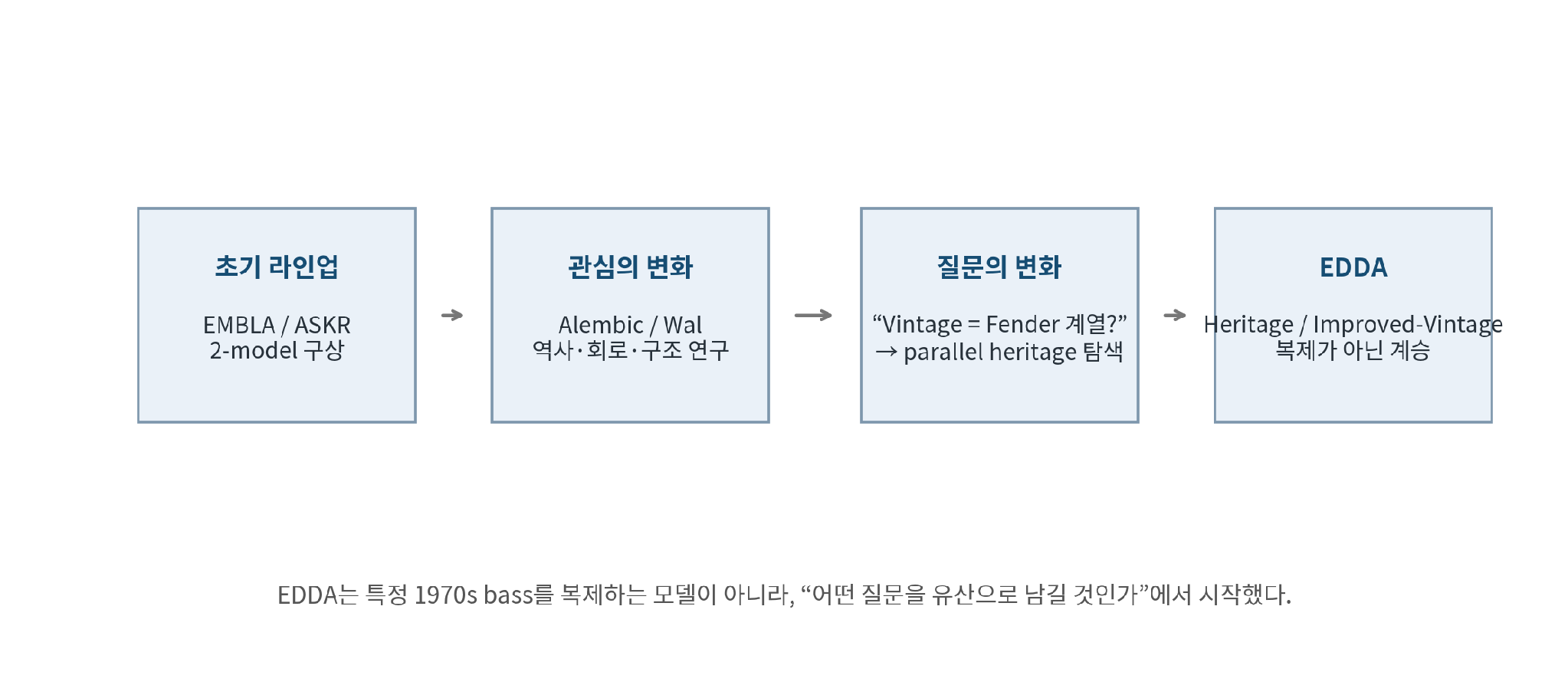
RavenForge의 초기 라인업은 EMBLA와 ASKR처럼 현대적인 연주성, 다현·장스케일 확장, 라미네이트 넥과 적극적인 전자계통을 중심으로 잡혀 있었다. 그 단계에서 EDDA 같은 별도의 vintage-oriented model은 필요하다고 생각하지 않았다. 이미 시장에는 Precision/Jazz Bass 계열의 형태와 부품 구성을 반복하는 “빈티지” 제품이 충분히 많았고, RavenForge가 같은 문법을 하나 더 만드는 것은 연구 가치가 낮다고 봤기 때문이다 [R3].
전환점은 Alembic과 Wal을 단순한 고가 빈티지 브랜드가 아니라 “당대의 베이스 설계를 다시 정의하려 했던 engineering lineage”로 보기 시작하면서 생겼다. 그 역사를 따라가면 1970년대의 유산은 오래된 body shape나 nitro finish에만 있지 않다. pickup의 impedance, onboard gain, filter topology, 전용 hardware, multi-laminate construction, studio/road feedback까지 악기 전체를 하나의 시스템으로 재설계하려는 태도 자체가 유산이었다 [1–4].
핵심 관점 |
Figure 1. EDDA가 초기 라인업 밖에서 추가된 개념적 경로. RavenForge internal development narrative [R3]. |
1.1 Fender의 유산을 부정하는 것이 아니라, “빈티지”의 범위를 넓힌다
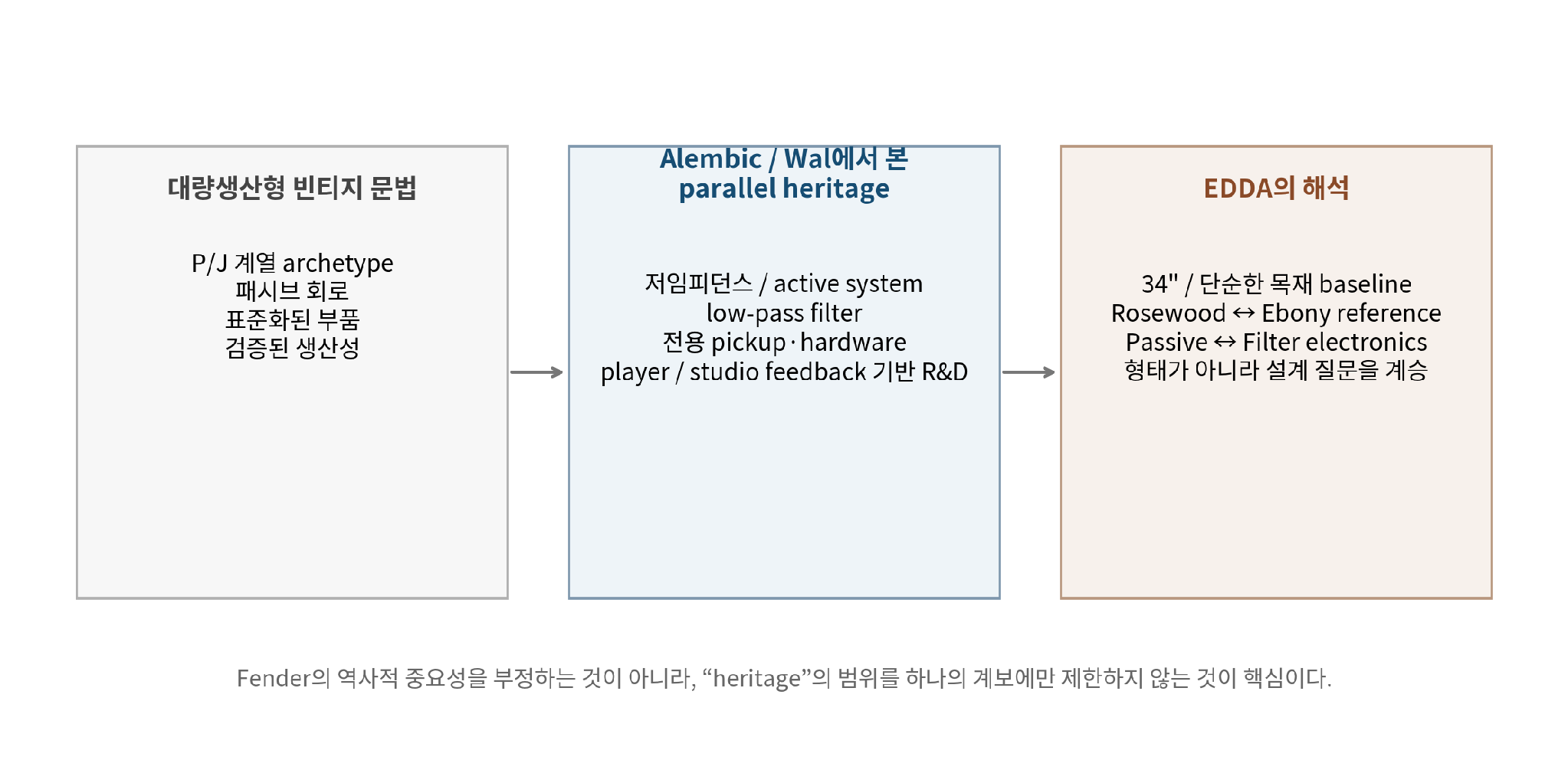
Fender의 Precision/Jazz Bass는 전기베이스 역사에서 가장 중요한 기준점 중 하나이며, Alder/Maple/Rosewood와 수동 회로가 산업적으로 축적한 데이터와 연주 경험 역시 무시할 수 없다. 다만 현대 시장에서 vintage라는 단어가 이 계열의 silhouette, pickup layout, passive control에 과도하게 수렴하면 Alembic, Wal처럼 전혀 다른 방향으로 “전기베이스란 무엇인가”를 다시 설계했던 계보가 가려진다. EDDA의 목적은 Fender 계열을 지우는 것이 아니라, heritage의 좌표계를 확장하는 데 있다.
2. Heritage Reference — Alembic과 Wal에서 실제로 계승하려는 것은 무엇인가
2.1 Alembic — 목재보다 먼저 “instrument + electronics = one system”을 만든 계보
Alembic은 1969년 Ron과 Susan Wickersham이 라이브 사운드와 녹음 품질을 개선하는 consulting operation으로 시작했고, 이후 악기 자체의 noise와 bandwidth 문제로 연구 범위를 넓혔다. Alembic의 공식 역사에 따르면 Ron Wickersham은 넓은 bandwidth를 위해 low-impedance pickup과 이를 보상하는 onboard preamp를 개발했고, 1972년에는 Jack Casady를 위한 첫 자체 bass를 제작했다 [1]. Series I 역시 pickup과 electronics를 별개 부품이 아니라 하나의 system으로 설명하며, low-pass filter tone control을 핵심으로 둔다 [2].
다만 “Alembic이 최초의 active electric instrument를 발명했다”는 식의 절대명제는 피한다. Vintage Guitar의 역사 정리에는 1962년 Burns TR2처럼 더 이른 onboard preamp 사례가 언급된다 [5]. 따라서 EDDA가 가져오는 역사적 결론은 “최초” 경쟁이 아니라, Alembic이 low-impedance pickup·active preamp·filter·custom construction을 boutique bass의 통합 설계 언어로 정착시키는 데 선구적인 역할을 했다는 점이다.
2.2 Wal — professional feedback, proprietary pickup, per-pickup low-pass filter
Wal의 공식 역사에서는 1976년 session player John G. Perry의 custom bass를 출발점으로 제시하며, Ian Waller와 Pete Stevens가 top-flight player와 recording producer의 피드백을 설계 과정에 지속적으로 반영했다고 설명한다 [3]. 현재 Wal의 pickup은 각 string에 대응하는 matched coil pair를 사용하고, preamp는 각 pickup별 electronic low-pass filter와 roll-off frequency control, pull boost를 조합한다 [4].
이 지점은 EDDA에 직접적으로 중요하다. “빈티지”를 passive V/T control의 복원으로만 이해하면 1970년대에 이미 존재했던 filter-based instrument design을 오히려 역사 밖으로 밀어내게 된다. EDDA가 passive를 standard로 두면서도 Double NFP나 custom dual-filter architecture를 주요 확장축으로 유지하는 이유는 이 계보를 복제하지 않고 연구하기 위해서다 [R1].
Figure 2. EDDA가 사용하는 heritage의 범위. Historical references: Alembic [1,2], Wal [3,4]. Diagram is a RavenForge interpretation, not a market-share claim. |
Design rule |
3. Body — 왜 Alder가 EDDA의 기준재인가
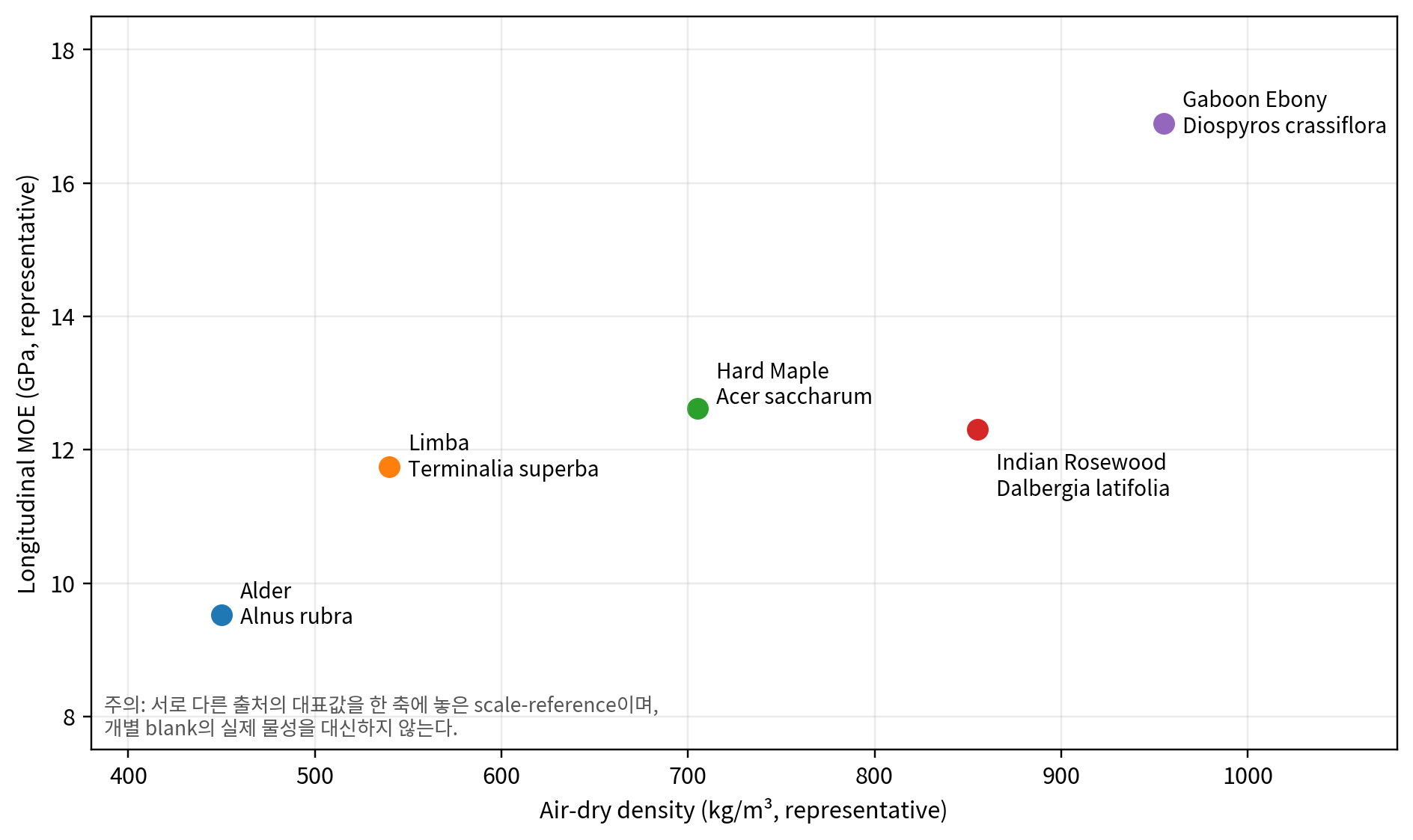
현재 EDDA의 표준 바디는 Alder center core + Alder side wings의 3-piece solid construction이다 [R1]. 이 선택은 “Alder가 빈티지 톤을 낸다”는 관용적 문장을 과학적 사실로 채택한 것이 아니다. Red Alder(Alnus rubra)의 대표 air-dry density는 약 450 kg/m³, longitudinal MOE는 약 9.5 GPa 수준으로, Hard Maple이나 Ebony 같은 고밀도 재료보다 가볍고 낮은 stiffness 영역에 위치한다 [6,7]. 가공·도장성이 좋고 body blank로 반복 조달하기 쉬운 편이라는 점도 생산 기준재로서 유리하다 [6].
EDDA에서 Alder의 역할은 “Fender와 같은 소리”가 아니라 familiar reference coordinate다. 34인치 4현, 비교적 단순한 Maple neck, passive baseline이라는 구조에서 body mass를 과도하게 키우지 않고, 이후 pickup/filter/hardware 변경을 비교할 수 있는 출발점을 만든다. 실제 완성 악기의 tonal result는 Alder라는 종명으로 예측하지 않고 bridge-side FRF와 string decay로 확인한다 [R2].
EDDA body question | Design response |
Why Alder? | 낮~중간 밀도의 반복 가능한 기준재; 전체 질량 관리와 가공성이 좋음 |
Why 3-piece? | core/wing blank를 개별 선별하고 결함·질량 편차를 관리하기 쉬움 |
Main risk | Alder도 blank별 밀도·함수율 편차가 존재; “가벼움”을 종명으로 보장할 수 없음 |
Control method | MC·mass·density 기록 → 완성 body/bridge FRF → 실제 string decay 비교 |
3.1 Limba wing — “따뜻한 나무”가 아니라 peripheral mass / stiffness를 바꾸는 controlled variant
Recommended EDDA에서는 Alder center core를 유지하면서 Limba(Terminalia superba) side wing을 선택할 수 있다 [R1]. ITTO 자료에서 Limba의 대표 air-dry density는 약 0.54 g/cm³, MOE는 약 11.7 GPa, tangential/radial shrinkage ratio는 약 1.4로 제시되며 가공성도 양호하다 [8]. 즉 Alder보다 다소 높은 밀도·강성 영역을 가지면서도 극단적인 heavy hardwood는 아니다.
이 조합의 연구 가치는 “Limba가 warmer하다”는 전통적 설명이 아니라, bridge와 neck joint가 놓이는 center core는 Alder로 유지하고 peripheral wing의 mass/stiffness window를 바꾸는 데 있다. 물론 접착된 body는 하나의 연속 구조이므로 wing만 음향적으로 독립된다고 말할 수는 없다. Alder/Alder와 Alder/Limba의 body mode, bridge mobility, 총중량을 같은 프로토콜로 비교해야 의미가 생긴다.
Figure 3. EDDA에 직접 관련된 주요 재료의 대표 density–MOE 위치. Representative values: USDA / Wood Database [6,7,9–11], ITTO [8]. Mixed-source scale reference only. |
4. Neck — 왜 EDDA는 5-piece laminate가 아니라 1-piece / 3-piece Maple인가
EMBLA와 ASKR가 5-piece laminated neck을 생산 baseline으로 삼는 것과 달리, EDDA는 1-piece Maple을 표준, 3-piece Maple을 option으로 둔다 [R1]. 이것은 “한 피스 넥이 더 빈티지하게 울린다”는 가설을 채택한 것이 아니다. EDDA는 의도적으로 neck architecture의 복잡도를 낮춰 34인치 4현 heritage platform의 구조적 reference를 만들고, body·fingerboard·electronics의 변화를 별도로 관찰하기 쉽게 한다.
Hard Maple(Acer saccharum)의 대표 air-dry density는 약 705 kg/m³, longitudinal MOE는 약 12.6 GPa로, Alder보다 높은 stiffness/mass 영역에 위치한다 [9]. 그러나 실제 neck stiffness는 species가 아니라 profile, grain orientation, truss rod, reinforcement, fingerboard와 접착된 최종 section geometry에 의해 결정된다 [R2]. 따라서 “Maple neck = bright” 같은 문장은 사용하지 않는다.
4.1 3-piece Maple의 의미 — 강화 마케팅이 아니라 stock selection option
3-piece Maple은 조각 수가 늘어났다는 이유만으로 자동으로 1-piece보다 강하거나 안정적이라고 가정하지 않는다. 이 옵션의 실제 장점은 각 strip의 grain runout과 결함, 밀도, 함수율을 선별하고 좌우 배치를 조정할 수 있다는 데 있다. EDDA에서는 이 단순한 1pc↔3pc 비교 자체가 좋은 연구 변수가 된다. 동일 fingerboard와 profile로 matched neck을 만들 수 있다면 modal frequency, torsional tendency, RH cycle 후 relief 변화까지 직접 비교할 수 있다.
Design rule |
5. Fingerboard — Rosewood와 Ebony를 “reference pair”로 유지하는 이유
EDDA는 Rosewood를 standard, Ebony를 recommended reference로 둔다 [R1]. 이 역시 전통적 색채 묘사보다 비교 가능성이 우선이다. Liu et al.은 fretboard material을 같은 실험계에서 비교하면서 Indian Rosewood, Ebony, African Blackwood, Hard Maple의 밀도·MOE·hardness·swelling·wear를 측정했다 [12]. 해당 실험에서 Indian Rosewood의 air-dry density는 0.81 g/cm³, Ebony는 1.21 g/cm³였고, 두 재료 모두 지판용 hardness와 wear 기준을 충족했지만 물성과 치수반응에는 차이가 있었다 [12].
따라서 Rosewood↔Ebony는 “warm↔bright”의 심리적 축이 아니라, 밀도·경도·강성·mass contribution이 다른 두 established fretboard material을 같은 neck family에서 비교하는 축이다. EDDA가 ASKR처럼 Mpingo/Kingwood의 최대 물성치를 우선 탐색하지 않는 이유도 여기 있다. EDDA는 고밀도 지판 경쟁보다 “역사적으로 익숙한 두 reference가 완성 neck assembly에서 어떤 차이를 만드는가”를 먼저 보는 모델이다.
6. Premium Fingerboard — Ironwood와 Bog Oak는 왜 stock-specific material인가
6.1 “Ironwood”는 종명이 아니다 — technical BOM에서는 반드시 학명으로 분해한다
현재 portfolio에서는 EDDA premium fingerboard에 “Ironwood / Bog Oak”가 Custom / Request로 제시되어 있다 [R1]. 그러나 Ironwood는 단일한 botanical species가 아니라 여러 지역의 서로 다른 고밀도 수종에 붙는 commercial/common name이다. 따라서 실제 제작 BOM과 연구기록에서는 “Ironwood”만으로 density, MOE, oil content, CITES status, 접착성이나 가공성을 추정해서는 안 된다. 확보 stock의 정확한 species identification과 provenance가 확인될 때만 별도 material candidate로 등록한다.
6.2 Bog Oak — 오래됐다는 사실은 “더 안정적이고 더 단단하다”는 보증이 아니다
Bog Oak는 수백~수천 년 동안 습윤·저산소 환경에 매몰된 oak가 화학·미생물학적 변화를 겪은 material이다. 2022년 Venetian Plain의 bog oak 연구에서는 겉보기엔 intact한 내부에도 bacterial degradation과 큰 shrinkage 변화가 확인됐고, 기존 연구와 비교하면 density·hardness·strength 변화의 방향도 sample과 매몰환경에 따라 단순하지 않다 [13]. 즉 “천년 묵은 oak니까 mechanically superior”라는 이야기는 근거가 없다.
그럼에도 Bog Oak가 EDDA에 어울리는 이유는 오히려 다른 데 있다. EDDA가 다루는 heritage라는 개념을 재료 자체의 time-depth와 provenance가 직접 보여줄 수 있기 때문이다. 따라서 premium status는 음향적 서열이 아니라 희소성, 역사성, stock-specific processing cost에 대한 분류다. 실제 blank는 crack, density, MC, dimensional response를 개별 측정하고 사용할지 결정한다.
7. Premium Body / Top — Jindai Keyaki와 Ancient Kauri를 “오래된 나무”라는 이유로 미화하지 않는다
7.1 Jindai Keyaki — 문자 그대로 시간의 흔적을 가진 재료, 그러나 working risk도 heritage의 일부다
Japan Kogei Association은 Jindai를 “신대(神代)에서 온 것”이라는 뜻의 매우 오래된 목재로 설명하며, Keyaki(Zelkova), Sugi, Kuri 등이 오랜 기간 땅에 묻히거나 물속에 잠긴 재료를 가리킨다고 정리한다. 동시에 이러한 timber는 매우 귀하게 여겨지지만 가공에 극도의 주의가 필요하다고 명시한다 [14].
이 특성은 EDDA premium body로서의 매력과 위험을 동시에 설명한다. Jindai Keyaki는 “예전 나무라 resonance가 좋다”는 근거 없는 upgrade가 아니라, provenance와 변형 이력을 가진 unique stock이다. 1-piece chambered body로 사용할 경우에는 완성 width 확보 여부, crack/check, MC gradient, density, chamber wall thickness를 먼저 확인해야 하며, 기준을 통과하지 못하면 premium이라는 이유로 억지로 사용하지 않는다.
7.2 Ancient Kauri — 오래된 재료가 오히려 낮은 MOE를 가질 수 있다는 직접 반례
30,000-year-old Ancient Kauri와 modern Kauri를 비교한 Freedland, Rowell, Plackett의 연구에서는 매몰 환경이 cell-wall structure를 변화시켰고, ancient material의 MOE와 proportional-limit 관련 지표가 modern wood보다 유의하게 낮았다. MOR 역시 낮아져 오래된 재료가 자동으로 더 강하고 탄성적인 것은 아니라는 점을 보여준다 [15].
따라서 EDDA에서 Ancient Kauri cap은 “고대 목재라서 더 좋은 tone”을 내기 위한 부품이 아니라, 재료의 시간성과 시각적 provenance를 드러내는 top option이다. 수 mm 이상의 cap으로 사용할 경우 body mass와 bending stiffness에 개입할 수 있으므로, thin decorative veneer와 structural cap을 분리해 기록해야 한다 [R2].
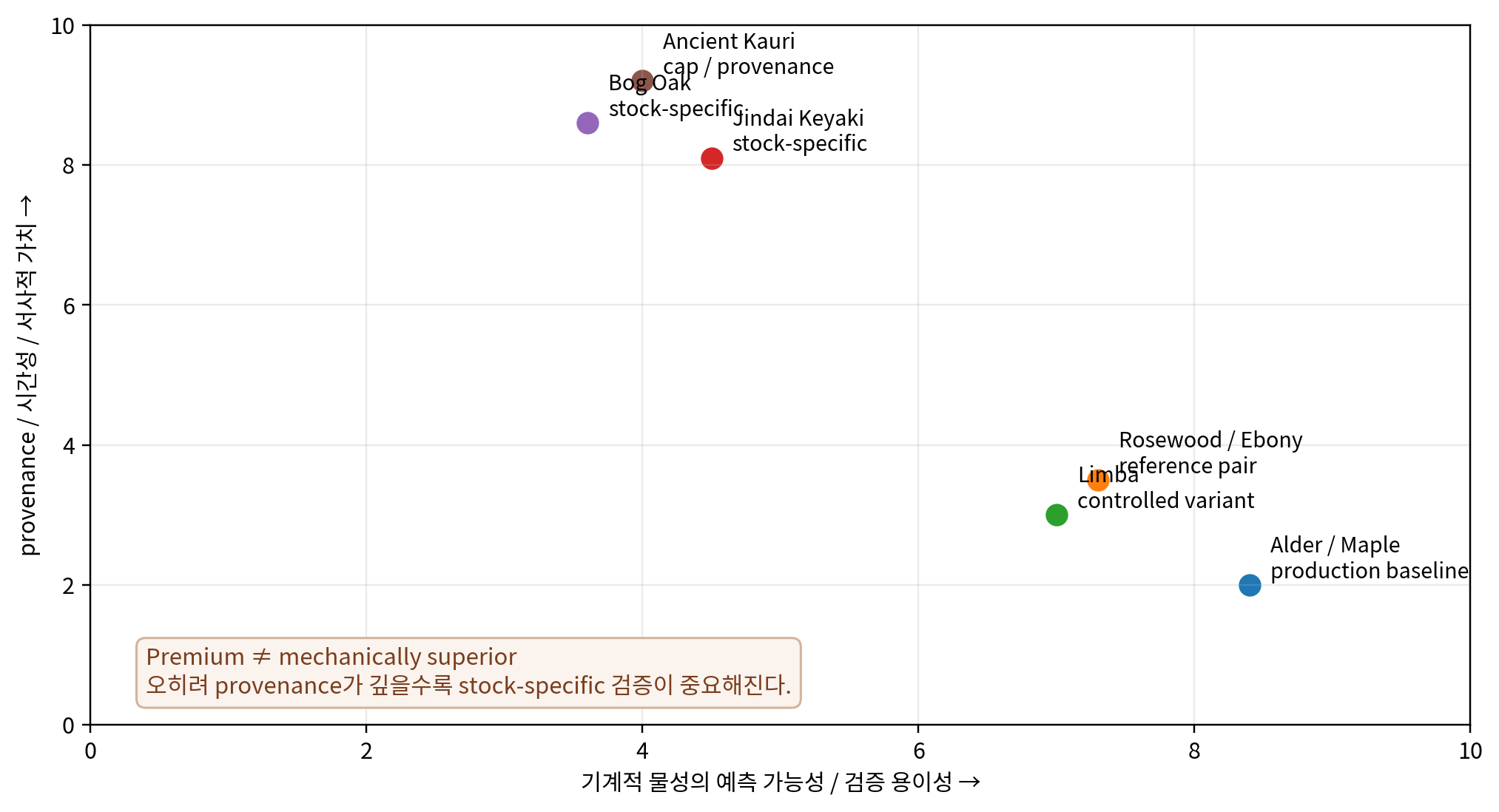
Figure 4. EDDA premium material을 해석하는 기준. Historical/provenance value and mechanical certainty are separate axes. Jindai [14], Bog Oak [13], Ancient Kauri [15]. |
8. Electronics — EDDA의 “유산”은 목재보다 회로에서 더 명확하게 드러날 수 있다
현재 EDDA의 standard electronics는 passive이며, recommended 단계에서는 Lusithand Double NFP MKII 같은 filter-based preamp, premium 단계에서는 custom dual-filter system을 연구 대상으로 둔다 [R1]. 이 hierarchy는 “active가 상급”이라는 가격 서열이 아니다. Passive baseline은 pickup 자체와 악기 구조의 변화를 비교하기 위한 reference이고, filter system은 Alembic/Wal에서 확인한 역사적 설계 질문을 현대적으로 다시 다루기 위한 별도 architecture다.
특히 Wal의 현재 circuit은 각 pickup별 low-pass filter의 roll-off frequency를 조절하고, pull function으로 roll-off 근처 harmonic를 강조하는 방식이다 [4]. Alembic Series I도 pickup과 electronics를 하나의 system으로 보며 low-pass filter를 핵심 tone control로 사용한다 [2]. EDDA는 이 topology의 역사적 의미를 참고하지만 proprietary circuit을 복제하지 않는다. cutoff range, Q, output level, pickup loading을 RavenForge 목적에 맞춰 독립적으로 설계하고 level-matched test를 수행하는 것이 원칙이다.
Heritage rule |
9. Standard / Recommended / Premium — 가격 등급이 아니라 연구 리스크와 변수의 단계
Item | Standard | Recommended | Premium / Research |
Strings / Scale | 4-string / 34" | 4-string / 34" | 4-string / 34" |
Neck | 1-pc Maple | 3-pc Maple | 3-pc Maple / stock-selected |
Fingerboard | Rosewood | Ebony | Species-specified Ironwood or verified Bog Oak — Request |
Body | 3-pc Alder / Alder | Alder core + Limba wings | 1-pc chambered Jindai Keyaki — Request |
Top | Matching Alder | Flame Maple veneer | Ancient Kauri cap — Request |
Electronics | Passive | Double NFP filter | Custom dual-filter architecture |
Research role | production/reference baseline | controlled material/electronic variants | high provenance + high stock-specific uncertainty |
이 표에서 Premium은 “더 좋은 소리”를 뜻하지 않는다. 오히려 standard에서 멀어질수록 procurement, provenance, material variability, 가공 리스크와 측정 필요성이 커진다는 의미다. 특히 Jindai, Bog Oak, Ancient Kauri는 각 stock의 history가 물성의 일부이므로 종명 평균값으로 설계를 끝낼 수 없다.
10. Evidence Matrix — 현재 어디까지 주장할 수 있는가
Claim | Assessment | Evidence | RavenForge wording |
Alembic/Wal은 Fender와 다른 bass heritage를 보여준다 | Supported historical basis | Official histories / components [1–4] | Parallel lineage로 설명; 시장 전체의 우열 주장 금지 |
Alembic이 active electronics를 “최초 발명”했다 | Too absolute | Earlier active-preamp example exists [5] | Pioneered integrated low-Z / active boutique-bass system |
Alder는 “빈티지 톤”을 보장한다 | Not supported | Species label ≠ output [R2] | Low–medium density production/reference baseline |
Limba wing은 warmer tone을 만든다 | Not established | Material data only [8] | Peripheral mass/stiffness variant; measure FRF |
3-pc Maple이 1-pc보다 무조건 안정적이다 | Not generalizable | Beam / material variability [R2] | Selection/symmetry option; matched test required |
Rosewood와 Ebony는 지판 물성이 다르다 | Supported | Direct fretboard study [12] | Use as established reference pair |
Bog Oak는 오래돼서 mechanically superior하다 | Not supported | Stock/degradation variability [13] | Provenance material; inspect every blank |
Ancient Kauri는 오래돼서 더 stiff하다 | Contradicted by cited sample | Ancient-vs-modern study [15] | Primarily provenance/top hypothesis; measure cap |
Jindai는 premium acoustic upgrade다 | Not established | Craft terminology / stock variability [14] | Premium = rarity/history/processing, not tonal rank |
Filter electronics는 “modern”일 뿐 vintage와 무관하다 | Incorrect historically | Alembic / Wal [1–4] | Filter systems are part of 1970s bass heritage |
11. EDDA Prototype Measurement Protocol
문헌과 역사 연구는 “왜 이 재료를 시험하는가”를 설명할 뿐, 완성 EDDA의 결과를 대신하지 않는다. EDDA에서는 material A/B와 electronics A/B를 가능한 한 분리해 아래 순서로 기록한다.
Figure 5. EDDA material / electronics validation loop. RavenForge measurement plan linked to Material & Acoustics Research Log 01 [R2]. |
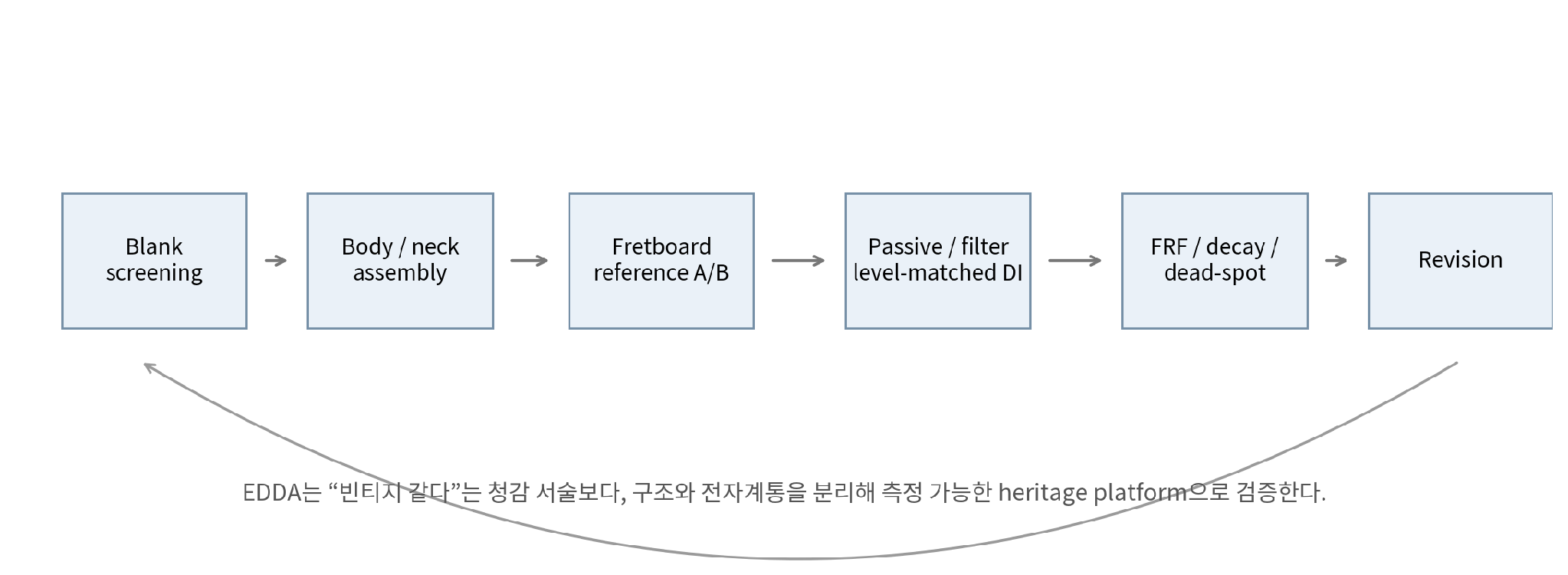
Stage | Record | Decision |
Raw body / neck blank | MC, dimensions, mass, density, grain/runout, cracks/checks | accept / reject / chamber plan |
Alder/Alder vs Alder/Limba body | mass, bridge-side FRF, main body modes | wing-material hypothesis |
1-pc vs 3-pc Maple neck | mass, relief, tap/FRF, torsional tendency, RH cycle | neck architecture baseline |
Rosewood vs Ebony matched neck | board mass/thickness, finished-neck FRF, fret conductance | fretboard reference A/B |
Passive vs filter electronics | same pickup, normalized output, DI spectrum/noise, control sweep | electronics-only comparison |
Premium stock | species/provenance, density, defects, MC gradient, machining notes | stock-specific go/no-go |
Assembled bass | neck/bridge conductance, partial decay, T60, dead spots | actual system response |
12. 현재 결론 — EDDA에서 “유산”은 실루엣이 아니라 아직 끝나지 않은 설계 질문이다
EDDA는 처음부터 계획된 vintage model이 아니었다. 오히려 Alembic과 Wal의 역사를 따라가면서, 전기베이스의 heritage를 Fender 계열의 형태와 passive recipe만으로 축소할 수 없다는 문제의식에서 뒤늦게 생겨난 모델이다. Alembic은 low-impedance pickup과 onboard electronics를 악기 전체의 시스템으로 다뤘고, Wal은 proprietary multi-coil pickup과 per-pickup low-pass filter, professional feedback을 통해 별도의 설계 문법을 만들었다 [1–4]. EDDA가 계승하려는 것은 바로 그 “전체 시스템을 다시 질문하는 태도”다.
그래서 재료 선택도 의도적으로 과장하지 않는다. Alder는 익숙하고 비교 가능한 body baseline이며, Limba wing은 mass/stiffness를 바꾸는 controlled variant다. Maple 1-piece/3-piece neck은 단순한 reference architecture이고, Rosewood/Ebony는 물성이 다른 established fretboard pair다. 반면 Jindai Keyaki, Bog Oak, Ancient Kauri는 오래됐다는 이유로 기계적 우위를 부여하지 않는다. 그들의 가치가 provenance와 시간성에 있다면, 그만큼 물성은 stock별로 다시 측정해야 한다 [13–15].
EDDA의 improved-vintage라는 표현은 “옛날 소리를 더 잘 복제한다”는 뜻이 아니다. 과거의 설계에서 아직 유효한 질문을 분리하고, 현재의 제작 정밀도와 측정 방법으로 다시 검증한다는 뜻이다. 그 결과가 Rosewood/passive일 수도 있고, Ebony/filter preamp일 수도 있다. 어느 쪽도 history를 장식으로 소비하지 않고 실제 engineering variable로 다룬다는 점이 EDDA의 기준이다.
Current design position |
References
[1] Alembic, Inc. “A Brief History of Alembic.” Official company history. Alembic states that the company began in March 1969 and developed low-impedance pickups with onboard preamplification before building its own basses; first Alembic bass 72-01 in 1972. https://www.alembicguitars.com/history.html
[2] Alembic, Inc. “Series I Bass.” Official model documentation. Describes pickup/electronics as one system and uses low-pass filter tone controls. https://alembicguitars.com/seriesibass.html
[3] Wal Basses. “About Us / History.” Official history. Wal basses entered the scene in 1976 from John G. Perry’s custom commission; Ian Waller and Pete Stevens developed the instruments with professional player/producer feedback. https://walbasses.co.uk/about-us/
[4] Wal Basses. “Components.” Official pickup/preamp documentation. Matched coil pairs per string; individual electronic low-pass filters and harmonic boost functions. https://walbasses.co.uk/components/
[5] Moseley, W. G. “Alembic Distillate DMSB.” Vintage Guitar. Notes Burns TR2 (1962) as an earlier onboard-preamp example and Alembic’s major role from 1969 onward. https://www.vintageguitar.com/3920/alembic-distillate-dmsb/
[6] Alden, H. A. Hardwoods of North America. USDA Forest Products Laboratory, General Technical Report FPL-GTR-83 (1995). DOI: 10.2737/FPL-GTR-83.
[7] Meier, E. “Red Alder (Alnus rubra).” The Wood Database — representative air-dry density / MOE cross-check. https://www.wood-database.com/red-alder/
[8] ITTO / Tropical Timber. “Limba/Fraké (Terminalia superba).” Air-dry density, shrinkage, MOE, workability reference. https://www.tropicaltimber.info/specie/limbafrake-terminalia-superba/
[9] Meier, E. “Hard Maple (Acer saccharum).” The Wood Database — representative density / MOE cross-check. https://www.wood-database.com/hard-maple/
[10] Meier, E. “East Indian Rosewood (Dalbergia latifolia).” The Wood Database — representative density / MOE cross-check. https://www.wood-database.com/east-indian-rosewood/
[11] Meier, E. “Gaboon Ebony (Diospyros crassiflora).” The Wood Database — representative density / MOE cross-check. https://www.wood-database.com/gaboon-ebony/
[12] Liu, M.; Peng, L.; Lyu, S.; Lyu, J. “Properties of common tropical hardwoods for fretboard of string instruments.” Journal of Wood Science 66, 14 (2020). DOI: 10.1186/s10086-020-01862-7.
[13] Meneghello, C.; Maraschin, P.; Zanetti, M.; Urso, T. “Bog oak: Characteristics and characterization of a log from the Venetian Plain (Italy).” Journal of Archaeological Science: Reports 43, 103473 (2022). DOI: 10.1016/j.jasrep.2022.103473.
[14] Japan Kogei Association. “Woodwork & Bamboowork — Terms: Jindai.” Defines Jindai as very old buried/submerged timbers such as Keyaki, Sugi and Kuri; notes the material requires great care in working. https://www.nihonkogeikai.or.jp/en/woodwork-bamboowork
[15] Freedland, C.; Rowell, R. M.; Plackett, D. “Environmentally Induced Physical Changes in Ancient Kauri (Agathis australis) Wood.” Wood and Fiber Science (2007). Study comparing ca. 30,000-year-old and modern kauri; ancient material showed lower MOE and strength-related values.
[R1] RavenForge portfolio / current configuration showcase — internal revision, 2026-09-02. EDDA: 4-string / 34", 1-pc Maple + Rosewood + Alder/Alder standard; 3-pc Maple + Ebony + Alder/Limba recommended; Jindai Keyaki / Ironwood or Bog Oak / Ancient Kauri as Custom / Request premium materials.
[R2] RavenForge / Material & Acoustics Research Log 01. “Tonewood as a Structural Variable.” 2026-09-01.
[R3] RavenForge internal development note, 2026-09. EDDA was added after the initial EMBLA/ASKR concept as research into bass heritage expanded from Fender-derived vintage archetypes toward Alembic/Wal and other system-level lineages.
Source-status note |
Working research document · 2026.09.04