RavenForge Shift-Nut System
A dual-scale bass platform for lowering the entry barrier to extended-scale instruments
Concept paper | Version 0.1 | 2026
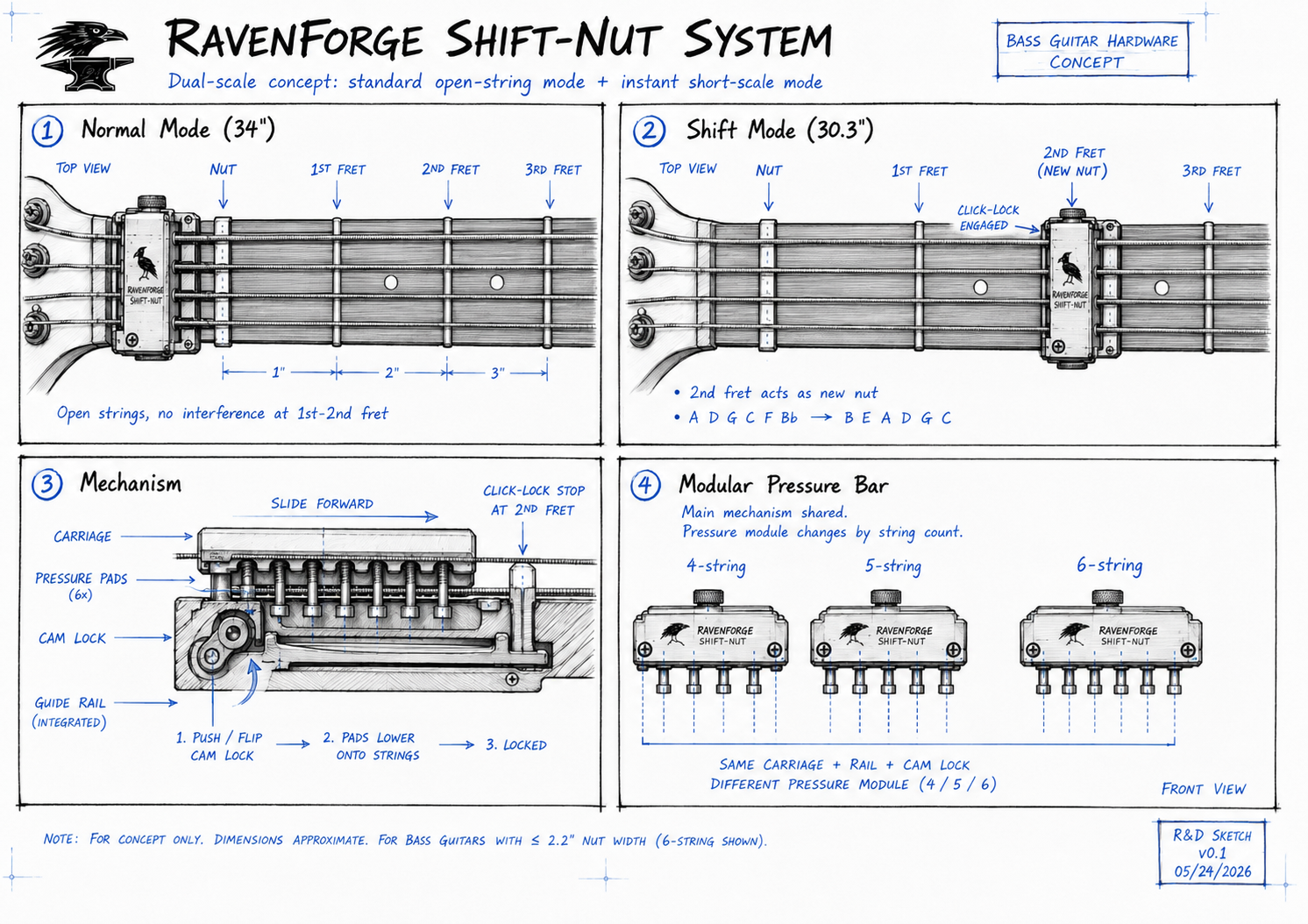
Figure 1. Early R&D concept sketch of the RavenForge Shift-Nut System.
1. Executive Summary
The RavenForge Shift-Nut System is a proposed built-in capo-nut mechanism for bass guitars. Its purpose is to preserve the benefits of extended scale lengths such as 35 inches or 36 inches while giving players the option to switch into a shorter effective scale when needed.
The concept did not begin as a simple short-scale bass idea. The underlying problem is that many players understand the advantages of extended-scale basses but abandon them because of a vague fear that they may fail to adapt.
Many bassists do not reject 35-inch or 36-inch instruments because they deny the benefits. They reject them because the perceived risk of adaptation feels too high.
The Shift-Nut System is designed as a technical answer to that psychological barrier. It allows a player to experience the clarity, low-string stability, and tuning authority of a longer scale, while retaining a fallback mode with a shorter effective scale.
2. Problem Statement
In the modern bass market, 5-string, 6-string, multiscale, 35-inch, and 36-inch instruments are no longer niche specifications. For Low B strings and lower tunings, extended scale lengths offer clear musical and technical benefits.
- More stable Low B response
- Clearer attack on low strings
- Improved pitch stability
- Better support for drop tunings
- Higher low-end definition in recording and live contexts
- Greater flexibility for modern metal, progressive, fusion, and session work
Even so, many players avoid extended-scale basses for reasons that are not purely technical:
- Concern that the lower positions will feel too far apart
- Fear that the instrument will feel physically demanding
- Anxiety about switching from a familiar 34-inch scale
- The psychological weight of the numbers 35 or 36 inches
- Avoidance of a possible adaptation failure before actual testing
In many cases, the barrier is not the player’s true physical limitation. It is the pre-purchase fear of making the wrong commitment. The design question is therefore simple: can a bass preserve the advantages of a long scale while offering an accessible shorter-scale mode when needed?
3. Core Concept
The Shift-Nut System is a secondary nut mechanism built into the early section of the neck. In Normal Mode, the bass operates at its original scale length. In Shift Mode, the mechanism locks at a designated fret and makes that fret behave as a new open-string reference point.
Mode | Function | Example |
Normal Mode | Original scale length | 34", 35", or 36" |
Shift Mode | Selected fret becomes the new nut | 30", 32", or 33" effective scale |
This makes the system closer to a dual-scale architecture than to a conventional accessory capo. The design intent is not merely to clamp strings. The intent is to let the player change the practical scale behavior of the instrument.
4. Scale Operation Scenarios
Original Scale | Shift-Nut Position | Effective Scale | Product Meaning |
36" | 2nd fret | Approx. 32.1" | Extended-scale base with medium-scale mode |
35" | 1st fret | Approx. 33.0" | Compact long/medium mode |
34" | 2nd fret | Approx. 30.3" | Short-scale mode |
4.1 The 34-30 System
The most intuitive product concept is the 34-30 system. A 34-inch bass is tuned down by a whole step, and the Shift-Nut locks at the 2nd fret. The player then performs as if using standard tuning, but the effective scale becomes approximately 30.3 inches.
Parameter | Setting |
Actual scale | 34" |
Shift-Nut position | 2nd fret |
Effective scale | Approx. 30.3" |
Actual tuning, 6-string | A D G C F Bb |
Shift Mode reference | B E A D G C |
String Count | Actual Tuning | Shift Mode Reference |
4-string | D G C F | E A D G |
5-string | A D G C F | B E A D G |
6-string | A D G C F Bb | B E A D G C |
This approach is not a conventional short-scale bass. It is a long-scale construction that can enter a short-scale operating mode.
5. User Value
5.1 Lowering the Entry Barrier to Extended Scale
A typical concern from a prospective extended-scale buyer is: “The Low B will probably be better, but what if I cannot adapt to the longer scale?” The Shift-Nut System reduces this risk. The player can use Shift Mode when the longer scale feels demanding, and gradually increase reliance on Normal Mode as adaptation improves.
5.2 Two Playing Feels in One Instrument
Traditionally, long-scale and short-scale basses are separate instruments. The Shift-Nut System allows one instrument to offer two operating experiences:
- Low-string stability from the longer-scale construction
- Lower-position accessibility from the shorter effective scale
5.3 Practice and Adaptation Support
The system can also serve as an adaptation aid. A player may begin in Shift Mode and then gradually transition into Normal Mode. In that sense, the Shift-Nut is not only hardware; it is an extended-scale onboarding tool.
6. Technical Structure Proposal
The most important design requirement is non-interference. If the mechanism interferes with 1st- or 2nd-fret fingering in Normal Mode, the product fails. A fixed bar around the 2nd fret is therefore not acceptable.
The proposed structure is:
Parking pocket behind the nut + sliding carriage + click-lock at the 2nd fret + cam-lock pressure bar.
6.1 Normal Mode
- The Shift-Nut unit rests behind the nut or in a headstock-side parking pocket.
- The 1st and 2nd frets remain unobstructed.
- The instrument operates like a normal bass.
6.2 Shift Mode
- The unit slides toward the 2nd fret.
- It click-locks immediately behind the 2nd fret.
- A cam-lock or lever lowers the pressure bar onto the strings.
- The 2nd fret becomes the new nut reference.
6.3 Modular Pressure Bar
For 4-, 5-, and 6-string compatibility, the main mechanism should be shared while the pressure module changes according to string count.
Component | Common or Variable |
Sliding rail | Common |
Locking structure | Common |
Cam-lock mechanism | Common |
Housing | Mostly common |
Pressure bar | 4/5/6-string specific |
Pad spacing | String-count specific |
7. Key Engineering Challenges
7.1 Pitch Sharpness
If the mechanism presses the string too hard, the note will go sharp. The target is not maximum pressure, but the minimum pressure required to avoid buzzing.
7.2 String-Specific Pressure Differences
Bass strings vary greatly in gauge. A Low B and a high C do not require the same pressure. A single uniform rubber bar is therefore undesirable. Individual pads or segmented pressure modules are preferable.
7.3 Fingering Interference
In Normal Mode, the system must stay completely out of the player’s fretting path. No permanent protrusion should remain in the 1st- or 2nd-fret area.
7.4 Durability and Serviceability
The rail, lock, and pressure system must withstand sweat, dust, string changes, stage use, and repeated operation without developing looseness or tuning instability.
7.5 Development Cost
The Shift-Nut is not a simple accessory. It is neck-integrated hardware. Development should therefore proceed through staged validation rather than immediate full integration.
8. R&D Roadmap
Phase | Goal | Key Validation |
Phase 1: Musical validation | Test whether a 34" bass with 2nd-fret capo mode is musically valuable | Sound, feel, tuning, recording usefulness |
Phase 2: Test jig | Build a non-commercial pressure test device | Buzzing, pitch sharpness, string-specific pressure |
Phase 3: External prototype | Create a slide-click-lock prototype | Interference, speed, live stability, usability |
Phase 4: Integrated RavenForge model | Integrate the system into a dedicated RavenForge bass | Manufacturing, durability, brand value |
The recommended implementation order is S5 first, S4 second, and S6 as a flagship technology demonstrator. A 5-string version offers the best balance of market relevance and engineering difficulty.
9. Product Positioning
The Shift-Nut System can be positioned as follows:
A dual-scale bass system that preserves the benefits of a longer scale while allowing the accessibility of a shorter effective scale.
Product Name | Target |
Shift-Nut S4 | 4-string basses |
Shift-Nut S5 | 5-string basses |
Shift-Nut S6 | 6-string basses |
The central message is not novelty for novelty’s sake. The message is risk reduction: a safer path into extended-scale instruments.
10. Conclusion
The RavenForge Shift-Nut System is not merely a capo concept. Its purpose is to make extended-scale basses accessible to more players by reducing the fear of adaptation failure.
Many players do not give up on 35-inch or 36-inch basses because they misunderstand the benefits. They give up because they are unsure whether their hands, habits, and technique will adapt. The Shift-Nut System gives them a transitional operating mode.
For RavenForge, the value of this concept is strategic. It is not just a specification. It is a hardware platform that addresses a real user barrier through mechanical design.
The Shift-Nut System is an adaptive scale platform designed to open extended-scale basses to more players.